
FEED THE COUGAR ORIGINAL · Basketball
Nebraska’s First Exhibition Shows What BYU Must Measure Friday
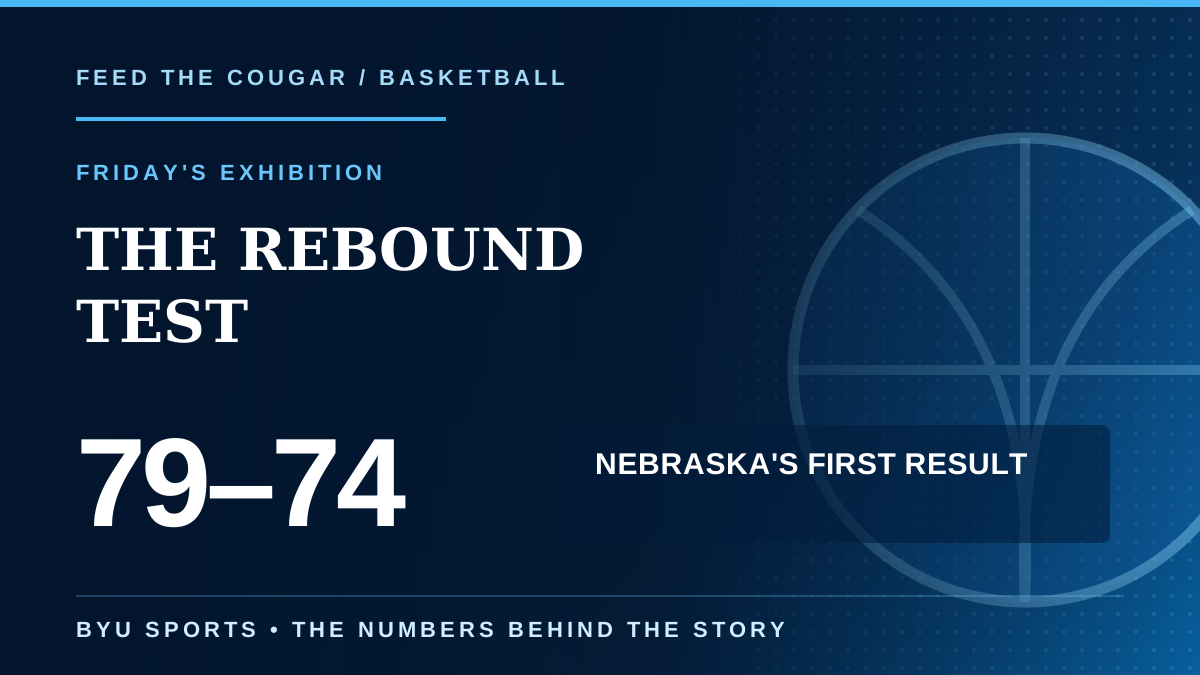
The Cornhuskers’ 79–74 loss to Saint Louis points toward the statistics that will matter most in BYU’s first public test: rebounds, pressure and connected defense.
Prepared with AI assistance. Feed the Cougar is responsible for sources and corrections. How our daily articles work →
BYU’s first public basketball appearance Friday will be called an exhibition, but Nebraska has already supplied a useful scouting report on what the night can reveal.
The Cornhuskers opened their exhibition schedule with a 79–74 loss to Saint Louis on Oct. 9. Nebraska led 39–37 at halftime and by five early in the second half before the Billikens took control. Saint Louis shot 50% after halftime, finished at 44% overall and made 12 of 35 three-pointers, according to Nebraska’s official recap. Nebraska shot 39%.
Those figures are not a preseason verdict. Fred Hoiberg played 13 Huskers, with 11 receiving at least 10 minutes, because the point was evaluation rather than maximizing one-night win probability. Still, the game produced a cleaner set of questions for BYU than anything available from the Cougars’ closed scrimmage: Can BYU turn pressure into useful possessions? Can it rebound through contact? And can a new roster defend well enough when the rotations become experimental?
Hoiberg did not hide what bothered him. “The disappointing thing to me was I thought they out-toughed us,” he said in the official Nebraska postgame transcript. He noted that Saint Louis recovered 53% of its missed shots in the first half, while Nebraska also collected 15 offensive rebounds of its own. That combination points directly toward Friday’s most revealing statistic: not the final score, but who finishes possessions.
BYU should have the size to make that a strength. Keba Keita’s physical rebounding and rim protection give the Cougars a natural anchor, while Jaxon Kohler can create second chances and punish smaller lineups if available. But preseason basketball has a way of exposing the difference between having rebounders and rebounding as a five-man unit. Guards must crack back, wings must find bodies, and the first big often has to make contact so somebody else can collect the ball.
Nebraska also offers a useful test on the perimeter. True freshman Jacob Lanier scored a game-high 15 points on 4-of-9 shooting against Saint Louis. Cale Jacobsen added 10 points and seven rebounds in a team-high 25 minutes, and 7-foot-1 freshman Leo Curtis went 4-for-4 for nine points with six rebounds. The Huskers can present shooting, size and unfamiliar combinations in the same stretch because Hoiberg is still sorting his rotation.
That is good for Kevin Young’s group. BYU does not need a cooperative opponent while it evaluates Rob Wright III, Tyler Betsey and a collection of new lineup possibilities. It needs a team capable of forcing communication errors, attacking a poor closeout and turning a missed box-out into two points. Nebraska just faced that kind of pressure itself. Jacobsen said Saint Louis’ backcourt heat was valuable because BYU “is going to do the same thing,” an assessment included in Nebraska’s recap.
The comment establishes a useful expectation. BYU should pressure Nebraska, but the method matters. Gambling for steals can make an exhibition look energetic while masking weak positioning. The better indicator is whether the Cougars can speed up the ball without surrendering straight-line drives, then recover to shooters without opening the offensive glass.
Last season’s BYU offense averaged 83.5 points, shot 47.6% from the field and made 34.5% of its three-pointers, according to the school’s official 2025–26 statistics. Those season-long numbers describe a productive offense, but they do not answer how this remade roster will defend together. Friday’s game, scheduled for 7 p.m. Mountain on ESPN+, is the first public chance to see whether the Cougars can pair their obvious skill with connected possessions at the other end.
The score will still matter to the players and to a Marriott Center crowd seeing the new team for the first time. It simply should not be the first item on the evaluation sheet. Start with defensive rebounds, live-ball turnovers and Nebraska’s corner threes. Then track which BYU lineups can pressure the ball without losing the glass.
There is plenty to like about BYU’s ceiling. Wright can organize an offense, Betsey can stretch a defense, and Young has enough lineup options to create difficult matchups. Friday will begin answering the harder question: which combinations can be trusted when a possession becomes physical, broken and unscripted? Nebraska’s first exhibition suggests that is exactly where the useful work will be.
More basketball originals
 AJ Williams Is Visiting BYU. The Real Pitch Is Already on the FloorRead the original →
 BYU’s 17 National TV Games Reveal the Season’s Real Pressure PointsRead the original →
 Marriott Madness Was Fun. BYU’s Home-Court Math Is SeriousRead the original →
Questions about a source, update or correction? Contact the editor. Story updates are reflected in the published timestamp above.