
FEED THE COUGAR ORIGINAL · Football
Sione Moa Is Cleared. BYU Still Has to Decide How Much He Can Give Notre Dame
Moa’s medical clearance changes BYU’s options, but his first game back may be about three useful snaps rather than a full workload.
Prepared with AI assistance. Feed the Cougar is responsible for sources and corrections. How our daily articles work →
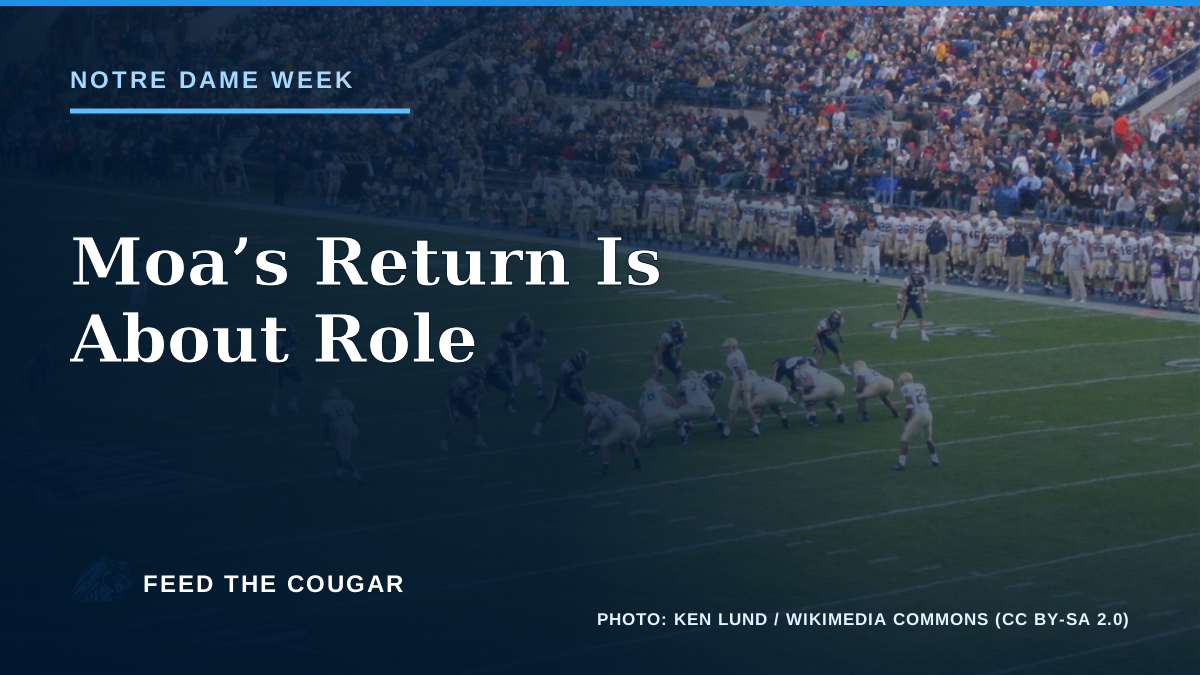
Sione Moa has been medically cleared to play against Notre Dame. That is not the same thing as being ready to play against Notre Dame.
The distinction matters because BYU’s second-string running back is returning from a knee injury, not a bruise. Offensive coordinator Aaron Roderick said Moa practiced Tuesday and was cleared, but he also said the staff has not decided whether Moa is ready for Saturday’s speed and contact. “This is going to be a fast, violent game,” Roderick said in BYU On SI’s report. “We just want to make sure we’re doing the right thing by him.”
That is the correct frame for the biggest new variable in BYU’s running-back plan. Moa’s status is no longer simply injured or healthy. It is a question of role, workload and whether three or four useful carries are worth placing a player five weeks removed from surgery into the country’s most demanding game.
Moa has not played since the first quarter of the season opener against Utah Tech, when he suffered torn MCL and PCL damage. He had six carries for 22 yards in that game. His 2025 season produced 18 carries for 92 yards and a touchdown, according to his official BYU profile. Those are small samples, but they show the kind of player BYU is missing: a 220-pound back who can handle a short-yardage collision without asking a smaller freshman to absorb every hard inside run.
The need is visible in the game plan, not just the depth chart. BYU’s current committee is Preston Rex, Journee Tonga and Devaughn Eka. All three can contribute, and the Cougars have already demonstrated that the offense does not disappear without LJ Martin. But Roderick told BYU On SI that none of the three is ready to play the full 60 snaps Martin might have handled. The goal is not to find one substitute. It is to keep the workload from becoming a punishment.
Moa’s size could make him useful immediately. BYU On SI notes that he is at least 20 pounds heavier than Rex, Eka and Tonga. That does not automatically make him the better back, especially after a long layoff. It does create a narrow role the others cannot duplicate as naturally: third-and-2, fourth-and-1, a goal-line carry, or a pass-protection assignment in which the offense wants a body capable of absorbing a linebacker.
Notre Dame will test that role more severely than Utah Tech or a normal conference opponent. The Irish allow only 214.2 yards per game and have given up two sacks through six games, while their offense averages 194.8 rushing yards and 44 points. Those figures come from BYU’s official game notes. If BYU uses Moa, every snap will carry a medical and tactical question: can he protect the quarterback, plant and cut, then recover for the next series?
The answer may be no, and that would not be a disappointment. Medically cleared means Moa can participate; it does not mean the staff has to expose him to a full game. He was limited Monday, and Tuesday was described as his first day “really going for it.” A Wednesday or Thursday practice report will tell BYU more than Tuesday’s headline.
There is an attractive middle ground. Give Moa a small package built around inside runs and protection, then return to the committee. Three or four carefully chosen touches could help the offense without turning his comeback into a referendum. If Notre Dame responds by tightening its front, BYU may gain room for its perimeter run game and play-action. If Moa is not ready, the Cougars can preserve the same plan with Rex, Tonga and Eka while using Bear Bachmeier’s mobility selectively.
The short-yardage piece deserves special attention because BYU’s recent production has been uneven there. The Cougars gained 506 yards against Iowa State but left points on the field through failed conversions and empty possessions. Notre Dame will not offer many red-zone chances, so a single fourth-and-short stop can be worth more than a dozen ordinary snaps.
What to watch Saturday is not merely whether Moa appears. Watch whether he enters for a defined situation, whether he is trusted in pass protection and whether his first contact looks controlled rather than tentative. Then watch what happens after his first series. A real return is not one carry. It is the ability to recover, communicate and play the next assignment.
BYU does not need Moa to rescue the backfield. It needs him to become one more option if his knee and the game both say he is ready. The encouraging news is that he has reached the medical doorway. The smart decision is still to decide how far through it he should walk.
Hero photo: [Ken Lund / Wikimedia Commons (CC BY-SA 2.0)](https://commons.wikimedia.org/wiki/File:Brigham_Young_University_Cougars_20,_Notre_Dame_Fighting_Irish_17,_LaVell_Edwards_Stadium,_Provo,_Utah_%2867175251%29.jpg).
More BYU football originals
 The CFP May Get Bigger. BYU’s Standard Against Notre Dame Shouldn’tRead the original →
 Notre Dame Has 68 Blue-Chips to BYU’s 12. The Records Are Nearly IdenticalRead the original →
 BYU’s Reinforcements Are Arriving. Against Notre Dame, the Rotation Matters More Than the NamesRead the original →
Questions about a source, update or correction? Contact the editor. Story updates are reflected in the published timestamp above.