
FEED THE COUGAR ORIGINAL · Football
Bruce Mitchell Is the Quiet Centerpiece of BYU’s Offensive Success
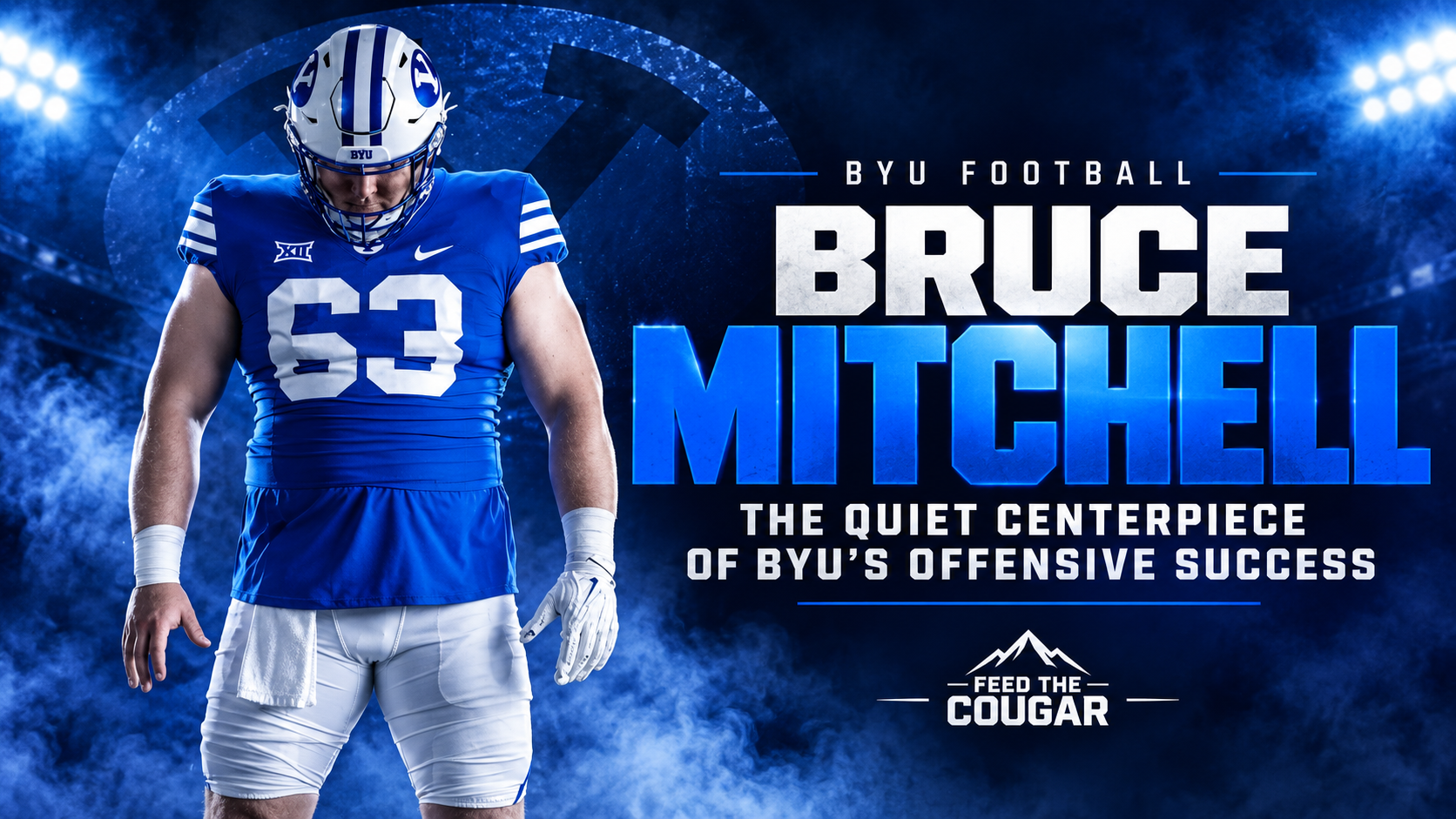
LJ Martin gets the rushing yards. Bear Bachmeier gets the touchdowns. Legend Glasker gets the explosive catches. But if you want to understand why BYU’s offense has been able to operate at such a high level through three games, start with the 305-pound senior standing over the football before every snap. Bruce Mitchell may be one of the most important players on BYU’s roster.
Centers rarely produce statistics that appear in a traditional box score, which makes their value harder to quantify. Mitchell's numbers require looking a little deeper, and once you do, the picture becomes difficult to ignore: he entered 2026 as one of the highest-rated centers in college football, and BYU's early offensive production has only strengthened his case.
Mitchell was already elite before 2026
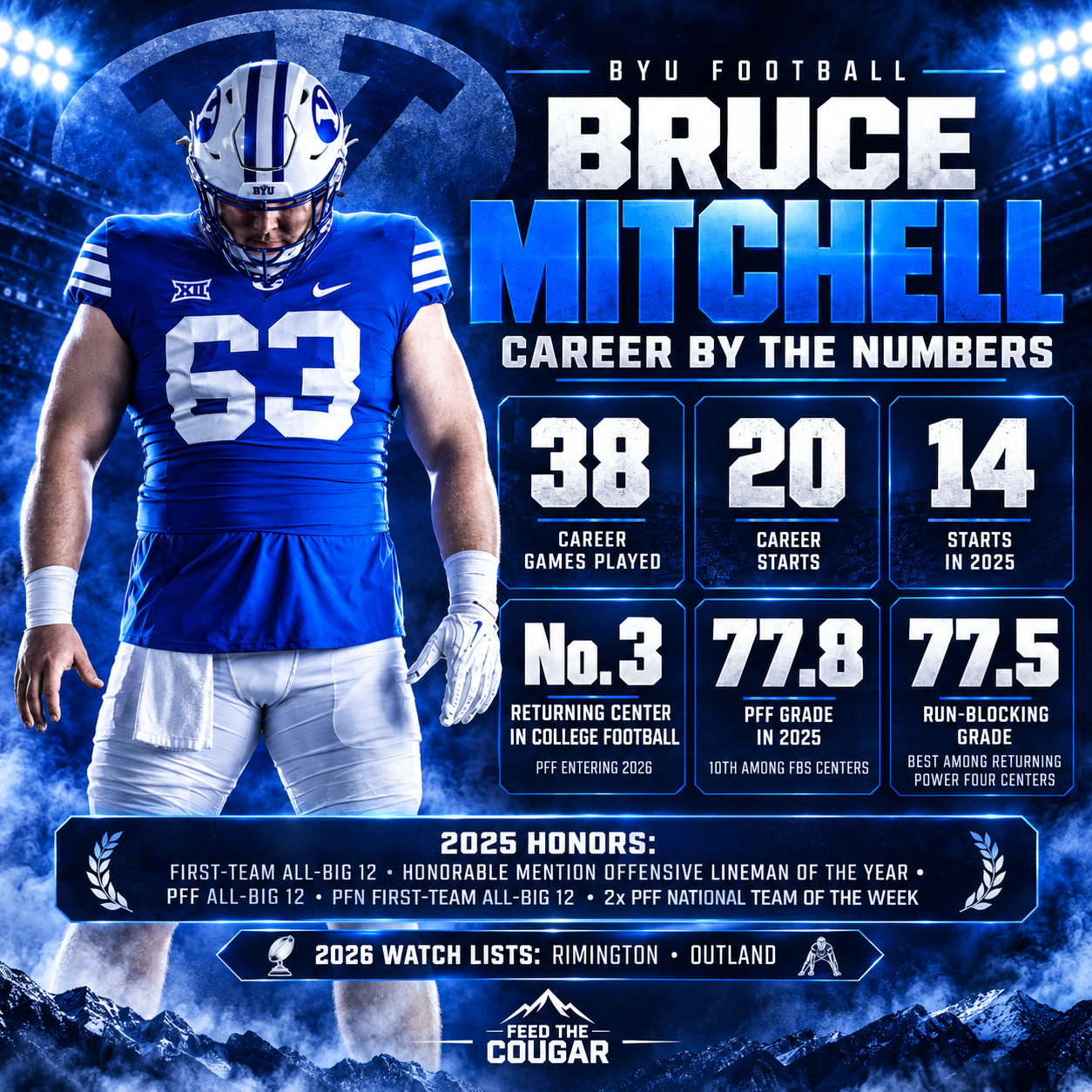
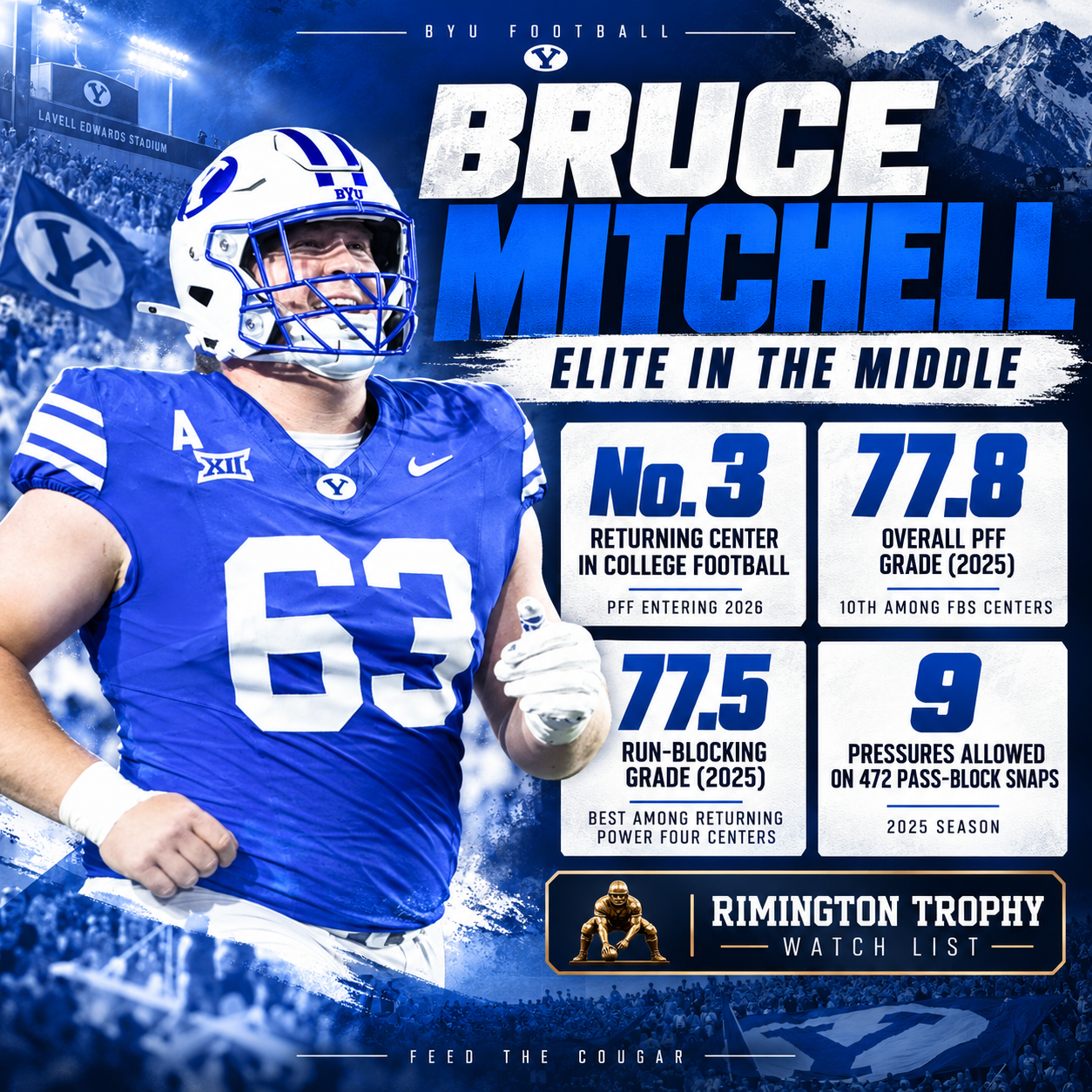
Pro Football Focus ranked Mitchell as the No. 3 returning center in college football entering this season. His 77.8 overall PFF grade in 2025 ranked 10th among all FBS centers, while his 77.5 run-blocking grade was the best among returning Power Four centers. Only one returning Power Four center rated higher than Mitchell in PFF's Wins Above Average metric.
His pass protection was equally impressive. Mitchell allowed only nine pressures across 472 pass-blocking snaps in 2025, meaning pressure came through his assignment on roughly 1.9% of those snaps. For a player positioned directly in front of the quarterback, where an interior pressure can destroy a play almost immediately, that consistency carries enormous value.
That performance translated into recognition well beyond BYU. Mitchell was named to the 2026 Rimington Trophy watchlist, given to the nation's outstanding center, and the Outland Trophy watchlist, which recognizes the nation's top interior lineman. He also entered the season as a Phil Steele second-team preseason All-American and a preseason All-Big 12 selection.
The 2026 numbers are getting even better
BYU's season opener against Utah Tech gave the first indication that the offensive line might be one of the strengths of the entire team. PFF graded BYU's offensive line at 95.6, the highest offensive-line grade in the nation for Week 1, while the Cougars also produced a nation-leading 88.2 run-blocking grade. Mitchell was rated as the second-highest graded center in the country that week.
BYU ran for 308 yards on 46 attempts, averaging 6.7 yards per carry, and scored five rushing touchdowns in that game. The Cougars generated 521 total yards and converted nine of 11 third downs. Mitchell isn't responsible for all of that production, but when an offense repeatedly creates movement between the tackles, stays ahead of the chains and keeps interior penetration away from the quarterback, the center is involved in a significant portion of the equation.
The Arizona game provided a tougher test. BYU didn't dominate statistically the way it had against Utah Tech, but it still generated 148 rushing yards at 4.9 yards per attempt while allowing only one sack in a 28-17 conference win. LJ Martin carried 20 times for 98 yards, and BYU continued to have success running directly into a Power Four defensive front. Then came Colorado State.
Mitchell posted an 87.9 PFF grade and did not allow a single quarterback pressure. BYU's offensive line surrendered only one pressure as an entire unit, while the offense erupted for 332 rushing yards at 8.1 yards per carry. The Cougars finished with 559 yards of offense in the 41-23 victory. That is the kind of performance that begins to connect an individual grade to what is happening around him.
Look at what BYU is doing on the ground
Through three games, BYU has rushed for 788 yards on 117 attempts, an average of approximately 6.7 yards per carry. The Cougars have scored 11 rushing touchdowns and are averaging more than 262 rushing yards per game.
LJ Martin has been the centerpiece of that production. Martin has 328 rushing yards on only 42 carries, an average of 7.8 yards per attempt, including 176 yards and three touchdowns against Colorado State. Perhaps just as notable, the official box scores show zero rushing yards lost by Martin through three games—54 yards with no losses against Utah Tech, 98 with no losses against Arizona and 176 with no losses against Colorado State.
Running backs deserve credit for vision, acceleration and creating yards after contact. But averaging nearly eight yards per carry becomes much easier when the first defender isn't meeting the running back behind the line of scrimmage. That is where Mitchell becomes particularly important.
Why center matters so much in BYU's offense
The center's job extends far beyond snapping the football. Centers have to recognize fronts, communicate protection adjustments, handle defensive tackles and nose guards immediately after delivering the snap, work combination blocks with the guards and then release toward linebackers when the scheme requires it. Mistakes happen directly in front of the quarterback and running back, which makes them difficult to hide.
Mitchell's background may actually help him here. He originally came to BYU as a defensive tackle before moving to the offensive line, eventually taking over at center. He started all 14 games there in 2025 after playing both center and guard in 2024, and his PFF grade improved by 22 points once he settled permanently into the position.
At 6-foot-4 and 305 pounds, Mitchell has enough size to absorb power inside, but his run-blocking grades suggest his game is about more than simply holding his ground. BYU can ask its center to create movement rather than merely survive the snap, which opens considerably more of the playbook for an offense built around Martin and Bachmeier.
Protection may be just as important as the rushing numbers
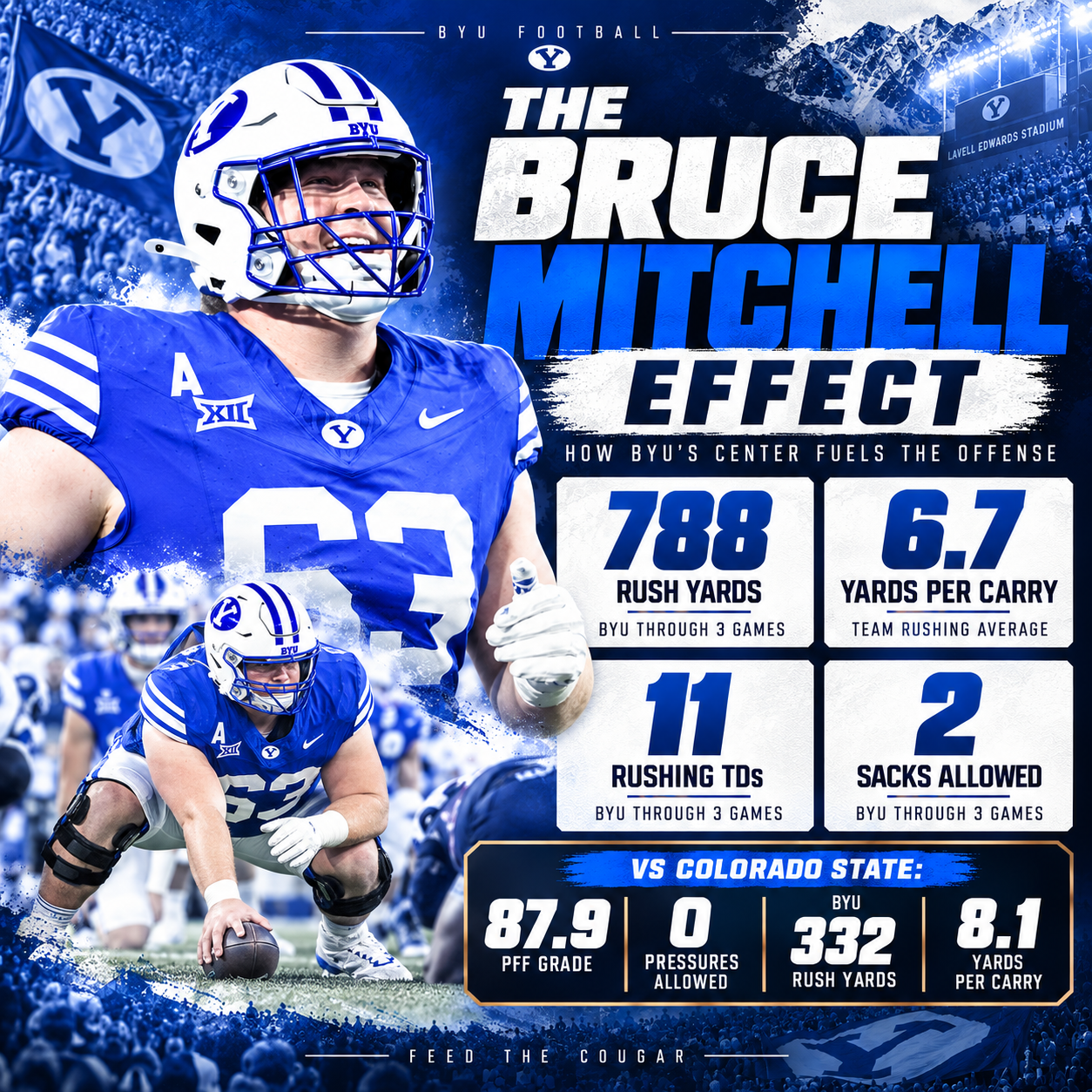
BYU has surrendered only two sacks through three games—one against Utah Tech, one against Arizona and none against Colorado State. That protection has helped Bachmeier operate an offense averaging approximately 481.7 total yards and 44 points per game.
Again, those are offensive-line statistics rather than Bruce Mitchell statistics. Andrew Gentry, Paki Finau, Trevin Ostler and BYU's other linemen deserve their share of the credit. But Mitchell is literally and figuratively in the middle of the unit, and his combination of experience, individual grading and nearly mistake-free protection makes him the stabilizing piece around which the rest of the group can operate.
There was evidence of the same relationship last season. With Mitchell starting all 14 games at center, BYU averaged 31.4 points per game and finished among the nation's top 25 in 10 offensive categories. Those included rushing first downs, rushing touchdowns, rushing plays of 10 or more yards and sacks allowed.
The player making everyone else's job easier
There is always danger in giving one offensive lineman too much credit for a team's success. Football is too interconnected for that. BYU's rushing numbers belong to the entire offensive line, its backs, tight ends, receivers and the scheme putting them into advantageous situations. But Mitchell's individual numbers line up remarkably well with BYU's team production.
A top-10 FBS center grade in 2025. The highest run-blocking grade among returning Power Four centers. Only nine pressures allowed on 472 pass-blocking snaps last season. The nation's No. 2 center grade in Week 1. An 87.9 grade and zero pressures allowed against Colorado State. Meanwhile, BYU is averaging 6.7 yards per rush, has allowed just two sacks and is scoring 44 points per game. Those numbers don't prove Bruce Mitchell is solely responsible for BYU's offensive success.
They show something more realistic—and perhaps more important. Nearly everything BYU wants to do offensively becomes easier with Bruce Mitchell in the middle of it. Martin needs space to reach the second level. Bachmeier needs a clean interior pocket. BYU's guards need someone who can work combination blocks and communicate what's happening across the defensive front. Offensive coordinator Aaron Roderick needs an offensive line capable of making the running game dangerous enough that defenses cannot simply concentrate on stopping the quarterback.
Mitchell helps provide all of it. There are flashier players on BYU's roster, and there will be plenty of Saturdays when the center's name is barely mentioned during the broadcast. That is often the nature of playing offensive line.
But through three games, the statistics are beginning to tell the story the box score does not. Bruce Mitchell isn't just BYU's center. He is one of the pieces making the entire offense work.
More BYU football originals
 The CFP May Get Bigger. BYU’s Standard Against Notre Dame Shouldn’tRead the original →
 Sione Moa Is Cleared. BYU Still Has to Decide How Much He Can Give Notre DameRead the original →
 Notre Dame Has 68 Blue-Chips to BYU’s 12. The Records Are Nearly IdenticalRead the original →
Questions about a source, update or correction? Contact the editor. Story updates are reflected in the published timestamp above.