
FEED THE COUGAR ORIGINAL · Football
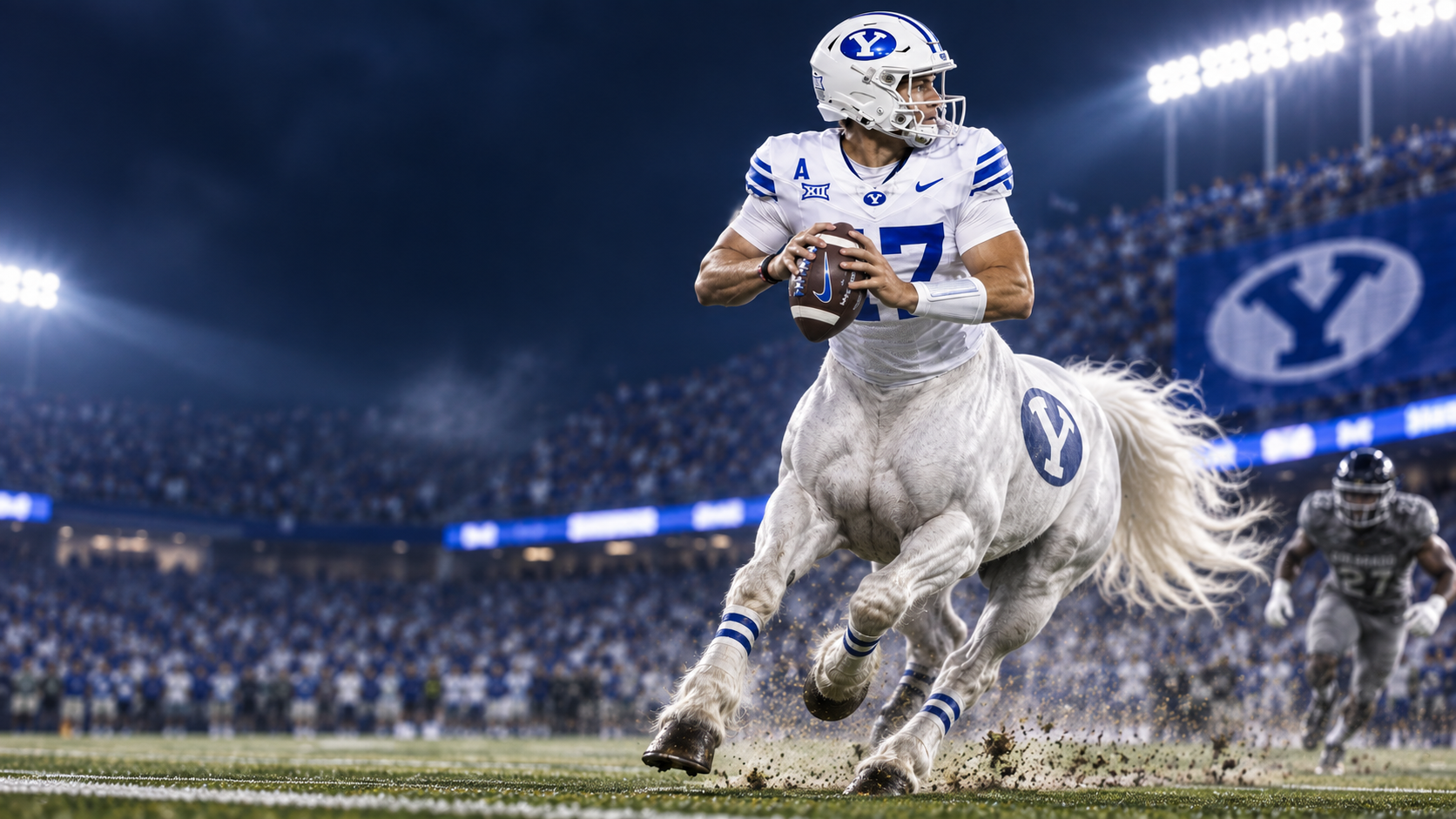
BYU-Arizona Preview: Is Bear "The Centaur" Bachmeier Already Better Than Noah Fifita?
Fifita owns the experience and passing résumé, but Bachmeier’s efficiency, rushing production and total-QB value make the matchup much closer than the career numbers suggest.
The line to know
Arizona is currently a 7.5-point favorite over BYU. Betting lines can move before kickoff.
Bear Bachmeier vs. Noah Fifita: Which Quarterback Would You Rather Have? Arizona’s Noah Fifita brings the experience, the career numbers and one of the most accomplished passing résumés in the Big 12. BYU’s Bear Bachmeier brings something different, and the deeper numbers suggest the gap between them is much smaller than the career totals make it appear.
PROVO — There is a very easy way to compare Bear Bachmeier and Noah Fifita heading into Saturday’s Arizona-BYU matchup at LaVell Edwards Stadium. Look at the career passing numbers. Fifita has thrown for 9,445 yards and 75 touchdowns during his Arizona career. Bachmeier has 3,231 yards and 18 touchdown passes. If that is where the comparison begins and ends, Arizona’s quarterback wins by a landslide.
The problem is that Fifita has played 41 college games and Bachmeier has played 15. Fifita is one of the most experienced quarterbacks in the Big 12 and has been playing major college football for several years. Bachmeier just opened his sophomore season after being thrown into the middle of a Big 12 race as a true freshman.
That makes accumulated career yardage a pretty poor way to answer the question that actually matters this week: Which quarterback is better right now? The answer is considerably more complicated.
Fifita remains the more accomplished passer, and there are several categories where his résumé is clearly superior. But when the comparison expands beyond passing yards and touchdown passes to include efficiency, rushing production, total offense, turnover avoidance and advanced quarterback metrics, Bachmeier begins closing the gap quickly. In some areas, he has already passed him.
Fifita owns the résumé, but the efficiency numbers are close The career totals heavily favor Fifita, as they should. He has completed 65.1% of his passes while throwing 75 touchdowns and 24 interceptions. His career passer rating is 145.3. Those are good numbers over a very large sample.
Bachmeier’s sample is much smaller, but his rates are remarkably similar. He has completed 65.6% of his passes, thrown 18 touchdowns against seven interceptions and posted a 143.4 passer rating.
Career comparison
| Statistic | Bear Bachmeier | Noah Fifita | |---|---:|---:| | Games | 15 | 41 | | Completion percentage | 65.6% | 65.1% | | Passing yards | 3,231 | 9,445 | | Passing touchdowns | 18 | 75 | | Interceptions | 7 | 24 | | Touchdown rate | 4.4% | 6.1% | | Interception rate | 1.7% | 1.9% | | Yards per attempt | 7.9 | 7.6 | | Adjusted yards per attempt | 8.05 | 7.96 | | Passer rating | 143.4 | 145.3 | | Rushing yards | 557 | 224 | | Rushing touchdowns | 12 | 4 |
The most obvious advantage for Fifita is touchdown passing. He has consistently been more productive putting the football into the end zone through the air, and that matters when evaluating a quarterback. But several of the efficiency statistics are almost indistinguishable.
Bachmeier currently owns a slightly higher career completion percentage, a lower interception rate and a higher yards-per-attempt figure. Fifita has the better touchdown rate and a narrow advantage in traditional passer rating. That doesn’t mean Bachmeier is already a more polished passer. He isn’t.
It does mean the gap is considerably smaller than 9,445 career passing yards compared with 3,231 might suggest. And then there is the running game. That is where the two quarterbacks stop looking alike.
The 2025 comparison is much more useful If the goal is to determine which quarterback is better entering Saturday, comparing the two over the same season is much more meaningful than comparing their career totals. Fifita entered 2025 as an established college quarterback. Bachmeier entered it as a true freshman. Here is what they produced:
2025 apples-to-apples comparison
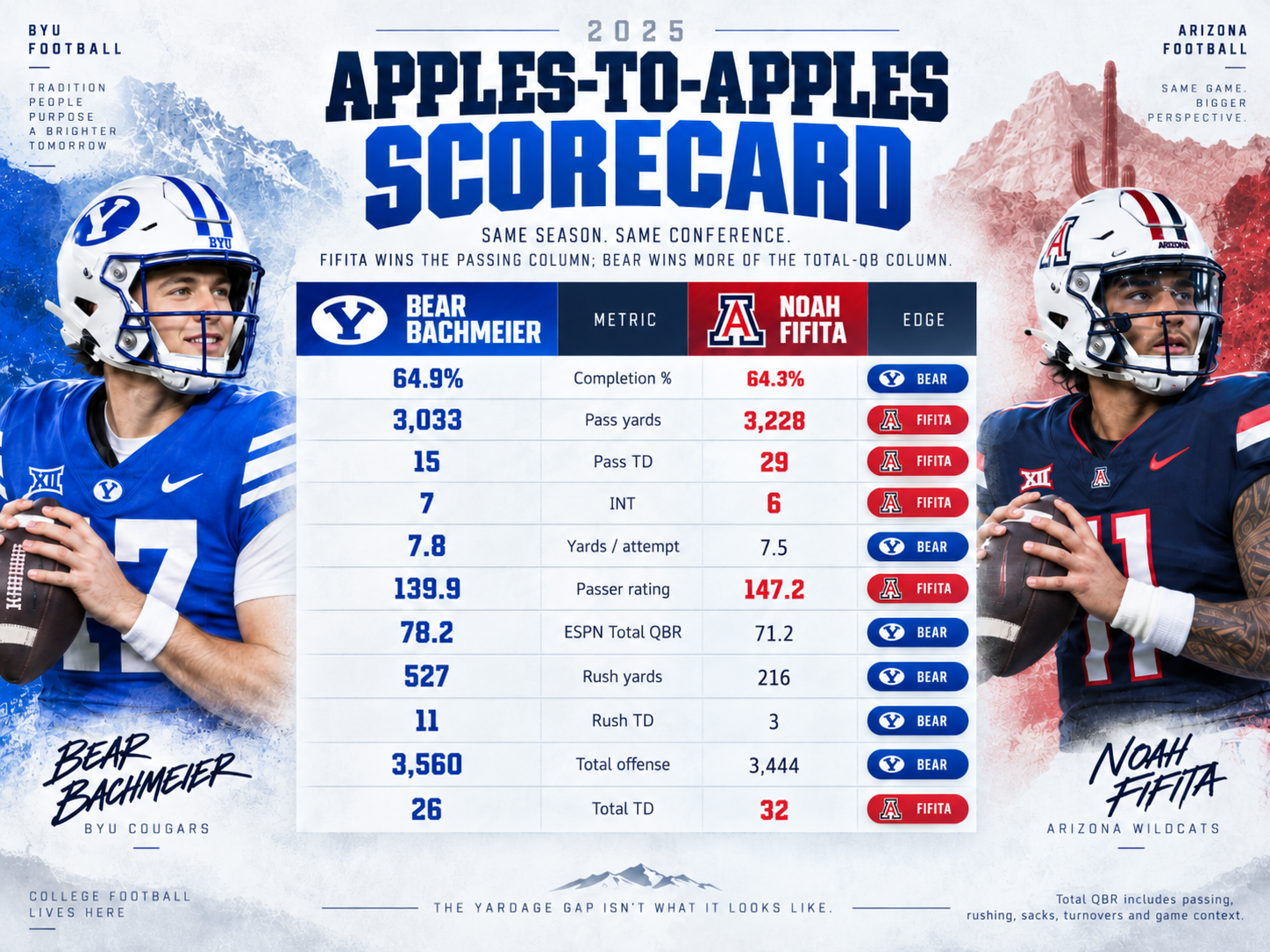
| Statistic | Bear Bachmeier | Noah Fifita | |---|---:|---:| | Completion percentage | 64.9% | 64.3% | | Passing yards | 3,033 | 3,228 | | Passing touchdowns | 15 | 29 | | Interceptions | 7 | 6 | | Yards per attempt | 7.8 | 7.5 | | Passer rating | 139.9 | 147.2 | | Rushing yards | 527 | 216 | | Rushing touchdowns | 11 | 3 | | Total offense | 3,560 | 3,444 | | Total touchdowns | 26 | 32 | Those numbers provide a fairly clean picture of the two quarterbacks.
Fifita was the better passer. He threw nearly twice as many touchdown passes, finished with one fewer interception and posted the better traditional passer rating. Arizona could put the game in his hands and ask him to win from the pocket in a way BYU generally did not ask of Bachmeier during his freshman season.
That advantage should not be minimized simply to make the comparison more interesting. But quarterback play involves more than passing efficiency. Bachmeier rushed for 527 yards and 11 touchdowns, while Fifita finished with 216 rushing yards and three scores. Once those numbers are added to their passing production, Bachmeier actually finished with 3,560 yards of total offense compared with 3,444 for Fifita. A true freshman produced more total offense than one of the most experienced quarterbacks in the conference. That matters.
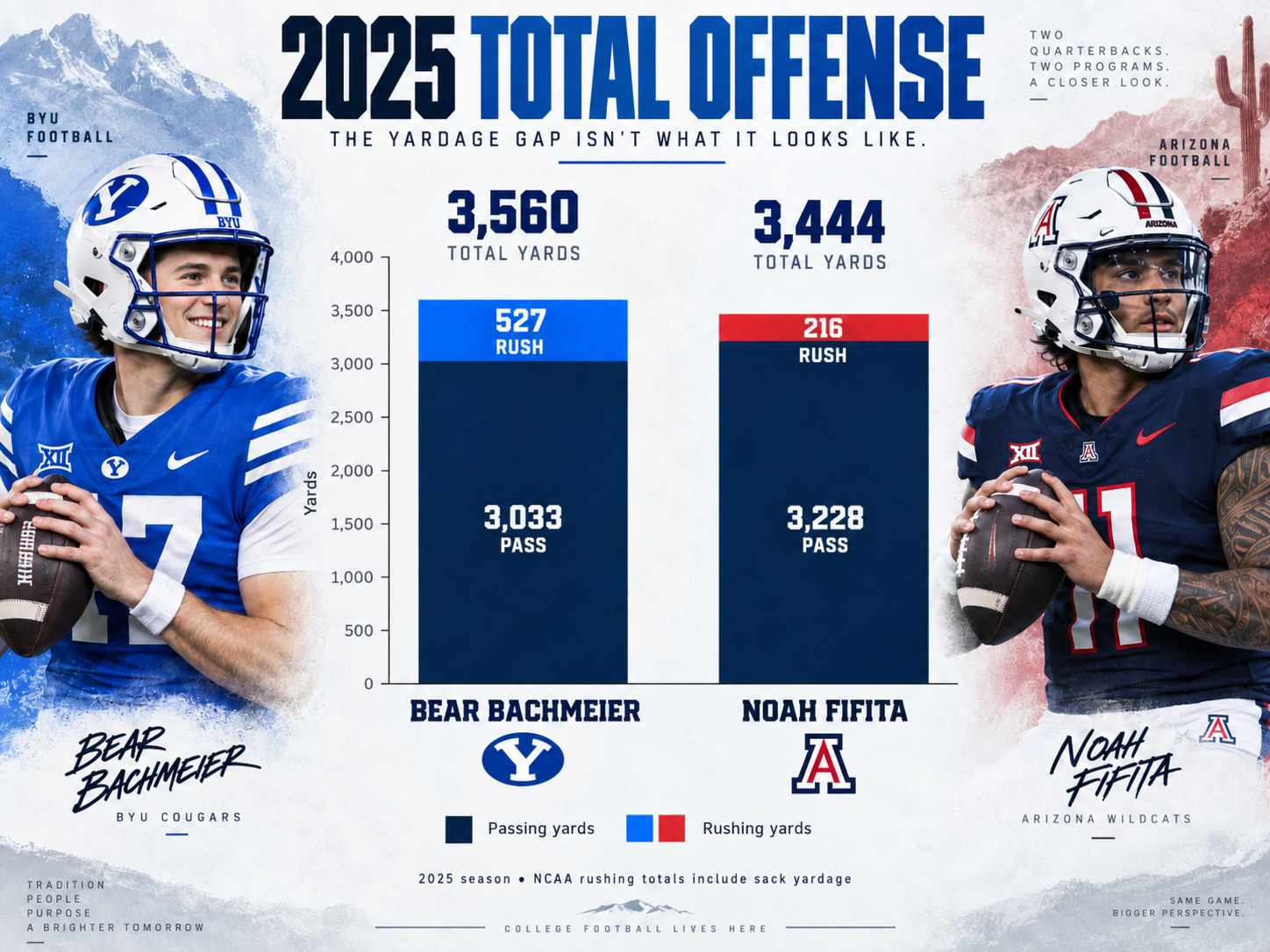
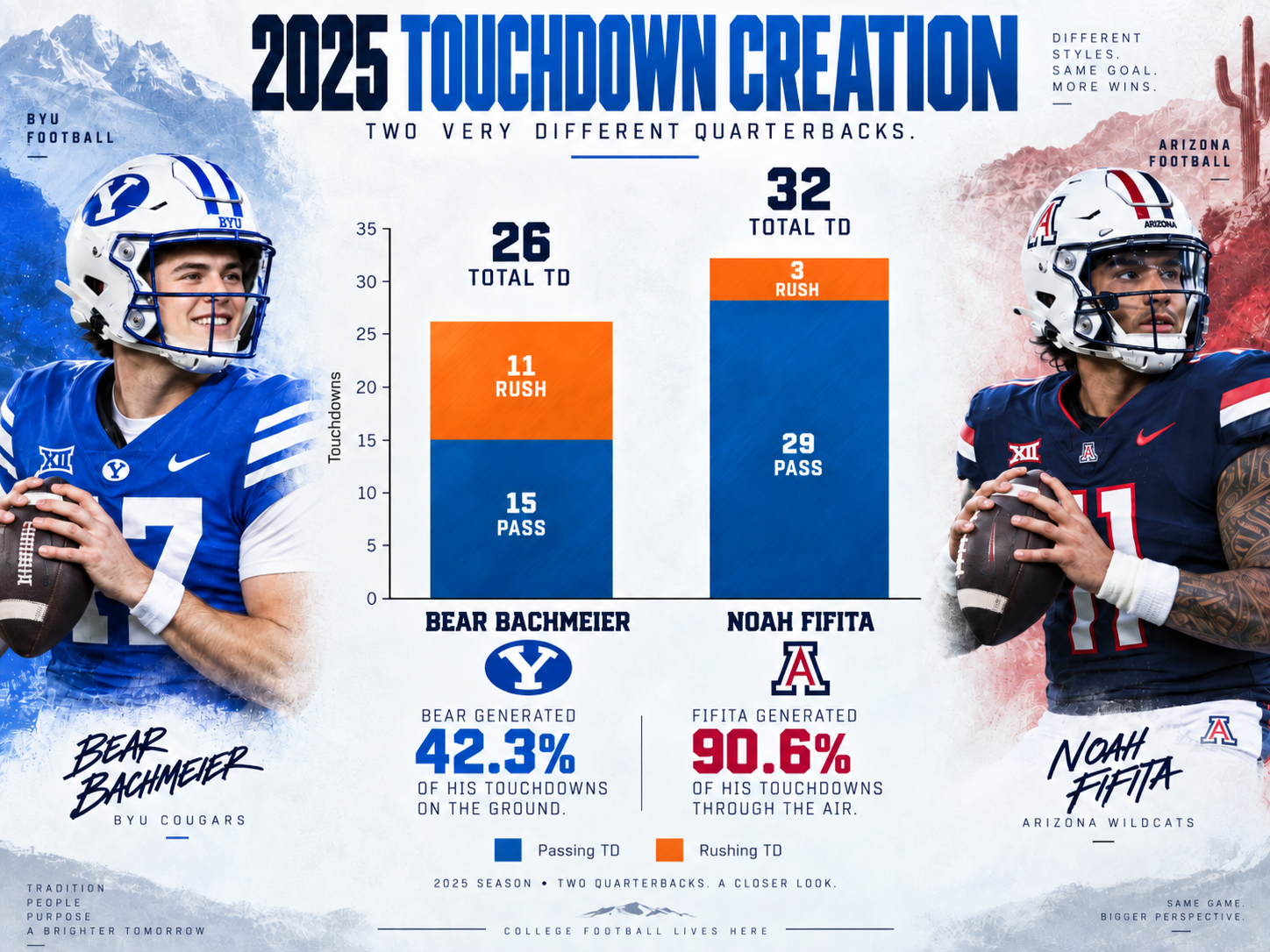
2025 TOTAL OFFENSE The way they generated touchdowns was even more different. Fifita accounted for 32 total touchdowns last season, with 29 of them coming through the air. Bachmeier accounted for 26, but 11 came as a runner.
That meant more than 42% of Bachmeier’s touchdowns came on the ground. For opposing defenses, that changes the geometry of the game. When Arizona gets into a passing situation, the primary threat remains Fifita’s arm. He has the experience to diagnose coverage, find favorable matchups and deliver the football accurately.
BYU can create a different problem. Bachmeier can hand the ball off, throw it, scramble when protection breaks down or keep it himself on designed quarterback runs. In short-yardage situations, the defense has to treat him as another legitimate ball carrier instead of simply accounting for the running back. It is one of the reasons traditional passing statistics do not fully describe his impact.
TOUCHDOWN CREATION Total QBR tells a different story Perhaps the most interesting statistical split between these quarterbacks is the difference between traditional passer rating and ESPN’s Total QBR. Fifita had the better passer rating in 2025, finishing at 147.2 compared with Bachmeier’s 139.9.
That makes sense. Passer rating evaluates passing, and Fifita had the stronger passing season. Total QBR attempts to measure a broader collection of quarterback contributions, including passing, rushing, sacks, turnovers, down-and-distance and game situation.
There, Bachmeier finished at 78.2. Fifita finished at 71.2. Bachmeier ranked 16th nationally while Fifita ranked 32nd.
That metric doesn’t prove Bachmeier is definitively the better quarterback, but it helps explain why the comparison becomes so much tighter once the entire position is considered. Fifita produced considerably more touchdowns through the air. Bachmeier compensated by creating first downs and touchdowns with his legs while also producing slightly more yards per passing attempt. A traditional passing statistic prefers Fifita. A metric designed to evaluate total quarterback value prefers Bachmeier.
2025 APPLES-TO-APPLES SCORECARD Experience remains Fifita’s biggest advantage There is no statistical adjustment that can completely erase the value of 41 college games. Fifita has seen more defensive structures, experienced more difficult road environments and been forced to respond to more bad possessions than Bachmeier has encountered.
He has also demonstrated a passing ceiling Bachmeier has yet to reach. Fifita’s 2023 season was outstanding. He completed 72.4% of his passes for 2,869 yards, 25 touchdowns and only six interceptions while posting a 165.9 passer rating.
Bachmeier has not produced a passing season like that. At the same time, Fifita’s career shows that quarterback development is rarely a straight line. His completion percentage fell to 60.5% in 2024, when he threw 18 touchdowns against 12 interceptions and posted a 126.5 passer rating, before responding with a much stronger 2025 season.
BYU has several years of evidence showing what Fifita can be. With Bachmeier, there is still far less certainty because his sophomore season has barely started. That is also what makes the comparison so intriguing.
BYU knows what Bachmeier was as a freshman. It does not yet know how much better he can become. The first meeting followed the same pattern These two quarterbacks have already shared a football field, and their first meeting looked surprisingly similar to their season-long statistical profiles.
Fifita was clearly the better passer in Arizona’s game against BYU last fall. He completed 25 of 45 passes for 219 yards, two touchdowns and one interception. Bachmeier struggled badly at times through the air, completing just 12 of 29 passes for 172 yards, one touchdown and two interceptions.
If the quarterback comparison were limited to passing, there would have been little debate about who played better. But Bachmeier also ran 22 times for 89 yards and two touchdowns. That pushed his total offensive production to 261 yards and three touchdowns, compared with roughly 234 yards of total offense and two touchdowns for Fifita.
Then came the plays BYU needed most. Bachmeier scored the touchdown that helped BYU force overtime late in regulation and eventually ran for the game-winning touchdown in double overtime as the Cougars escaped Tucson with a 33-27 victory. ESPN’s game-level QBR reflected the difference, giving Bachmeier a 74.3 and Fifita a 62.8. Once again, Fifita threw the football better. Bachmeier affected the game in more ways.
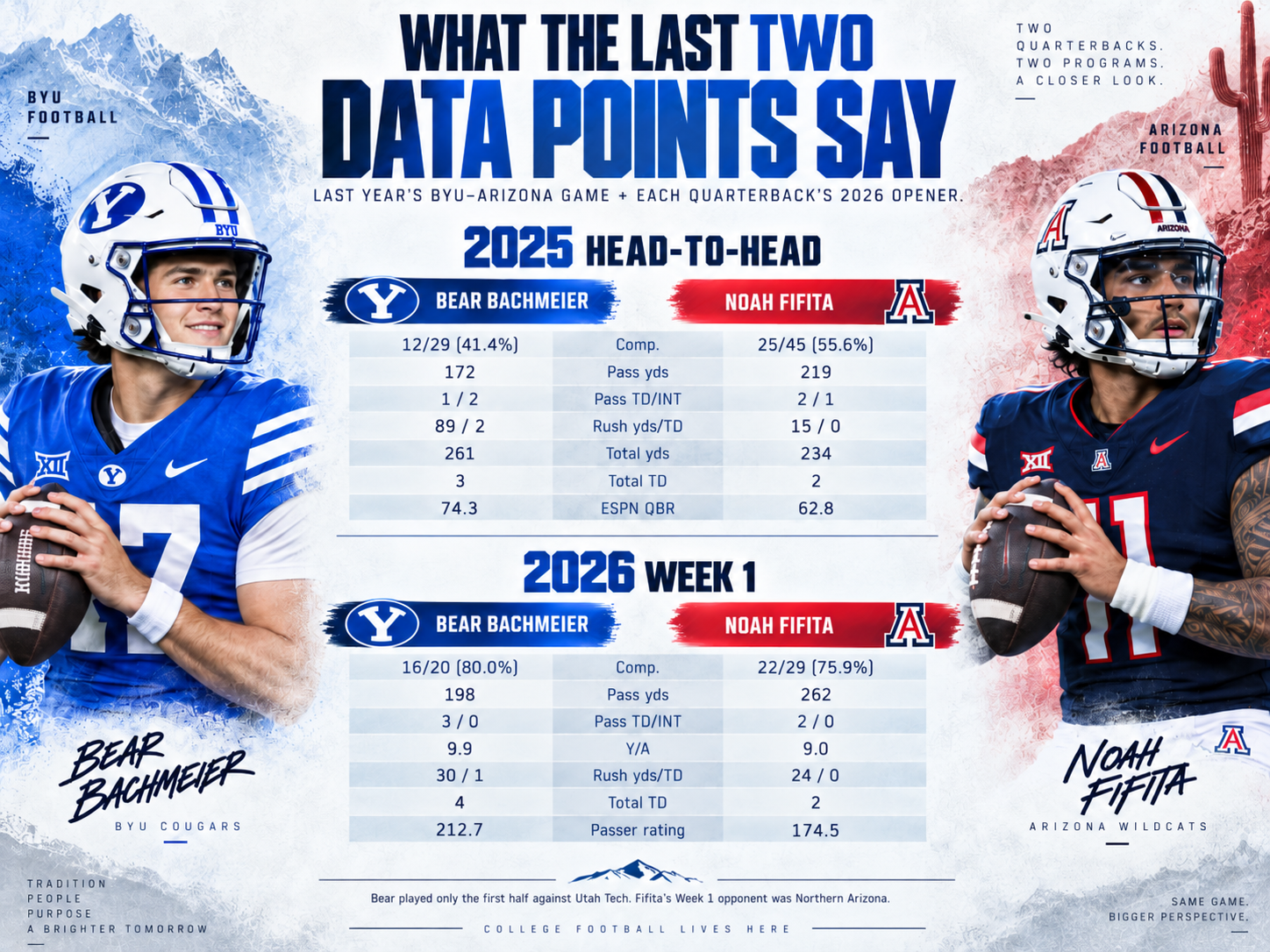
2025 HEAD-TO-HEAD + 2026 WEEK 1 The season opener added another wrinkle Neither quarterback faced a Power Four defense in the opener, so there is a limit to how much should be taken from one September game. Still, both looked sharp.
Bachmeier completed 16 of 20 passes against Utah Tech for 198 yards, three touchdowns and no interceptions. He averaged 9.9 yards per attempt, added 30 rushing yards and another touchdown and finished his day after the first half. That was four touchdowns in two quarters.
Fifita completed 22 of 29 passes against Northern Arizona for 262 yards, two touchdowns and no interceptions. He averaged 9.0 yards per attempt and added 24 rushing yards. Both quarterbacks did exactly what their teams needed them to do against overmatched opponents.
The more interesting development for BYU was Bachmeier’s efficiency. If his sophomore season produces a meaningful jump in passing accuracy and touchdown production while he retains the rushing ability that made him so difficult to defend last year, the argument begins to shift. Fifita’s clearest advantage in 2025 was his ability to produce touchdowns through the passing game.
If Bachmeier begins reducing that gap, there are not many other statistical categories where Fifita holds a decisive edge. So who would you rather have? The answer depends on what a team needs.
If the choice is based strictly on pocket passing, Fifita deserves the advantage. He has thrown 75 career touchdown passes, produced a 29-touchdown season last year and already demonstrated that he can complete more than 70% of his passes over an extended stretch. He is the more proven passer.
The accuracy comparison is much closer than perception suggests. Their career completion percentages are separated by only half a percentage point, while Bachmeier currently owns a slight advantage in career yards per attempt and interception rate.
As runners, there is no serious comparison. Bachmeier has already rushed for more than twice as many career yards despite playing 26 fewer games, and his 12 rushing touchdowns give BYU an offensive component Arizona does not get from Fifita. In total offensive impact, Bachmeier has a legitimate argument. He produced more total offense last season and finished with the better Total QBR.
Fifita owns the experience advantage by a huge margin, and that could be especially important Saturday if the game becomes a fourth-quarter possession-by-possession battle. There is also little question which quarterback has shown the higher pure passing ceiling. Fifita’s 2023 season remains the best passing season either player has produced.
But the ceiling question going forward may favor Bachmeier simply because there is so much development still ahead of him. What makes Saturday fascinating. Arizona is bringing an experienced quarterback into Provo who has already thrown for more than 9,000 yards and 75 touchdowns. BYU counters with a sophomore who has played only 15 games but already owns the slightly better career completion percentage, yards-per-attempt figure and interception rate, produced more total offense last season and finished with the higher Total QBR.
The easy answer is that Fifita is the better passer. The harder question is whether he is the better quarterback. There may no longer be much separating the two.
More BYU football originals
 The CFP May Get Bigger. BYU’s Standard Against Notre Dame Shouldn’tRead the original →
 Sione Moa Is Cleared. BYU Still Has to Decide How Much He Can Give Notre DameRead the original →
 Notre Dame Has 68 Blue-Chips to BYU’s 12. The Records Are Nearly IdenticalRead the original →
Questions about a source, update or correction? Contact the editor. Story updates are reflected in the published timestamp above.