
FEED THE COUGAR ORIGINAL · Football
BYU’s Defense Is Winning the Hidden Yardage Battle
The Cougars’ defensive story is not only points allowed. Field position, third downs, pressure and explosive plays explain why the unit keeps giving BYU a chance to control games.
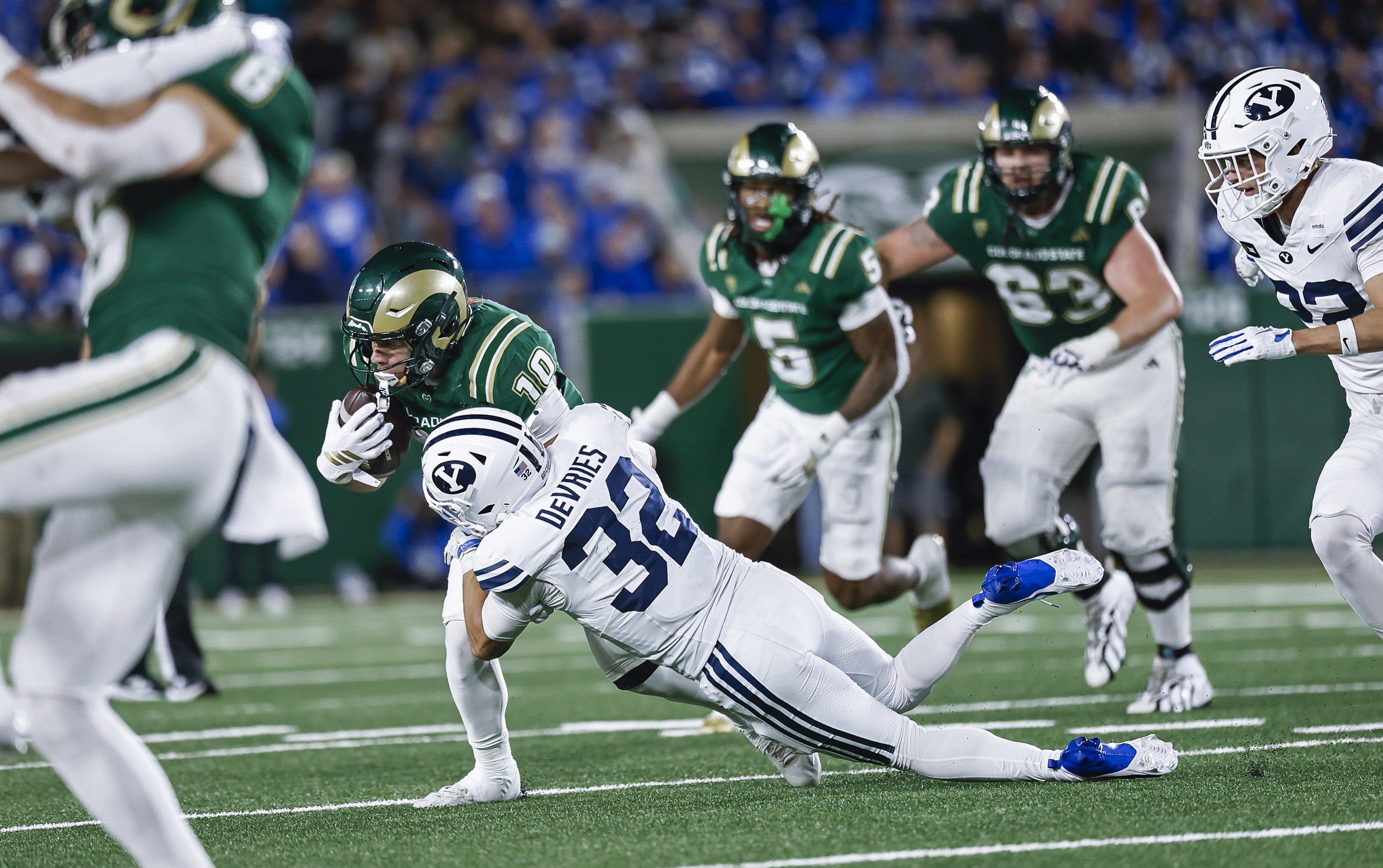
A defense can win a game without producing a highlight every Saturday. It can win by turning a promising drive into a punt, by forcing an offense to start at its own 18 and by making third-and-six feel like third-and-12. That is the hidden-yardage battle, and it is where BYU’s defense has been more interesting than its points-allowed average. The Cougars are still allowing 27.8 points per game, but the surrounding numbers show a unit that is shaping possessions before the scoreboard records the final result.
The strongest signal is third down. BYU’s current FTC snapshot has opponents converting 36.4 percent of third downs, a Big 12 top-five figure and No. 33 nationally in the site’s comparison board. Third-down defense is not a single skill. It is a report card on first-down efficiency, tackling, coverage communication and pass-rush timing. A defense that lives in third-and-short is often surviving. A defense that creates third-and-medium or third-and-long can dictate the call and make the quarterback prove he can win without the entire playbook available.
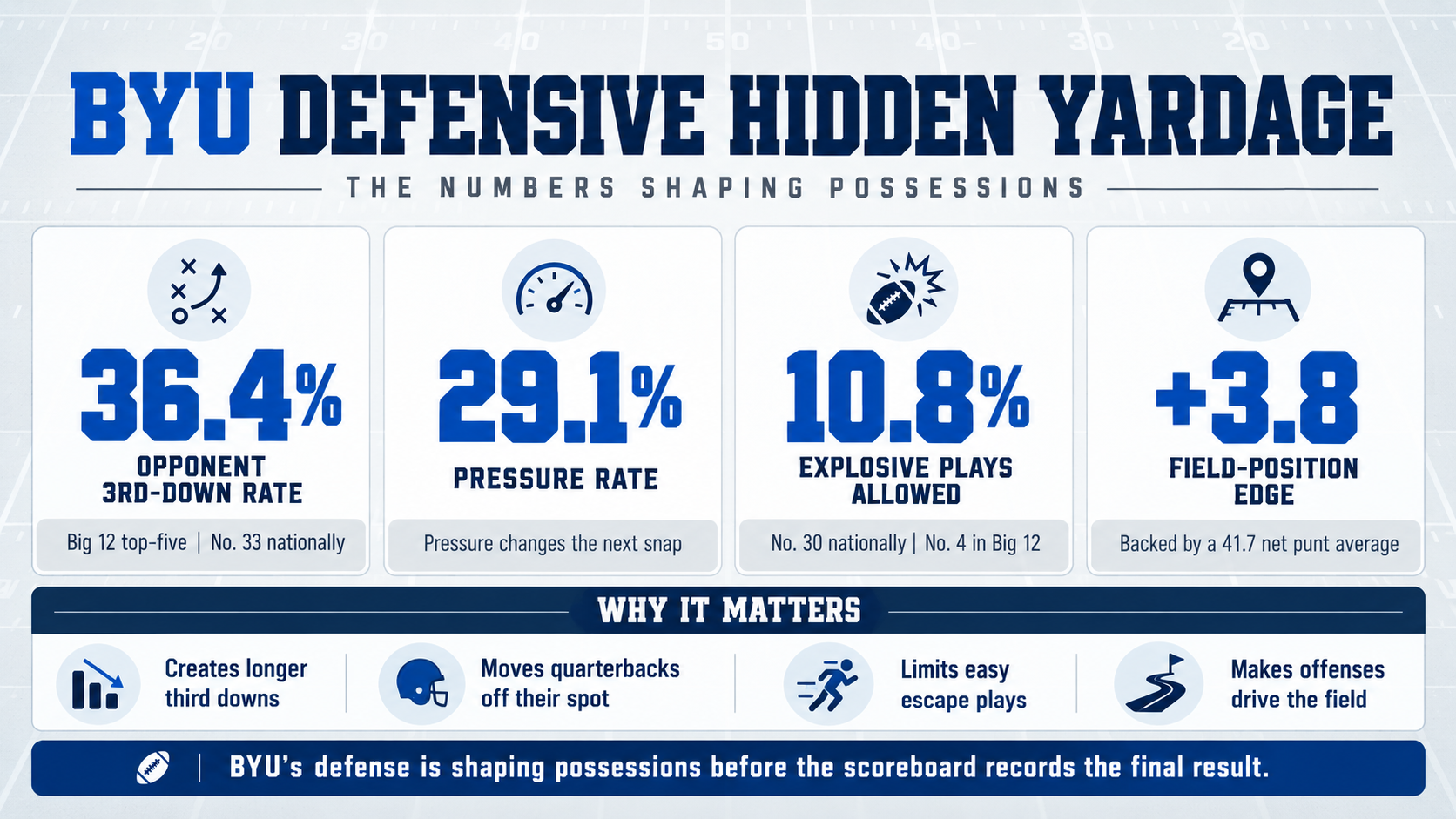
Pressure rate gives that third-down number a personality. The Cougars are listed at 29.1 percent, which puts the defense in the upper half nationally and inside the Big 12’s better group on the current board. Pressure does not have to end in a sack to matter. It can move a quarterback off his spot, shorten the route window or turn a checkdown into a punt. The best pressure defenses are not merely collecting sacks; they are changing what the offense is willing to call on the next snap.
The other piece is explosive plays allowed. BYU’s 10.8 percent rate is listed No. 30 nationally and No. 4 in the Big 12 comparison snapshot. That is a meaningful number because explosive plays are the quickest way for an offense to escape otherwise ordinary down-to-down defense. A defense can give up four yards and still force a punt. Give up one 40-yard run and the entire possession has a different shape. BYU has limited those escape hatches often enough to keep opponents working through a full series.
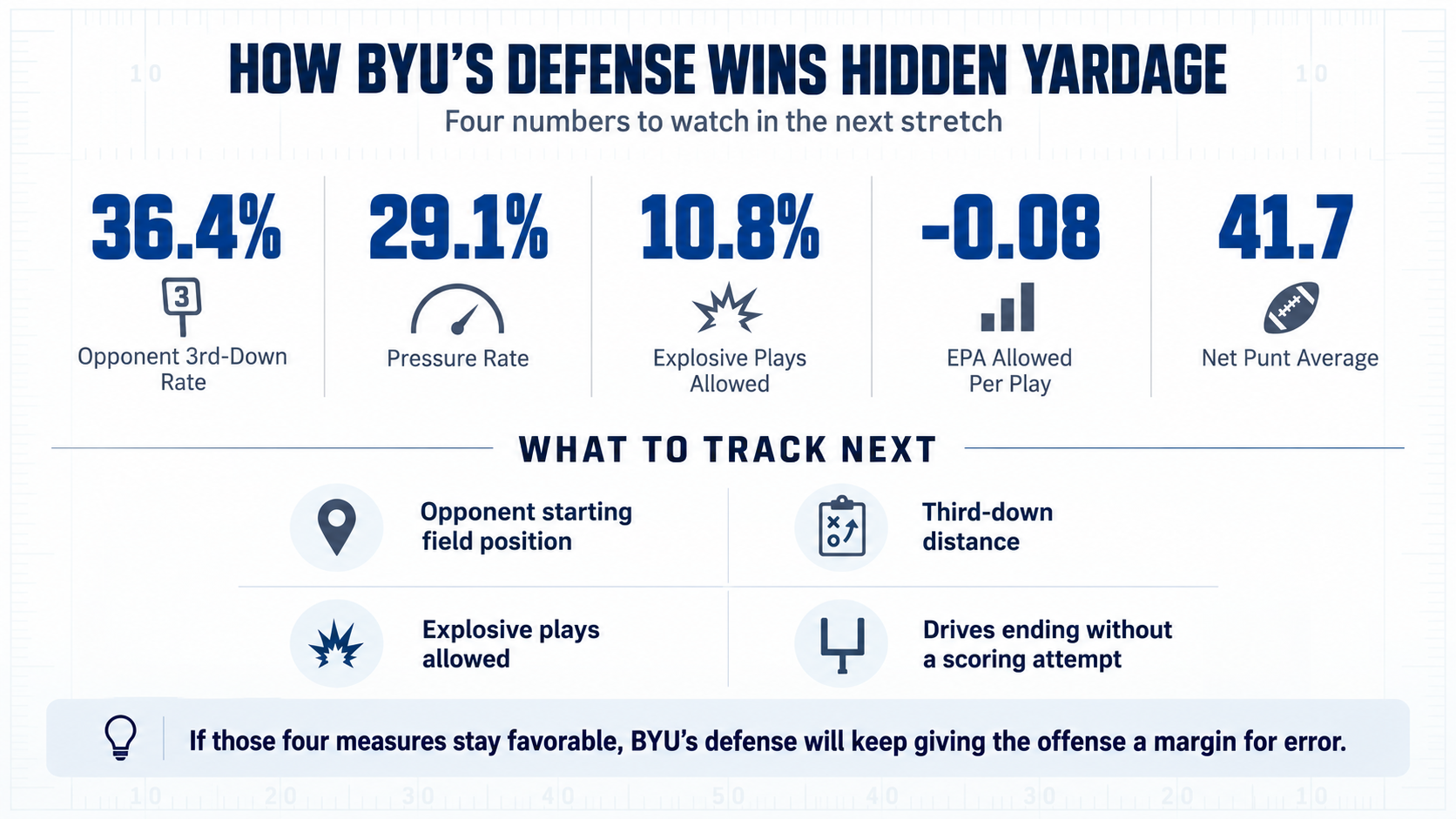
Field position connects the pieces. BYU’s current team board shows a plus-3.8 field-position edge and a 41.7 net punt average. The defense benefits when the punt unit flips the field, but the offense benefits too. A defense that starts most possessions at its own 35 can be aggressive without being reckless. A defense that starts near its goal line may have to protect against the one mistake that turns a good drive into seven points. Hidden yardage is often the difference between a pressure call and a prevent call.
There is still a warning inside the points-per-game figure. EPA allowed per play is encouraging at minus-0.08, but opponents will eventually test BYU’s ability to defend the red zone after a long drive. The Cougars can control the middle of the field and still give away points if missed tackles or penalties extend possessions. The next meaningful defensive question is not whether BYU can make one stop. It is whether the unit can stack three or four ordinary stops without surrendering one explosive correction.
The names behind the numbers matter, too. Cade Uluave has emerged as the leading solo-tackle signal on the current player board, while Isaiah Glasker and the rest of the front-seven rotation have supplied enough activity to keep the defense from becoming one-dimensional. Those totals are opportunities, not grades. Tackles near the line of scrimmage are different from tackles eight yards downfield. The film question is whether BYU is arriving early or cleaning up late.
That is why the hidden-yardage battle is the right lens for the next stretch of the season. Watch opponent starting field position, third-down distance, explosive plays allowed and the number of drives that end without a scoring attempt. If those four measures stay favorable, BYU’s defense will continue to give the offense a margin for error. The scoreboard will eventually catch up to that work, but the work is already visible in the shape of each possession.
More BYU football originals
 The CFP May Get Bigger. BYU’s Standard Against Notre Dame Shouldn’tRead the original →
 Sione Moa Is Cleared. BYU Still Has to Decide How Much He Can Give Notre DameRead the original →
 Notre Dame Has 68 Blue-Chips to BYU’s 12. The Records Are Nearly IdenticalRead the original →
Questions about a source, update or correction? Contact the editor. Story updates are reflected in the published timestamp above.