
FEED THE COUGAR ORIGINAL · Football
BYU Football Is More Experienced Than the Numbers Say
Why Power Four Snaps Tell a Different Story
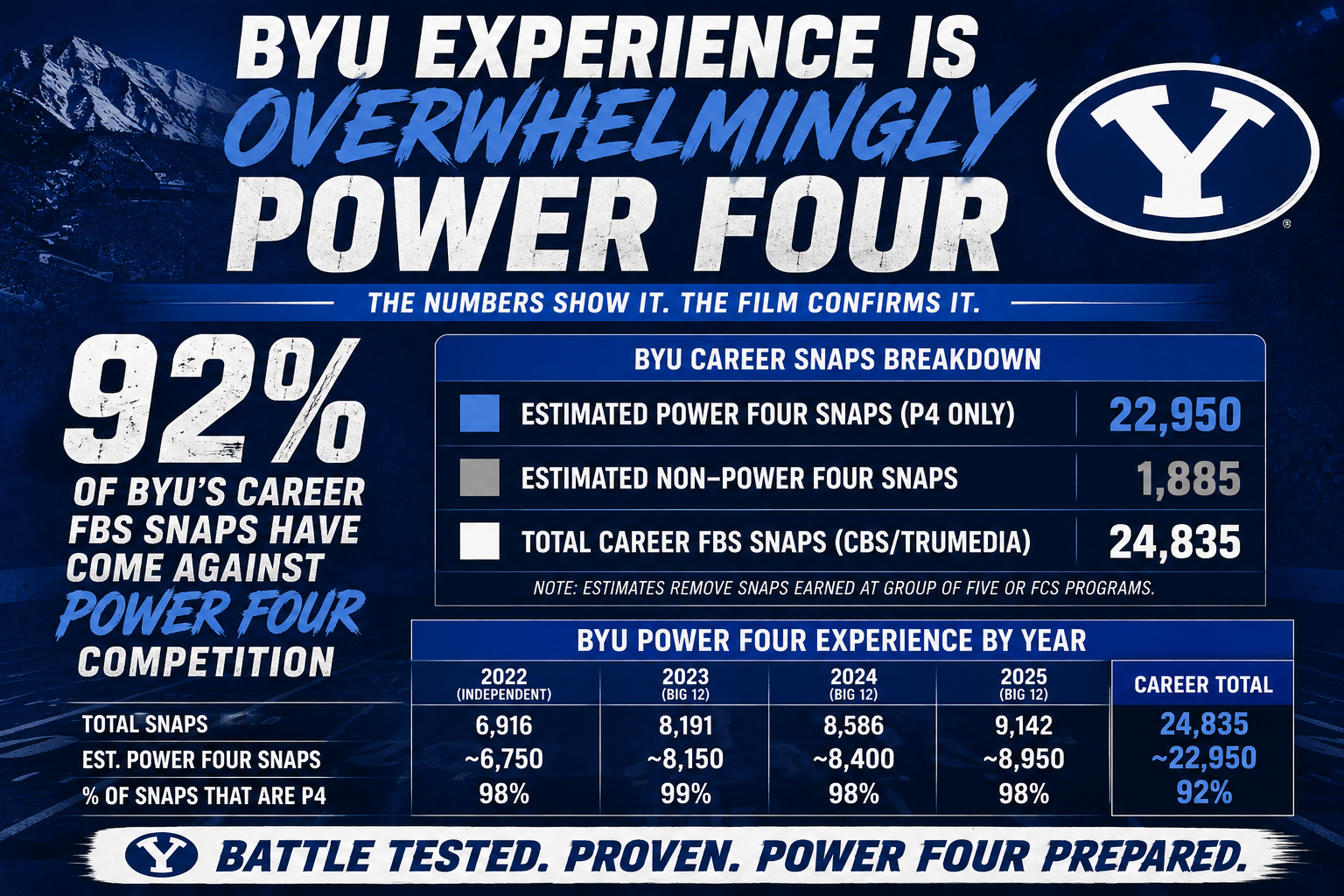
The headline number puts BYU in the middle of the Big 12. A closer look at where those snaps were played tells a different story. CBS Sports and TruMedia credited players on BYU's 2026 roster with 24,835 career FBS snaps. That ranked 35th nationally and 10th in the conference. Oklahoma State led the Big 12 with 35,928, followed by Texas Tech at 35,838 and Houston at 32,439.
Those totals measure college experience, but they do not measure the same kind of experience. A snap in the American or Mountain West counts exactly like a snap in the Big 12, SEC or Big Ten. That is reasonable for an overall career total. It is less useful when the question is how often a roster has faced Power Four speed, size and depth.
FTC reviewed the published FBS totals and subtracted known experience accumulated at non-Power Four programs from the published totals. The result is an estimate, not an official TruMedia ranking, but it changes BYU's place in the conference substantially.
Start with the raw totals
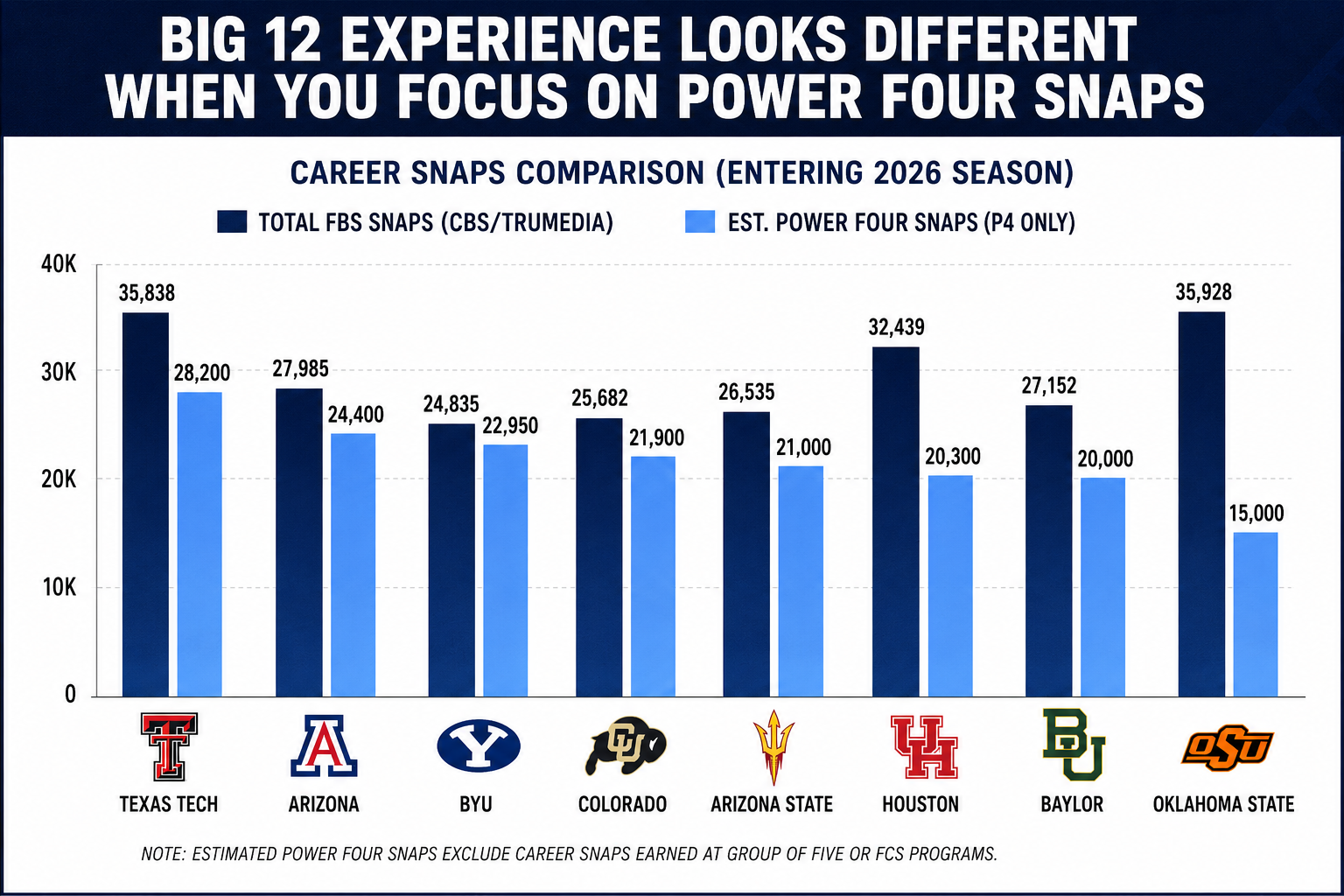
The published Big 12 leaders in career FBS snaps were: Oklahoma State (35,928), Texas Tech (35,838), Houston (32,439), Arizona (27,985), Baylor (27,152), UCF (26,945) and BYU (24,835). At face value, Oklahoma State held an advantage of roughly 11,100 snaps over BYU. Houston had about 7,600 more, and UCF had more than 2,000 more.
Roster construction explains part of the difference. Oklahoma State brought in a large transfer group that included 21 players who previously went through North Texas. BYU, meanwhile, has played a Power Four schedule since joining the Big 12 in 2023 and retained a large share of the players responsible for its 2025 season.
There are non-Power Four snaps on BYU's roster. Jr Sia logged 694 offensive snaps at Utah State, and Treyson Bourguet played extensively at Western Michigan. Those reps should be removed in a Power Four-only comparison. But several of BYU's additions came from Cal, Kansas State, Washington, Oregon, USC, Mississippi State and Stanford, so most of the Cougars' career total survives the filter.
FTC's Power Four estimate
Using that roster-by-roster review, the estimated conference leaders look like this:
- Texas Tech: approximately 28,200 Power Four snaps
- Arizona: approximately 24,400
- BYU: approximately 22,950
- Colorado: approximately 21,900
- Arizona State: approximately 21,000
- Houston: approximately 20,300
- Baylor: approximately 20,000
- TCU: approximately 18,000
Oklahoma State falls to roughly 15,000 in FTC's estimate because so much of its overall experience came outside the Power Four. Methodology note: These are directional estimates, not official TruMedia figures. No complete public database ranks 2026 rosters by Power Four-only career snaps. FTC began with the published career FBS totals and subtracted known non-Power Four experience. The figures may change if roster histories or participation totals are corrected.
Why BYU moves
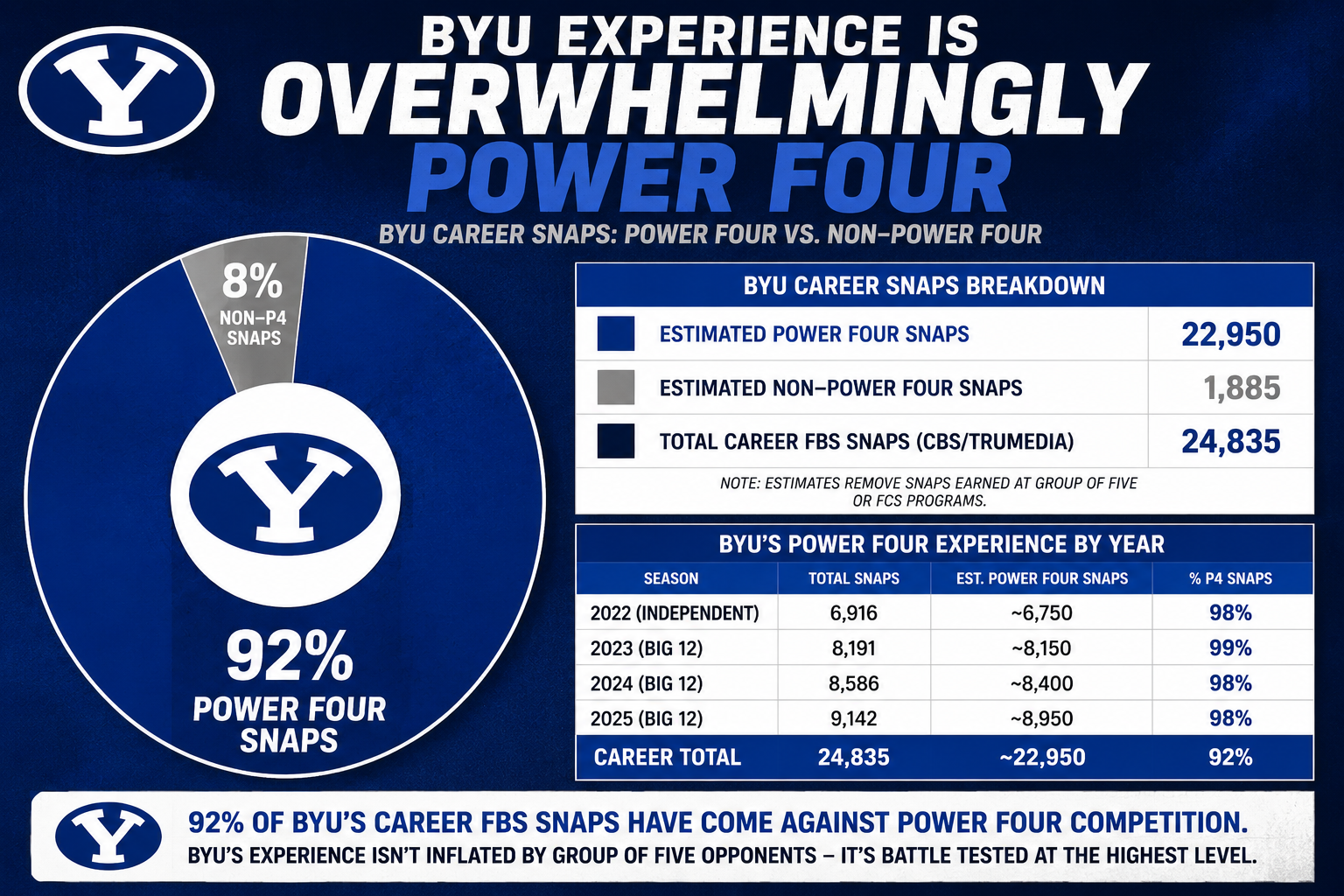
FTC's estimate puts BYU between 22,900 and 23,000 career Power Four snaps, or roughly 92% of its published FBS total. That would move the Cougars from 10th in the Big 12's raw ranking to approximately third in this adjusted comparison.
The estimate does not make BYU the conference's experience leader. Texas Tech remains comfortably first, even after accounting for transfers who played outside the Power Four. Arizona also holds up well. Its 27,985 total FBS snaps become an estimated 24,000 to 24,800 Power Four snaps after deductions for players including Tre Smith, Jay'Vion Cole, Tyrese Boss and Dwight Bootle.
The next tier is closer. Arizona State begins with 26,535 total FBS snaps, but quarterback Mikey Keene accumulated most of his experience at UCF before it joined the Big 12 and at Fresno State. Jalen Moss played at Fresno State, and Owen Long played at Colorado State. Removing that experience brings the Sun Devils toward 21,000 in FTC's estimate.
Colorado starts at 25,682 career FBS snaps. Significant experience from previous stops at FIU, New Mexico State, Tulsa, Miami (Ohio), Appalachian State and San Jose State lowers the Buffaloes to an estimated 21,900. That puts both teams behind BYU in this specific comparison.
Continuity strengthens BYU's case
Career snaps answer one question: How much college football have these players seen? Returning snaps answer another: How much have they played together in the current program? BYU rates well in both areas. The Cougars return approximately 63% of their 2025 snaps, the highest figure in the Big 12 and one of the strongest rates nationally. Those players already know Kalani Sitake's program, BYU's defensive system and Aaron Roderick's offense. They have shared Big 12 road games and close fourth quarters.
A roster assembled from veteran transfers may have a larger career total. A returning lineup carries institutional experience that the raw total cannot capture. Neither form is automatically better, but they are not interchangeable.
What the numbers do — and do not — say
Group of Five experience still has value. A player with 2,000 college snaps is more prepared than one who has never played, regardless of conference. The adjustment is not meant to erase those reps. It adds context to a ranking that otherwise treats every snap as identical.
Texas Tech has the strongest experience case in the Big 12 by this measure. Arizona appears to be next. BYU belongs in the conversation immediately behind them, not in the conference's middle.
The Cougars' published total is 24,835 career FBS snaps. FTC estimates that about 23,000 came against Power Four competition, while roughly 63% of last season's snaps return to the same program. Those estimates should be treated as a lens rather than an official leaderboard. Through that lens, BYU looks less like the Big 12's 10th-most experienced roster and more like one of its most battle-tested. Sources: CBS Sports/TruMedia career FBS snap totals; team roster histories and player participation records reviewed by Feed the Cougar.
More BYU football originals
 The CFP May Get Bigger. BYU’s Standard Against Notre Dame Shouldn’tRead the original →
 Sione Moa Is Cleared. BYU Still Has to Decide How Much He Can Give Notre DameRead the original →
 Notre Dame Has 68 Blue-Chips to BYU’s 12. The Records Are Nearly IdenticalRead the original →
Questions about a source, update or correction? Contact the editor. Story updates are reflected in the published timestamp above.