
FEED THE COUGAR ORIGINAL · Basketball
Kevin Young Promotes Two BYU Assistants, but the Bigger Challenge Is Still Ahead
Brandon Dunson and Jordan Brady rise as BYU tries to turn consecutive lottery picks and Richie Saunders’ 72% scoring jump into a repeatable program advantage.
Prepared with AI assistance. Feed the Cougar is responsible for sources and corrections. How our daily articles work →
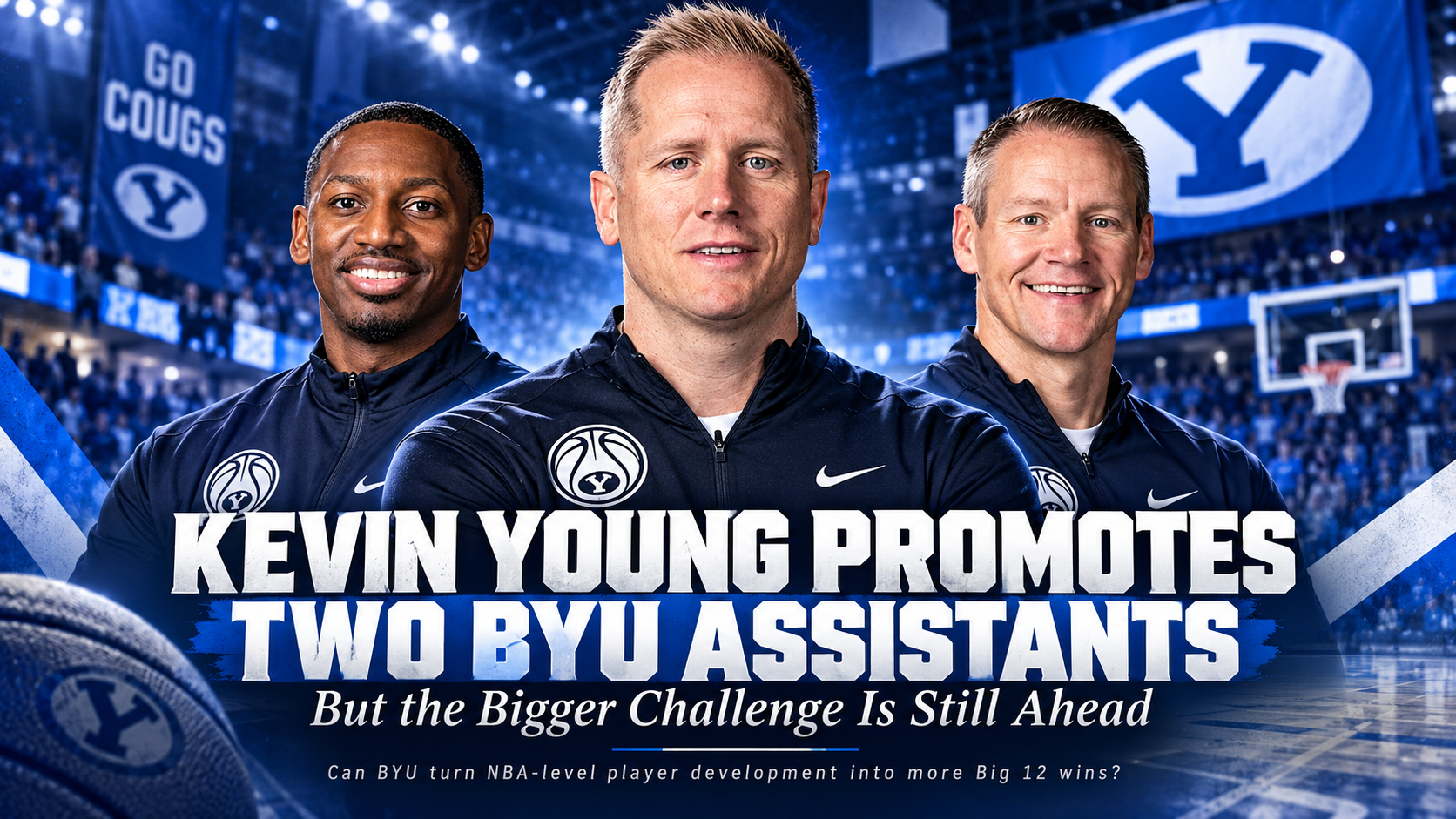
BYU has produced three NBA Draft picks in two seasons. Now the Cougars need that player-development success to translate into more Big 12 wins.
Kevin Young has sent three BYU players to the NBA Draft in just two seasons, including two lottery picks. Now he's promoting two of the coaches who helped make it happen.
Brandon Dunson has been named associate head coach, while Jordan Brady adds assistant coach responsibilities to his existing role as director of player development. Both joined Young's original staff in 2024 and have helped BYU become one of college basketball's more attractive destinations for NBA prospects.
But there's still a question hanging over the program. BYU has produced elite individual talent, yet last season's team finished just 9-9 in Big 12 play and lost its opening NCAA Tournament game to No. 11 seed Texas. For a program recruiting at this level, those results leave considerable room for improvement.
Young is keeping the coaches who helped build BYU's reputation for developing NBA talent. The challenge now is getting that talent to produce more consistent team results.
BYU's NBA development record is hard to ignore
The results speak for themselves. Egor Dëmin went eighth overall in the 2025 NBA Draft, AJ Dybantsa became the No. 1 pick in 2026, and Richie Saunders went 32nd overall. BYU is now one of just five programs in Big 12 history to produce lottery picks in consecutive drafts.
Dunson has played a significant role in BYU's recruiting success. Before arriving in Provo, he spent two seasons at Stanford, where he helped the Cardinal sign two top-40 recruits in the same class for the first time in nearly 20 years. At BYU, he's been part of a staff that has recruited players like Dybantsa and Bruce Branch III while helping the Cougars reach two consecutive NCAA Tournaments.
Brady brings a different background. He spent two seasons as head coach of the Wisconsin Herd in the NBA G League and has worked as an assistant for five G League organizations. That experience gives BYU someone familiar with developing players for professional basketball, something few college programs can offer with that level of firsthand experience.
Saunders is probably the best example of how BYU's development approach can pay off. He went from averaging 9.6 points as a sophomore to 16.5 as a junior, earning Big 12 Most Improved Player honors. His improvement continued during BYU's postseason run, when he averaged 22 points while shooting nearly 60% from the field and 41.7% from three.
Mawot Mag offers another example. After transferring from Rutgers, Mag shot career-best percentages of 48.6% overall and 39.7% from three in his lone season at BYU. The Cougars went 17-5 with him in the starting lineup, and he eventually signed a professional contract in Australia.
Those improvements can't be credited to Brady or Dunson alone, but they help explain why Young wants both coaches taking on larger roles.
"Brandon and Jordan have both been instrumental to our program since the day we arrived here," Young said in BYU's official announcement.
Individual success hasn't always translated into team success
There's another side to BYU's recent basketball history that deserves attention.
In Young's first season, the Cougars went 26-10, finished 14-6 in Big 12 play and reached the Sweet 16. They won eight consecutive regular-season games down the stretch and knocked off VCU and Wisconsin in the NCAA Tournament before falling to Alabama.
Last season looked considerably different. Despite having the nation's leading scorer in Dybantsa and another excellent offensive player in Robert Wright III, BYU slipped to 23-12 overall and 9-9 in conference play. Its NCAA Tournament ended with a 79-71 loss to Texas.
The offense wasn't necessarily the problem. BYU averaged 83.5 points per game, ranking 25th nationally. Defensively, however, the Cougars allowed 75.4 points per game and ranked 176th in Sports Reference's defensive rating metric.
That contrast is worth considering. BYU had enough scoring talent to compete with almost anyone, but too often struggled to get stops against quality opponents. The Cougars could put together impressive offensive stretches without consistently controlling games on the other end.
Young has already demonstrated that he can recruit NBA-caliber players and put them in positions to succeed individually. His staff's next challenge is building a more balanced team around those players.
Robert Wright III could be the biggest beneficiary
Wright enters the 2026-27 season as one of the nation's best returning guards. He averaged 18.1 points, 4.6 assists and 3.5 rebounds last year while shooting 41% from three. He scored at least 20 points in 13 games and earned first-team preseason All-America recognition from Blue Ribbon.
Wright doesn't need to prove he can score. What BYU needs now is for him to make an almost entirely rebuilt roster work together.
Only five scholarship players return from last season, with transfers Collin Chandler, Tyler Betsey and Jake Wahlin among the newcomers. BYU also added Michigan State transfer Jaxon Kohler and five-star freshman Bruce Branch III, giving Young another talented but largely untested collection of players.
Wright will have plenty of scoring options, but getting everyone involved without sacrificing his own production could be difficult. Chandler brings another experienced ball handler, Betsey provides perimeter shooting, and Branch arrives with the expectations that follow a five-star recruit. Deciding how those players share possessions will be one of the staff's first major assignments.
The defense deserves just as much attention. BYU needs better communication, more consistent rebounding and fewer easy scoring opportunities for opponents. Dunson and Brady have helped develop individual players, but their expanded roles will be judged partly by how quickly these newcomers learn to play together.
The first test is coming quickly
BYU opens its exhibition schedule against Nebraska on October 16 before traveling to UNLV on October 24. The regular season begins November 2 against Ohio State at the Delta Center.
Those two exhibitions should offer an early look at Young's plans. How will Wright and Chandler share ball-handling duties? Can Branch contribute immediately without having the offense built around him the way it was for Dybantsa? And which combinations give BYU its best defensive lineup?
The coaching promotions won't answer those questions by themselves. BYU has also added seven graduate assistants, giving Young more help across an already sizable staff, but the university hasn't detailed exactly how Dunson's and Brady's game-day responsibilities will change.
What we do know is that Young wants to keep two coaches who have contributed to BYU's rapid rise in recruiting and player development.
That success is real. Two lottery picks in two years would have been almost unimaginable for BYU not long ago, and the program has become a legitimate destination for players with NBA ambitions.
But the next step isn't another lottery pick. It's improving on a 9-9 conference record and getting back to the second weekend of the NCAA Tournament.
Dunson and Brady helped BYU become a place where talented players can reach the NBA. Now they need to help Young build a team that wins more games along the way.
More basketball originals
 AJ Williams Is Visiting BYU. The Real Pitch Is Already on the FloorRead the original →
 BYU’s 17 National TV Games Reveal the Season’s Real Pressure PointsRead the original →
 Nebraska’s First Exhibition Shows What BYU Must Measure FridayRead the original →
Questions about a source, update or correction? Contact the editor. Story updates are reflected in the published timestamp above.