
FEED THE COUGAR ORIGINAL · Football
BYU’s 61% Third-Down Offense Meets TCU’s 24% Wall
The Cougars’ best offensive statistic runs directly into the Horned Frogs’ best defensive one—and Andrew Gentry’s absence makes the collision even more revealing.
Prepared with AI assistance. Feed the Cougar is responsible for sources and corrections. How our daily articles work →
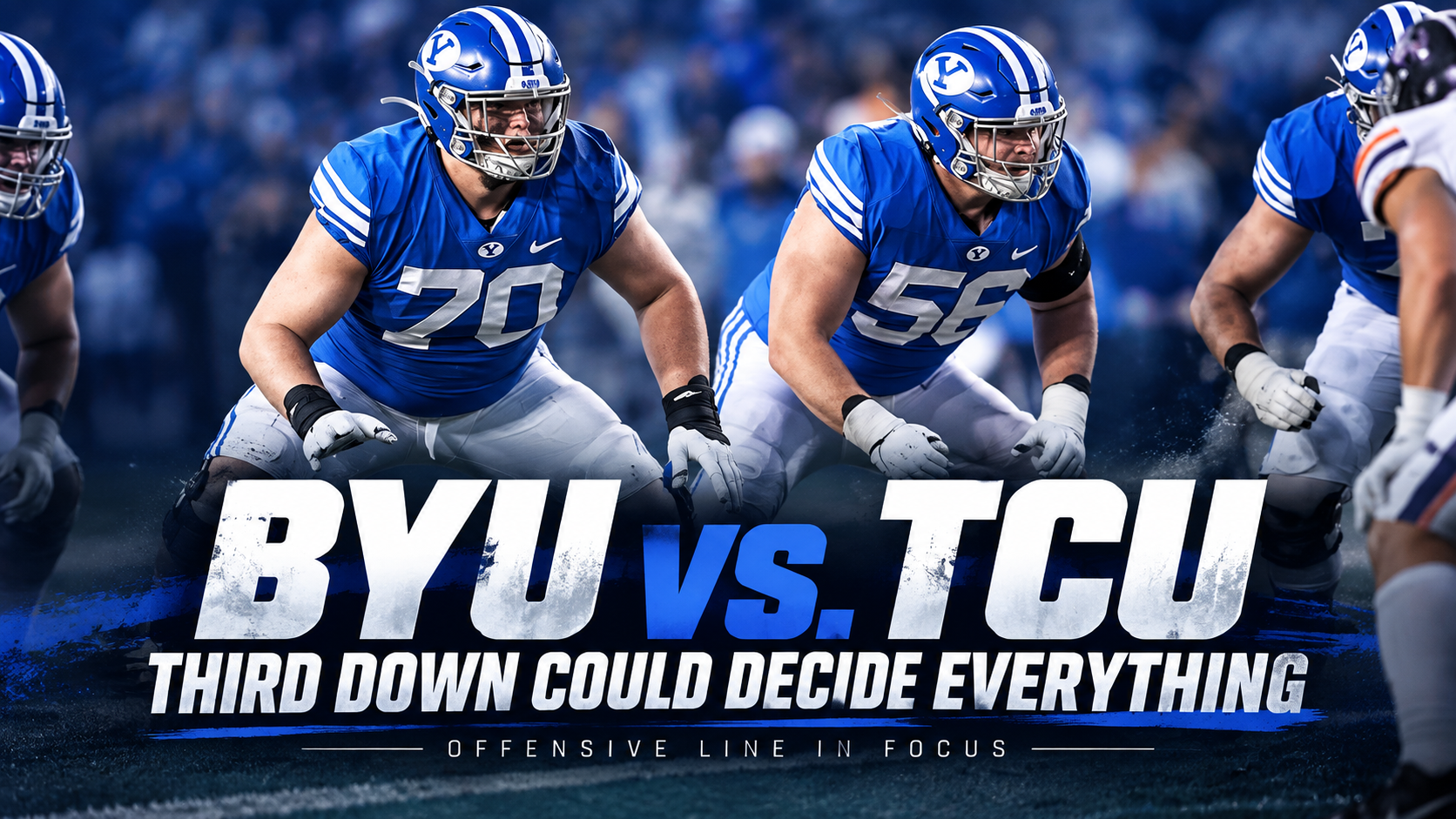
BYU’s trip to Fort Worth can be reduced to one unusually clean statistical collision. The Cougars have converted 19 of 31 third downs, a 61.3% rate that ranks third nationally. TCU’s defense has allowed only 12 conversions in 49 tries, a 24.5% rate that ranks seventh. Those numbers come from TCU’s official game notes, and whichever one survives Saturday will probably tell us more about BYU than the final margin.
Third down has been the connector in BYU’s 3-0 start. The Cougars are averaging 44.0 points and roughly 482 yards per game, but those totals are downstream of staying on the field. Bear Bachmeier has completed 71.0% of his passes, BYU averages 6.7 yards per rush and the offense has surrendered only two sacks. That combination keeps Aaron Roderick’s call sheet open: third-and-3 can still be an LJ Martin run, a quarterback keeper, play action or a quick throw to Walker Lyons.
TCU is built to remove that comfort. The Horned Frogs are allowing 12.5 points, 264.8 yards and only 13.8 first downs per game. Opponents have averaged 2.9 yards per carry and 86 rushing yards, while TCU has produced nine sacks. BYU’s offense ranks ninth nationally in rushing at 262.7 yards per game; TCU’s run defense ranks 17th. This is not a matchup where one side is waiting to exploit an obvious statistical weakness. It is strength against strength.
The complication is Andrew Gentry. BYU’s starting right tackle is out after undergoing surgery, and offensive line coach TJ Woods said redshirt freshman Siosiua Latu-Finau and true freshman Bott Mulitalo will rotate in his place. Neither has made a college start, although both have appeared this season. Woods told the Deseret News that BYU feels good about both young tackles, while the official depth chart lists each at 6-foot-5 and 310 pounds.
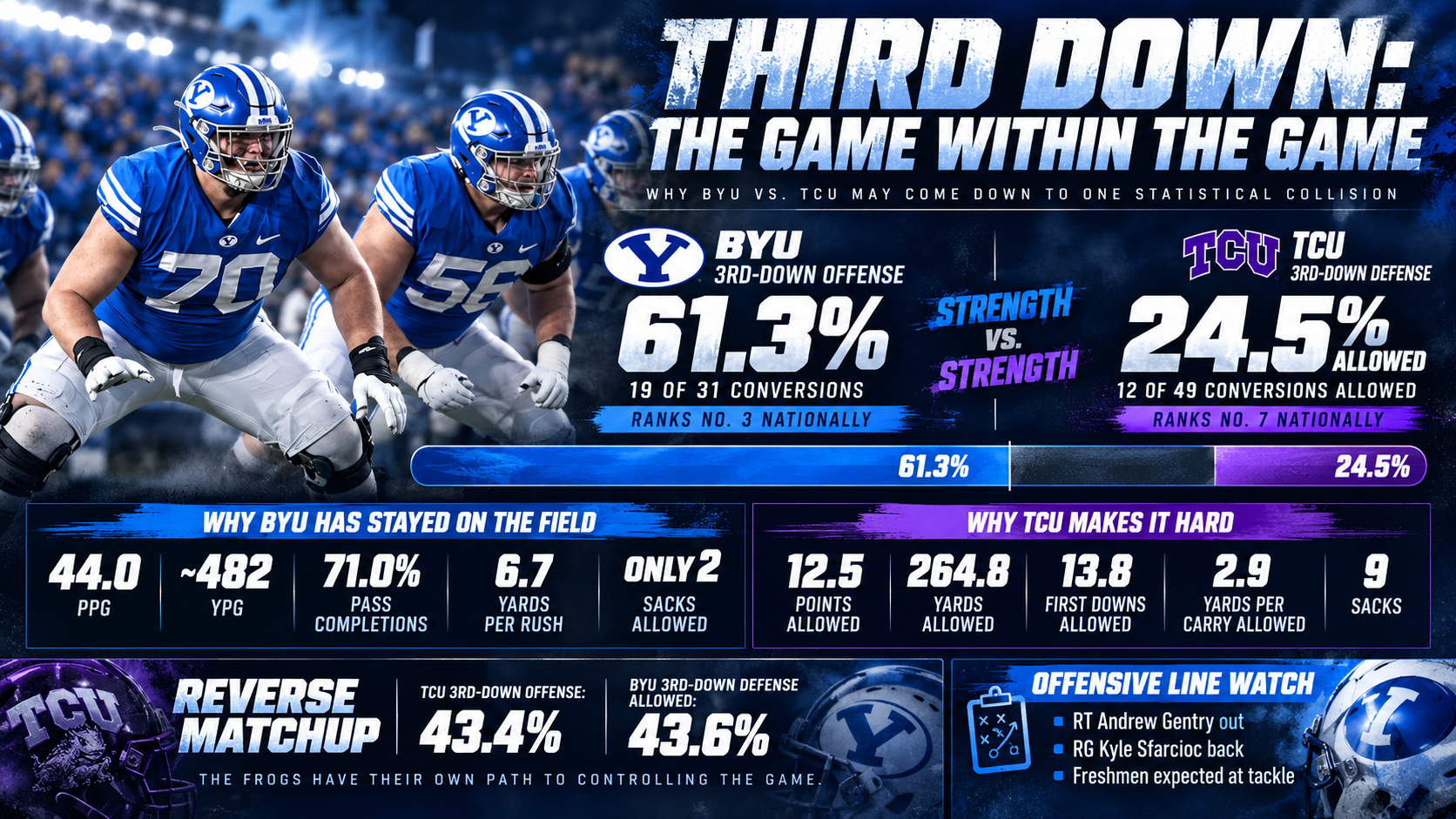
That change matters most when the down and distance tells TCU what is coming. A young tackle can receive help from a tight end, a running back or a protection slide on early downs. On third-and-8, disguising the intention becomes much harder. TCU can widen a rusher such as Ansel Din-Mbuh, test the protection with pressure and force Bachmeier to make a faster decision. BYU does get starting right guard Kyle Sfarcioc back, according to KSL Sports’ availability report, which should help stabilize the interior next to whichever freshman is at tackle.
There is an obvious caveat to all of this: the samples are still small, and the schedules have not been equal. BYU has played Utah Tech, Arizona and Colorado State. TCU’s defensive résumé includes Grambling State and Arkansas State, along with Power Four games against North Carolina and UCF. September statistics can reveal something real about a team without proving the same numbers will hold when the competition gets tougher.
There is also a revealing reverse matchup. TCU converts 43.4% of its third downs, while BYU’s defense has allowed 43.6%, ranking 112th in the comparison published in TCU’s notes. The Cougars have been excellent overall—15.7 points and 271 yards allowed per game—but they have not consistently ended drives at the first opportunity. That gives TCU its own path to controlling the game if the Horned Frogs can keep BYU’s defense on the field.
That part matters because BYU already showed last season what happens when it owns the rhythm of this matchup. The Cougars beat TCU 44-13, finished with 28 first downs and controlled possession for more than 36 minutes. This year’s teams are different, but the formula is familiar: stay ahead of the sticks, extend drives and prevent TCU from turning obvious passing situations into pressure opportunities.
What to watch Saturday is simple: the distance before the snap. If BYU keeps producing third-and-4 or less, its run game and quarterback mobility should preserve the broad menu that has fueled the 3-0 start. If penalties, negative runs or pressure create repeated third-and-long situations, TCU’s best defensive trait will be aimed directly at the least experienced spot on BYU’s offense.
At 5 p.m. Mountain on ESPN, total yards may not be the number that matters most. Watch third down. After four quarters, we should have a much better idea whether BYU’s 61% or TCU’s 24% was the more sustainable number.
More BYU football originals
 The CFP May Get Bigger. BYU’s Standard Against Notre Dame Shouldn’tRead the original →
 Sione Moa Is Cleared. BYU Still Has to Decide How Much He Can Give Notre DameRead the original →
 Notre Dame Has 68 Blue-Chips to BYU’s 12. The Records Are Nearly IdenticalRead the original →
Questions about a source, update or correction? Contact the editor. Story updates are reflected in the published timestamp above.