
FEED THE COUGAR ORIGINAL · Football
BYU’s Defense Meets Iowa State’s One-Man Offense: How to Stop Aiden Flora
Aiden Flora can run, throw and return punts, but BYU’s disciplined front has allowed only 75 rushing yards per game through four weeks.
Prepared with AI assistance. Feed the Cougar is responsible for sources and corrections. How our daily articles work →

Aiden Flora arrives in Provo as one of the most explosive running backs in college football, and BYU will counter with one of the stingiest run defenses in the country. Flora is averaging 8.1 yards per carry and 118.8 rushing yards per game, while the Cougars are allowing only 2.73 yards per attempt and 75.0 rushing yards per game. That contrast makes Friday night’s matchup one of the clearest strength-on-strength battles BYU has faced this season.
Flora’s numbers became even more difficult to ignore after his performance against West Virginia. The Iowa State sophomore rushed for 212 yards and three touchdowns on 22 carries, then added two touchdown passes as the Cyclones leaned on him in nearly every way imaginable. Through five games, he has rushed for 594 yards, and his 8.1 yards per carry ranks among the best marks in the country.
BYU’s defensive numbers provide an equally compelling counterpoint. The Cougars have allowed only 300 total rushing yards through four games, meaning Flora has nearly twice as many rushing yards by himself as BYU has surrendered to all four opponents combined. BYU has also limited opposing offenses to just 10 runs of at least 10 yards, two runs of 20 or more and no run longer than 25 yards.
The matchup by the numbers
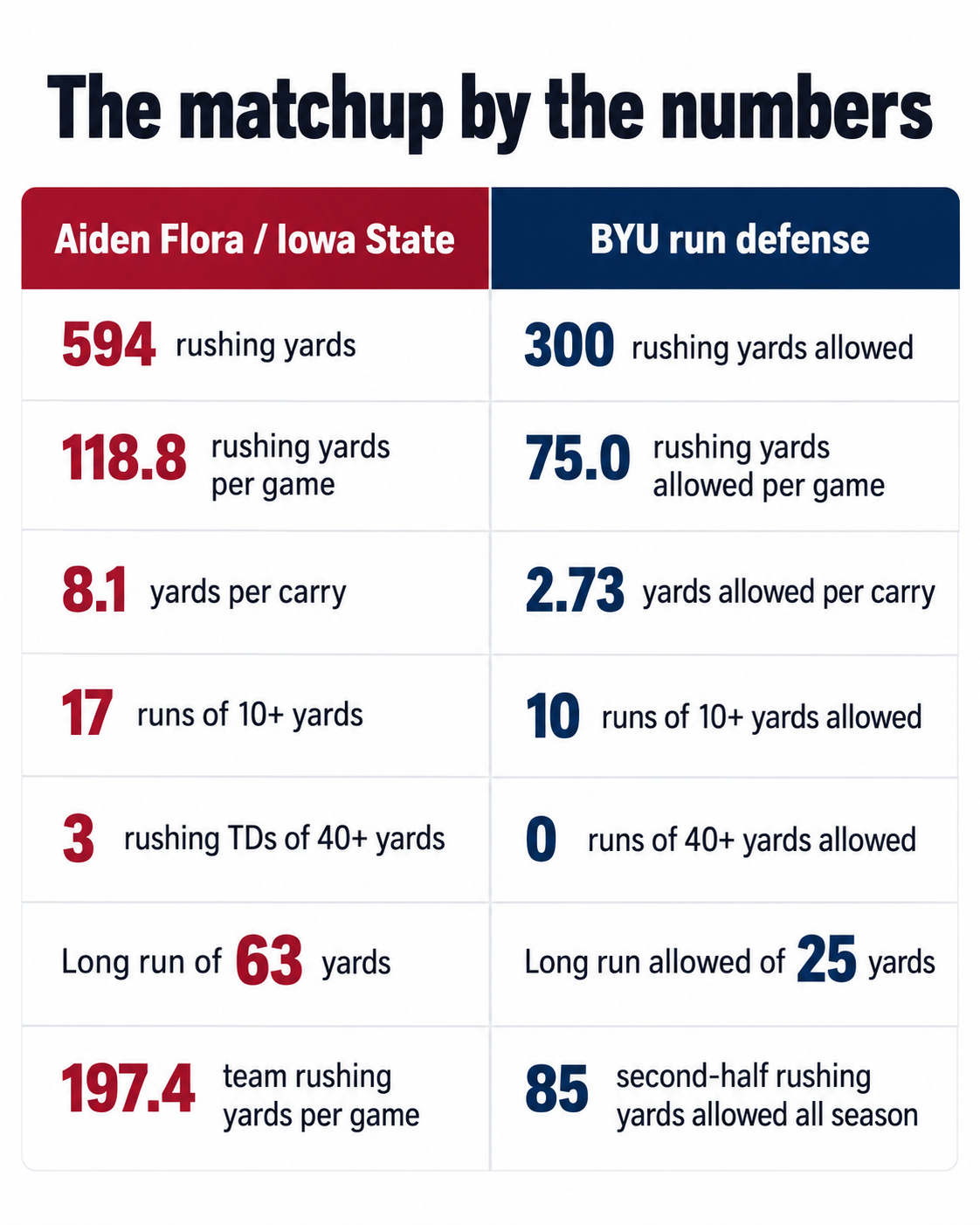
The most important part of Flora’s production is not simply the volume. It is how quickly he can change a game. He has 17 runs of at least 10 yards this season and has already produced touchdown runs of 42, 61 and 63 yards. Iowa State does not need to consistently drive the ball down the field when Flora is capable of turning one missed gap or poor pursuit angle into six points.
That is why BYU’s ability to limit explosive runs may matter more than Flora’s final rushing total. The Cougars can survive four- and five-yard gains if Iowa State is forced to repeatedly execute long drives. What they cannot afford is for an ordinary-looking running play to become the kind of 50- or 60-yard gain Flora has produced several times already this season.
BYU has been unusually good at preventing exactly that. Opponents have carried the ball 110 times against the Cougars, but only 10 of those attempts have gained at least 10 yards. Just two have reached 20 yards, and BYU has yet to allow a run longer than 25. That means the Cougars have spent most of the season forcing offenses to earn their rushing yards in small pieces rather than surrendering the single play that changes the complexion of a game.
There is another reason to believe BYU is well suited for this matchup. The run defense has actually improved as games have progressed. Opponents are averaging 3.36 yards per carry in the first half but only 1.85 after halftime. In the fourth quarter, that number drops to 1.48 yards per attempt. BYU has allowed only 85 second-half rushing yards through four games, which suggests the defensive front has not worn down late.
That trend will be worth watching against Iowa State because Flora’s explosiveness can force defenses to remain disciplined for an entire game. If he is still finding six- and seven-yard gains in the third quarter, the Cyclones will be able to stay ahead of the chains and keep the full offense available. If BYU gradually reduces those gains to two and three yards, the game begins to favor the Cougars’ defensive structure.
Iowa State also makes the matchup more difficult by using Flora as more than a traditional running back. He has recorded a rushing touchdown, passing touchdown and punt-return touchdown this season, becoming the first Big 12 player since 2017 to score all three ways in the same year. Against West Virginia, he became the first non-quarterback since at least 1996 to combine 200 rushing yards, three rushing touchdowns and two touchdown passes in the same game.
That versatility means BYU cannot simply crowd the line of scrimmage every time Flora enters the backfield. Safeties still have to respect the possibility of a pass, outside defenders have to maintain leverage when Iowa State uses motion, and the special teams unit has to account for a returner who already owns a 66-yard punt-return touchdown. The Cyclones can use the same player to create problems for BYU’s defensive front, secondary and punt coverage unit.
Utah provided a useful example of how Flora can be slowed. The Utes held him to only 14 rushing yards in the first half two weeks ago while limiting Iowa State to 41 rushing yards before halftime. Utah controlled the interior without allowing its pursuit players to get caught out of position, which forced Flora to repeatedly run into traffic rather than giving him open space.
That performance is particularly relevant because Utah’s run-defense profile looks similar to BYU’s. Both teams have been difficult to move at the line of scrimmage and have avoided surrendering long rushing plays. Utah showed that Flora’s explosiveness can be contained when a defense wins early downs, maintains gap discipline and tackles well in space.
BYU will have to attempt the same thing while potentially dealing with personnel changes at linebacker. Isaiah Glasker’s status matters because defending Flora requires more than individual tackling ability. The Cougars need clean communication between the defensive line and second level, particularly when Iowa State changes formations or uses motion to alter run fits.
The first defender does not necessarily have to make the tackle, but he does have to force Flora to commit to a path. That allows the next defender to arrive under control instead of chasing him from behind. Against an ordinary running back, one poor angle might turn a three-yard gain into eight. Against Flora, the same mistake can turn into a touchdown.
Third down is another area where BYU has been particularly strong against the run. Opponents have attempted 17 third-down rushes and gained minus-11 yards, an average of minus-0.65 yards per carry. BYU has not allowed a run of 10 or more yards on third down this season, which puts additional pressure on Iowa State to stay ahead of the chains.
That makes first down especially important. BYU is allowing only 2.61 yards per rush on first down. If the Cougars can regularly create second-and-7 and third-and-5 situations, Kelly Poppinga can be more aggressive with pressure packages and force Iowa State away from the part of its offense that has been most productive. If Flora is consistently creating second-and-2, the Cyclones can dictate the game instead.
The temptation for BYU will be to become overly aggressive in an effort to stop him. That would be a mistake. Flora’s two touchdown passes against West Virginia are evidence that Iowa State is willing to punish defenses that become too focused on the run. BYU’s front needs to attack while the secondary remains disciplined enough to prevent the Cyclones from turning that aggression against them.
For that reason, Flora’s final rushing total may not be the best way to judge who won the matchup. He could finish with 90 or 100 yards and still have a relatively quiet night if it takes 20 carries to get there. He could also finish with fewer carries and completely alter the game if two of them become explosive touchdowns.
The number worth following is how often Flora reaches 10 yards or more. He has done it 17 times this season, while BYU has allowed only 10 such runs through four games. Flora has produced three rushing touchdowns of at least 40 yards, while the longest run BYU has surrendered is 25.
Friday night will show whether those defensive numbers are sustainable against the most explosive running back BYU has faced so far. If the Cougars keep Flora in traffic and force Iowa State to earn its rushing yards five yards at a time, BYU should be able to play the type of game it wants. If Flora starts reaching the second level with space, the Cyclones have a player capable of changing the game before the defense has time to recover.
More BYU football originals
 The CFP May Get Bigger. BYU’s Standard Against Notre Dame Shouldn’tRead the original →
 Sione Moa Is Cleared. BYU Still Has to Decide How Much He Can Give Notre DameRead the original →
 Notre Dame Has 68 Blue-Chips to BYU’s 12. The Records Are Nearly IdenticalRead the original →
Questions about a source, update or correction? Contact the editor. Story updates are reflected in the published timestamp above.