
FEED THE COUGAR ORIGINAL · Football
BYU’s Freshman and Sophomores Weren’t Just Getting Reps. They Were Taking Over.
The final score was 63-7. The more interesting numbers were 7 of 9, 5 of 9 and 3 of 5.
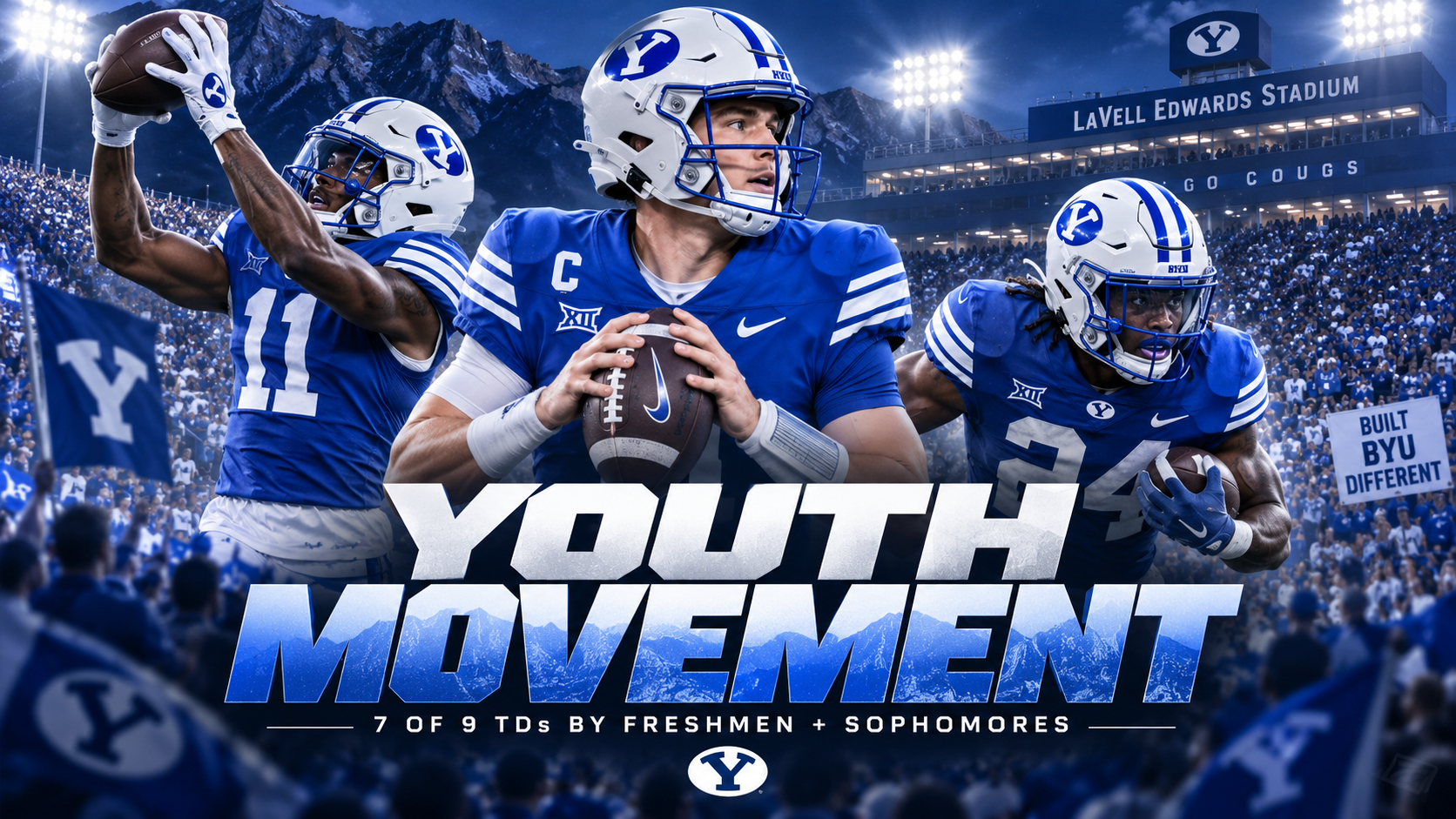
PROVO — Utah Tech wasn’t going to tell us whether BYU can win the Big 12. Arizona might begin answering that question next week. Saturday night was different. It was a scheduled mismatch, and everybody in LaVell Edwards Stadium knew it. Utah Tech had lost 54-0 to an FCS opponent a week earlier. No. 14 BYU was supposed to win this game quickly, comfortably and without drama.
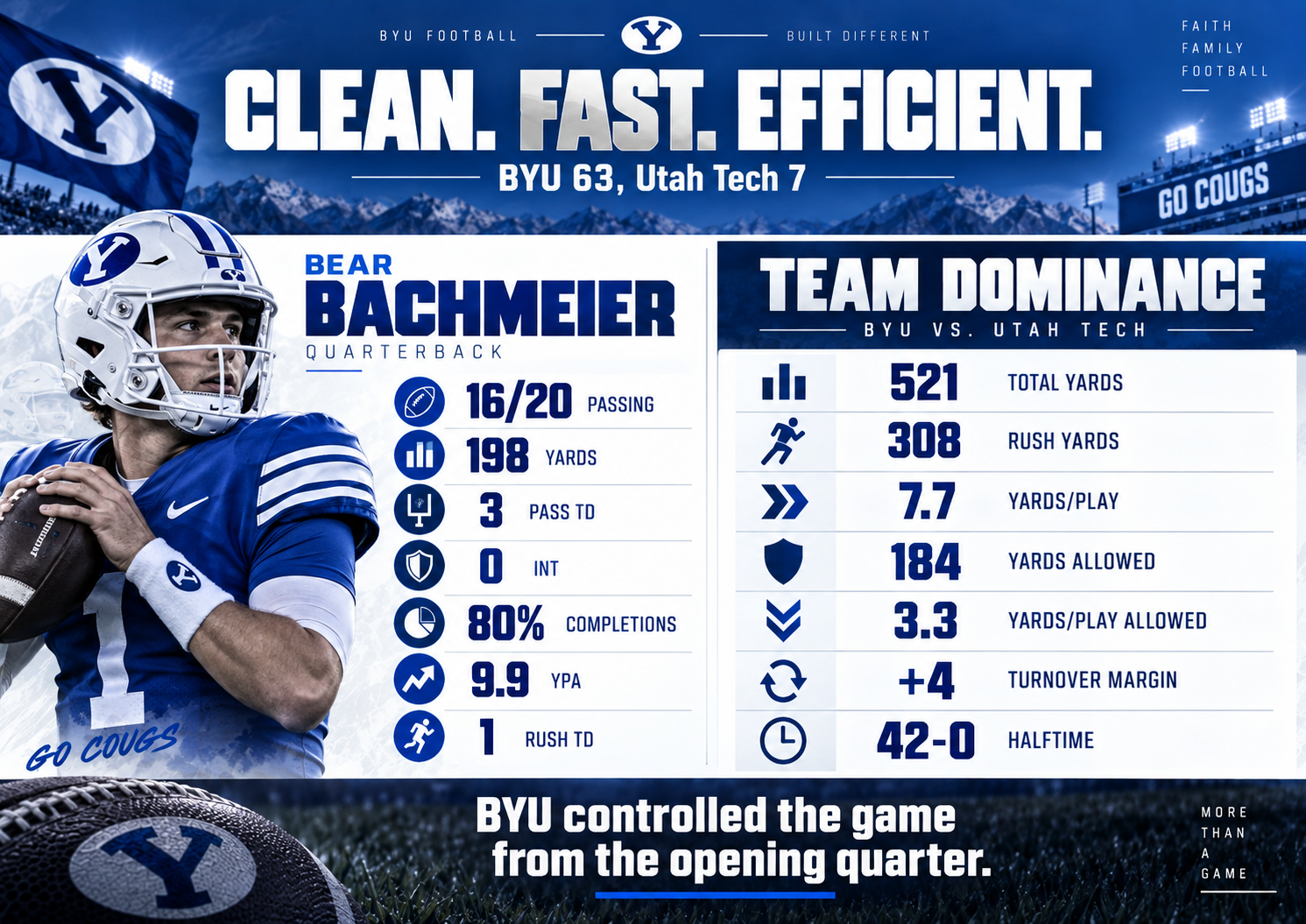
It did. BYU won 63-7, led 42-0 at halftime, rolled up 521 yards, averaged 7.7 yards per play, rushed for 308 yards, turned the football over zero times and forced four Utah Tech turnovers. The Cougars outgained the Trailblazers by 337 yards and held them to 3.3 yards per snap. (BYU Cougars)
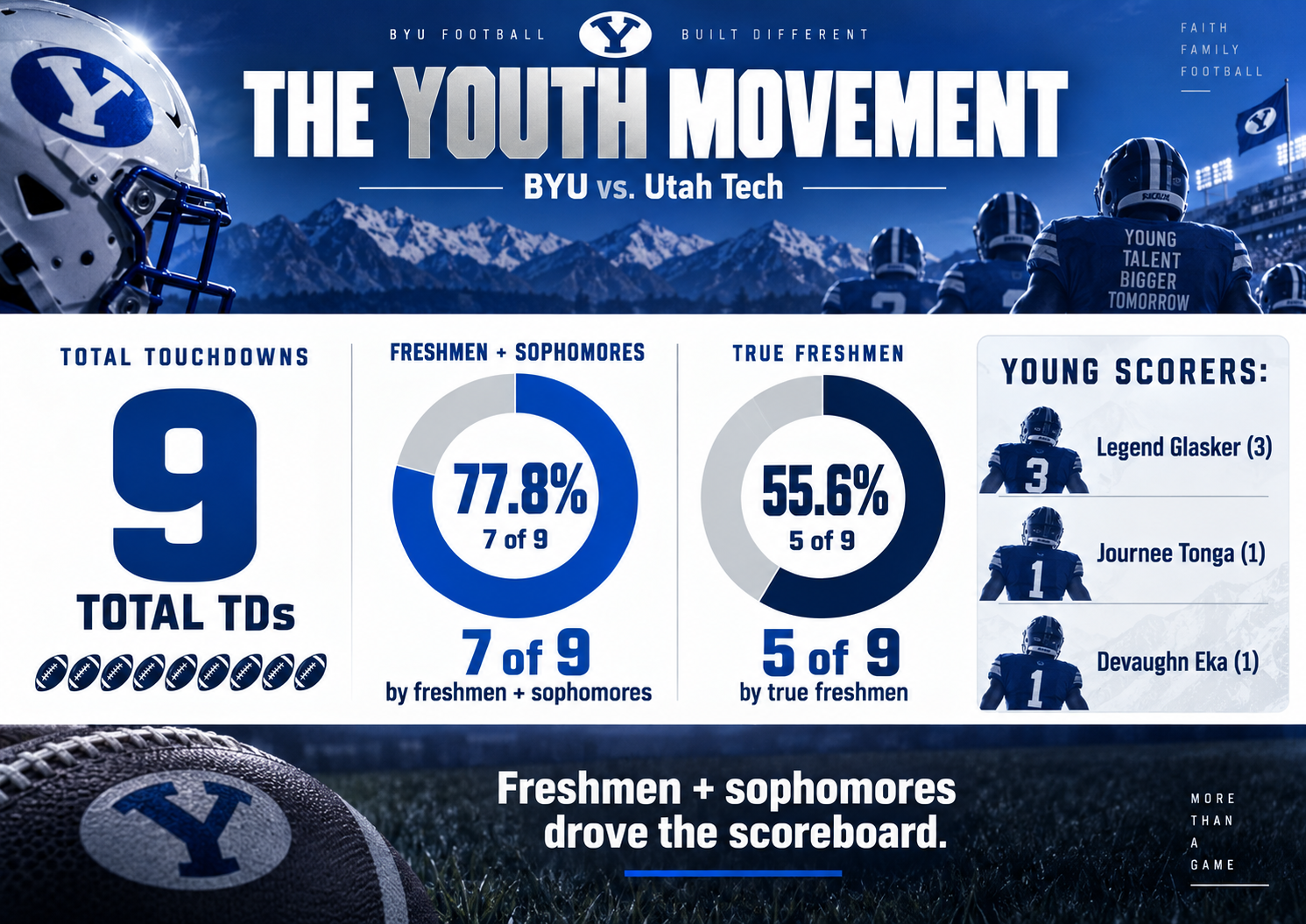
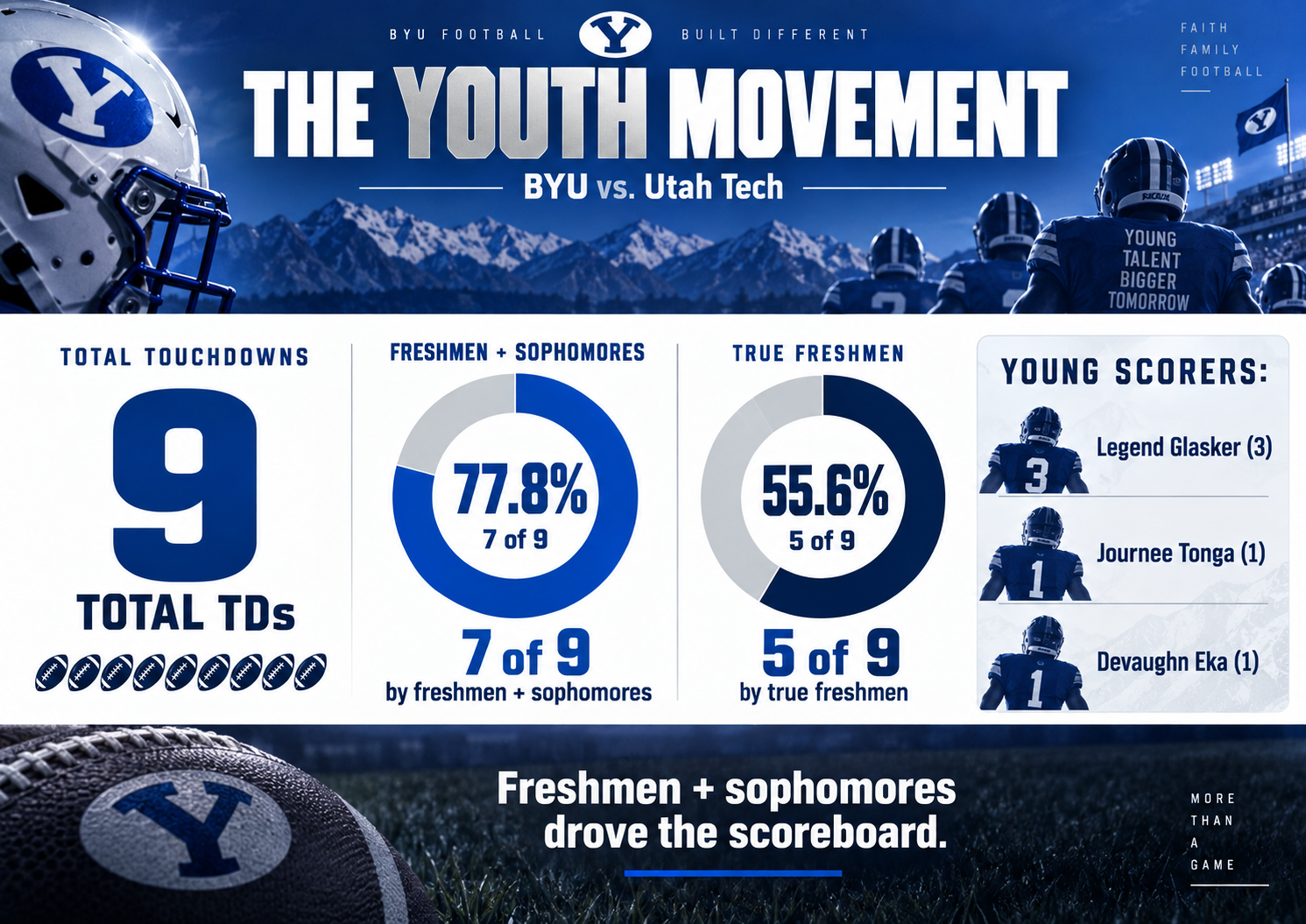
Those are blowout numbers. But here’s the number worth circling: 7 of 9. Seven of BYU’s nine touchdowns were scored by freshmen or sophomores.
Here’s another: 5 of 9. Five were scored by true freshmen. And one more: 3 of 5.
True freshman receiver Legend Glasker scored touchdowns on three of his first five collegiate touches. It is where this game became more interesting than the opponent. The 529 snapshot Metric BYU vs. Utah Tech What it says Score 63-7 +56 margin Total offense 521 yards Plenty despite early substitutions Rushing offense 308 yards 59.1% of total offense Offensive efficiency 7.7 yards/play Explosive without huge volume Yards allowed 184 Utah Tech never established offense Defensive efficiency 3.3 yards/play 4.4 YPP advantage Yardage differential +337 Complete territorial domination Turnover margin +4 Four takeaways, zero giveaways Underclassman TDs 7 of 9 77.8% of BYU’s touchdowns True-freshman TDs 5 of 9 55.6% of all touchdowns Glasker 81 yards, 3 TD on 5 touches 16.2 yards per touch Bear Bachmeier 16/20, 198, 3 TD, 0 INT 80% completions, 9.9 YPA
There are statistics that tell you who won. Then there are statistics that tell you what might matter later. That second column is where BYU should be encouraged.
Legend Glasker didn’t ease into anything Glasker’s first collegiate touch was a nine-yard touchdown run. His first reception was a 26-yard touchdown. His third score came on a 33-yard reception.
Three catches. Sixty-five receiving yards. Two receiving touchdowns. Add 16 rushing yards and another score. Five touches, 81 yards, three touchdowns.
It is 16.2 yards every time BYU put the football in his hands. Even sillier: 60% of his touches ended in the end zone. Now, nobody is projecting that over 12 games unless they’d like to predict roughly 40 touchdowns for a freshman receiver.
Utah Tech matters here. Opponent adjustment should be applied liberally. But there is one thing an opponent can’t completely manufacture: acceleration.
Glasker looked fast before the defense had time to look slow. At 6-foot-1 and 175 pounds, Glasker arrived from Lehi High as a three-star recruit after producing 1,457 career receiving yards. As a senior he caught 37 passes for 676 yards and nine touchdowns while adding 206 rushing yards on only 11 carries. BYU didn’t recruit him simply to stand outside the numbers and run routes. He was already a player accustomed to turning touches into chunks. (BYU Cougars)
Saturday looked like a continuation. The jet sweep mattered as much as the touchdown catches because it showed Aaron Roderick isn’t treating Glasker like a freshman who must first earn the safe portion of the playbook. BYU is looking for ways to give him the football.
It is different. There are freshmen who are ready to play. There are freshmen whom an offense begins designing plays around.
It’s one game, but Glasker looked suspiciously like the second kind. Then look behind LJ Martin BYU’s established running back is LJ Martin. No mystery there. Martin carried seven times for 54 yards, averaging 7.7 per carry. But BYU may have discovered that its running-back room is considerably deeper than the depth chart suggested.
True freshman Devaughn Eka carried eight times for a game-high 59 yards and scored on an 11-yard run. True freshman Journee Tonga carried twice for 38 yards and scored once. Put the two freshmen together:
10 carries. 97 yards. 9.7 yards per carry. 2 touchdowns. It is not enough work to establish an efficiency baseline.
It is enough to make a running-backs coach smile. Eka arrived at BYU after rushing for 3,276 yards during his high school career. Tonga is a 5-foot-8, 198-pound back who already looks physically capable of handling college contact. Both are listed as true freshmen on BYU’s 2026 roster. (BYU Cougars)
BYU had five different players score rushing touchdowns Saturday, something the program says hadn’t happened in at least 30 seasons. Three of those five — Glasker, Eka and Tonga — are freshmen. (BYU Cougars) It is not garbage-time trivia.
It is roster information. Don’t forget the quarterback is 19 years old Bear Bachmeier is no longer the shiny new freshman. It is what happens when a quarterback starts a full season, wins games and becomes nationally recognizable.
But Bachmeier is still a sophomore. His line Saturday was almost boringly efficient: 16 completions. 20 attempts. 198 yards. 3 touchdowns. 0 interceptions. 80% completions. 9.9 yards per attempt. 212.7 passer efficiency.
He also ran for 30 yards and another touchdown. So Bachmeier was directly responsible for four touchdowns before essentially becoming a spectator. The most encouraging number may have been zero.
No interceptions. No fumbles lost. No need to force throws to produce offense.
BYU had nine different players catch passes from Bachmeier, spread the field, ran the football for 308 yards and scored six offensive touchdowns before halftime. This wasn’t a quarterback carrying the offense. It was a quarterback operating it.
There’s a difference. And if BYU’s freshman skill talent continues developing around him, Bachmeier could spend the next two seasons surrounded by players growing up at essentially the same time he does. It is how roster windows open.
Cannon DeVries made the youth movement a three-phase affair Then the second half started. Cannon DeVries caught the kickoff at the goal line and went 100 yards. Touchdown.
DeVries is a sophomore. He was an all-state two-way player at Weber High, ran a 10.81-second 100 meters and returned interceptions, punts and kickoffs for touchdowns before arriving at BYU. (BYU Cougars) Apparently the return ability survived the trip to Provo.
He also averaged 37 yards on his punt returns Saturday. (Deseret News) So add special teams to the equation. The freshman receiver scored three times.
The sophomore quarterback accounted for four touchdowns. Two freshman running backs averaged 9.7 yards per carry. The sophomore returner went 100 yards.
Redshirt sophomore safety Matthias Leach intercepted a pass and tied for the team lead with four tackles. (BYU Cougars) This wasn’t one precocious freshman having a moment. Young players showed up all over the field.
Now apply the Utah Tech discount This is where everybody should put the calculator down for a minute. Utah Tech was a week removed from losing 54-0. BYU was No. 14.
This wasn’t Georgia in Atlanta. It wasn’t a November trip to Lubbock. It wasn’t even a Big 12 game. BYU was supposed to dominate.
The Cougars don’t deserve extra credit merely for doing what the schedule required. If BYU had beaten Utah Tech 31-17, we’d be asking uncomfortable questions Sunday morning. So don’t use 63-7 as evidence BYU is ready to win the conference.
Use the game for what it can actually tell you. Against an opponent BYU should dominate, did the Cougars dominate? Yes.
Did they play clean football? Mostly. Zero turnovers, although Kalani Sitake wasn’t pleased with five penalties. (BYU Cougars)
Did the starters establish control early enough to give the roster meaningful snaps? 42-0 at halftime answers that. And when the young players received those opportunities, did they look like players merely filling out the fourth-quarter depth chart?
No. The important part. The statistic that should survive the blowout BYU scored nine touchdowns Saturday.
Here are seven of them: Glasker — freshman. Glasker — freshman. Glasker — freshman. Bachmeier — sophomore. DeVries — sophomore. Tonga — freshman. Eka — freshman.
It is 77.8% of BYU’s touchdowns scored by first- or second-year players. Take Bachmeier and DeVries out and true freshmen alone accounted for 55.6% of BYU’s touchdowns. The kind of number that should make BYU fans look beyond September 5.
The Cougars still have seniors everywhere they need them. Martin is a senior. Cade Uluave is a senior. Isaiah Glasker is a redshirt senior. There is veteran talent supporting all this youth. BYU isn’t sending a freshman team into the Big 12. (BYU Cougars) It is actually what makes Saturday more intriguing.
The young players aren’t being asked to rescue a rebuilding roster. They’re pushing onto the field of a team already ranked No. 14.
Those are two very different situations. Arizona comes to Provo next. It is where the spreadsheet begins getting useful.
Does Glasker still create separation against Big 12 defensive backs? Can Eka or Tonga earn meaningful carries when the score is 17-14 instead of 49-0? Can Bachmeier maintain something close to Saturday’s efficiency when the windows get smaller?
Can DeVries turn field position into a repeatable advantage? Those answers will determine whether Saturday was simply what happens when a good FBS team meets an overmatched FCS opponent. But BYU learned something anyway.
The scoreboard said 63-7. The roster said something more interesting. The Cougars didn’t just look good Saturday. They looked young while doing it. And in college football, that’s the kind of statistic that can keep paying interest.
More BYU football originals
 The CFP May Get Bigger. BYU’s Standard Against Notre Dame Shouldn’tRead the original →
 Sione Moa Is Cleared. BYU Still Has to Decide How Much He Can Give Notre DameRead the original →
 Notre Dame Has 68 Blue-Chips to BYU’s 12. The Records Are Nearly IdenticalRead the original →
Questions about a source, update or correction? Contact the editor. Story updates are reflected in the published timestamp above.