
FEED THE COUGAR ORIGINAL · Football
BYU Sports Nation’s 2026 Predictions for Football
Putting Spencer Linton and Jarom Jordan’s Picks to the Test
Spencer Linton and Jarom Jordan expect BYU to contend for a Big 12 championship and a College Football Playoff berth in 2026. We put percentages on every prediction — and after one week, the scoreboard has already started moving.
There was a time when predicting BYU to play for a Big 12 championship, sit near the top 10 of the College Football Playoff rankings and spend December wondering about playoff seeding would have qualified as blue-goggled optimism. That is not where this program sits anymore.
BYU enters 2026 coming off consecutive seasons in which the Cougars established themselves near the top of the Big 12. That recent success explains why BYU Sports Nation hosts Spencer Linton and Jarom Jordan were willing to push their preseason predictions well beyond simply making another bowl game. They expect BYU to contend for the conference championship.
They expect the Cougars to be near the top 10 when the first CFP rankings arrive. They expect BYU to be sitting around No. 11 when the regular season is finished.
And they believe the defense and special teams will continue doing many of the things that have helped Kalani Sitake’s program win games over the past two seasons. The predictions are specific enough that they deserve to be tracked. So that is what we are going to do.
Each prediction receives an estimated probability based on recent BYU production, personnel, schedule and historical performance. Those percentages will remain unchanged throughout the season. Each week, a separate Results to Date column will show whether the prediction is ahead of pace, behind pace, already accomplished or already dead. That way, nobody gets to move the goalposts in November.
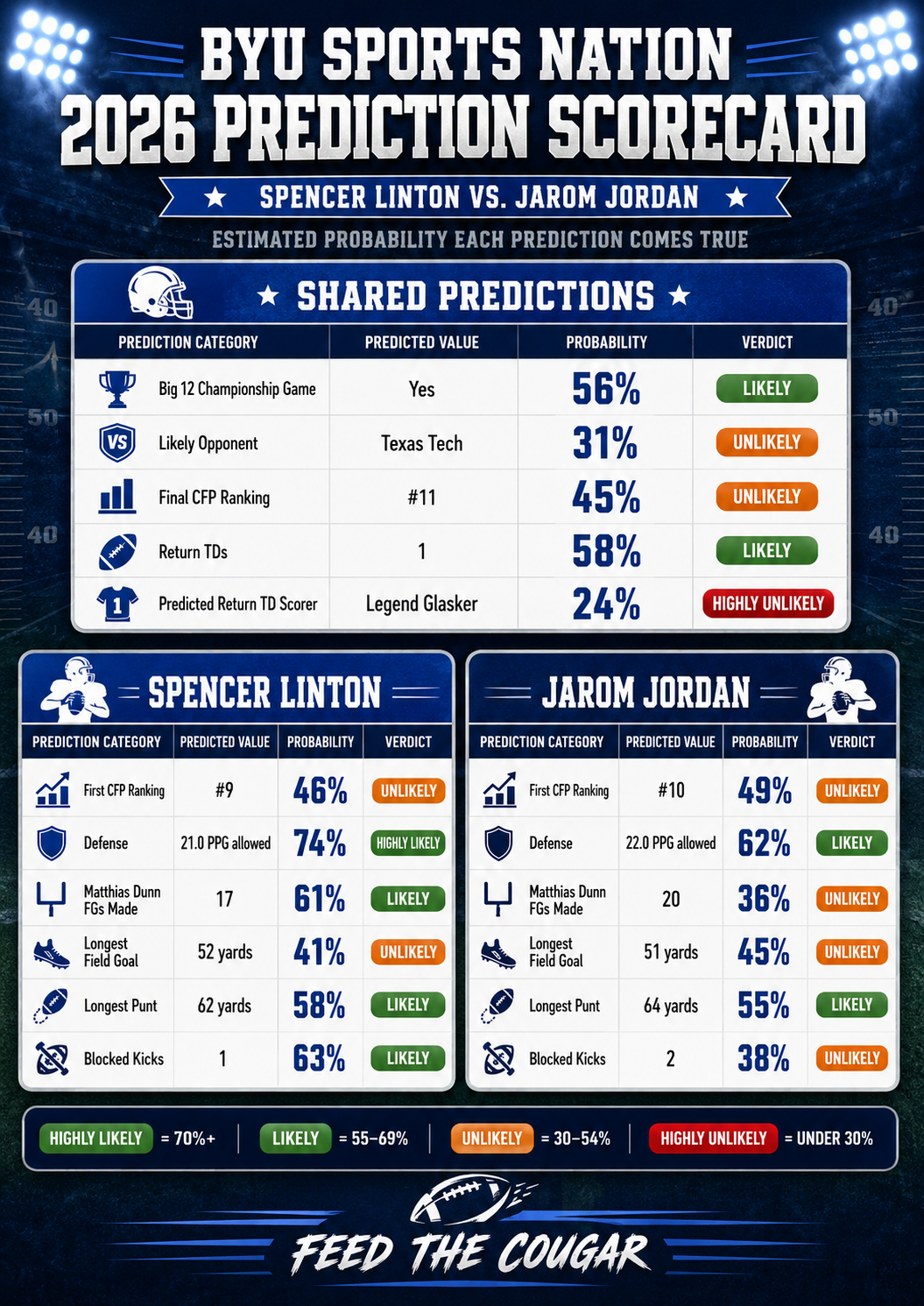
THE SCORECARD AFTER WEEK 1 Prediction Host Probability Verdict Results to Date Reach Big 12 Championship Game Both 56% Likely Alive — BYU 1-0 Face Texas Tech in Arlington Both 31% Unlikely Alive First CFP ranking around No. 9 Spencer 46% Unlikely Too early First CFP ranking around No. 10 Jarom 49% Unlikely Too early Finish around No. 11 / CFP range Both 45% Unlikely Alive Defense allows 21 PPG Spencer 74% Highly Likely 7.0 PPG after Week 1 Defense allows 22 PPG Jarom 62% Likely 7.0 PPG after Week 1 Matthias Dunn makes 17 FGs Spencer 61% Likely 0-for-1 Matthias Dunn makes 20 FGs Jarom 36% Unlikely 0-for-1 Longest FG is 52 yards Spencer 41% Unlikely No make; missed from 47 Longest FG is 51 yards Jarom 45% Unlikely No make; missed from 47 Longest punt is 62 yards Spencer 58% Likely 54 yards Longest punt is 64 yards Jarom 55% Likely 54 yards BYU blocks one kick Spencer 63% Likely 0 BYU blocks two kicks Jarom 38% Unlikely 0 BYU scores one return TD Both 58% Likely 1 — Cannon DeVries Legend Glasker scores return TD Both 24% Highly Unlikely Wrong player so far
The ratings are straightforward. Highly Likely means 70% or better. Likely is 55-69%. Unlikely covers 30-54%, while anything below 30% is Highly Unlikely. Now comes the interesting part.
Why? ⸻ THE BIG PREDICTIONS BYU Returns to the Big 12 Championship Game Spencer Linton: Yes Jarom Jordan: Yes Our probability: 56% — LIKELY Week 1 result: Still alive. BYU is 1-0.
This is the prediction that defines the entire list. If BYU reaches Arlington again, most of the conversation about whether the program’s recent success was sustainable disappears. The Cougars have already demonstrated that they can compete at the top of this league. Now they have to prove they can stay there.
There is a meaningful difference between saying BYU can reach Arlington and saying it is more likely than not. We put the number at 56%. That is hardly overwhelming confidence, but it reflects BYU’s position within the Big 12. The Cougars do not need to become something they have never been. They need to reproduce something close to what they have already been doing.
Week 1 changed almost nothing here. BYU’s 63-7 victory over Utah Tech was exactly what was expected. The Cougars handled an overmatched opponent without giving anyone reason to question the larger preseason assumptions.
The important games are still ahead. The Arlington prediction begins to take on real weight when conference play begins and road trips start appearing on the schedule. For now, Linton and Jordan remain very much alive.
⸻ BYU Meets Texas Tech in Arlington Spencer: Texas Tech Jarom: Texas Tech Our probability: 31% — UNLIKELY Week 1 result: Still alive. There is an important distinction here. If somebody asks for the single most likely opponent BYU would face in a Big 12 Championship Game, Texas Tech is a perfectly logical answer.
That does not mean Texas Tech is more likely than the rest of the field combined. Conference championship matchups are difficult predictions because two things have to happen simultaneously. BYU has to finish in the top two, and Texas Tech has to do the same.
A 31% probability might sound low, but for one specific championship matchup in a league with this much parity, 31% is significant. It is our favorite individual matchup. It is simply not more probable than all of the alternatives combined.
There is a lot of football between September and Arlington. ⸻ Spencer: BYU Debuts Around No. 9 in the CFP Rankings Probability: 46% — UNLIKELY Week 1 result: Too early to judge.
The exact ranking is not the point. Nobody should pretend there is a scientifically meaningful difference between predicting No. 9 and having BYU show up No. 8 or No. 10.
What Spencer is really predicting is that BYU will be a legitimate top-10 national team when the committee first reveals its rankings. That requires BYU to survive the first two months with no more than one meaningful blemish. An undefeated BYU would almost certainly be in that range or higher.
A one-loss BYU with a strong résumé could also land there. Two losses would make Spencer’s prediction considerably more difficult. Week 1 was simply the first checkbox.
BYU is 1-0. That is all it needed to be. ⸻ Jarom: BYU Debuts Around No. 10
Probability: 49% — UNLIKELY Week 1 result: Too early to judge. Jarom gave himself a little more room. One ranking spot does not seem like much, but his larger point is slightly more conservative. He believes BYU will be around the edge of the top 10 rather than clearly inside it.
That may prove to be the safer call. BYU has earned enough credibility nationally that the Cougars should not have to spend half a season convincing pollsters they belong in the conversation. But rankings ultimately follow wins.
Jarom is essentially betting on BYU reaching November with a résumé that looks like a serious CFP contender. At 49%, we see it as close to a coin flip. ⸻ Both Predict BYU Finishes Around No. 11
Probability: 45% — UNLIKELY Week 1 result: Alive. This prediction has a familiar ring to it. BYU has already experienced what it feels like to spend December close enough to the playoff line that every ranking matters.
Linton and Jordan are predicting another season on that edge. A No. 11 finish would almost certainly mean BYU has produced another 10- or 11-win regular season. It would mean the Cougars survived most of the Big 12 schedule. It would probably mean the Arlington conversation lasted until the final weeks.
That is a lot of things that have to go right. Hence the 45%. But 45% is not dismissive.
It means we believe there is nearly a one-in-two chance BYU ends the season in approximately the national position Linton and Jordan are forecasting. That alone tells you how much expectations have changed in Provo.
OFFENSE There is something notable about the BYU Sports Nation prediction list. Linton and Jordan did not spend much time attaching season-long statistical predictions to Bear Bachmeier, LJ Martin or BYU’s receiving corps. Their offensive prediction was indirect.
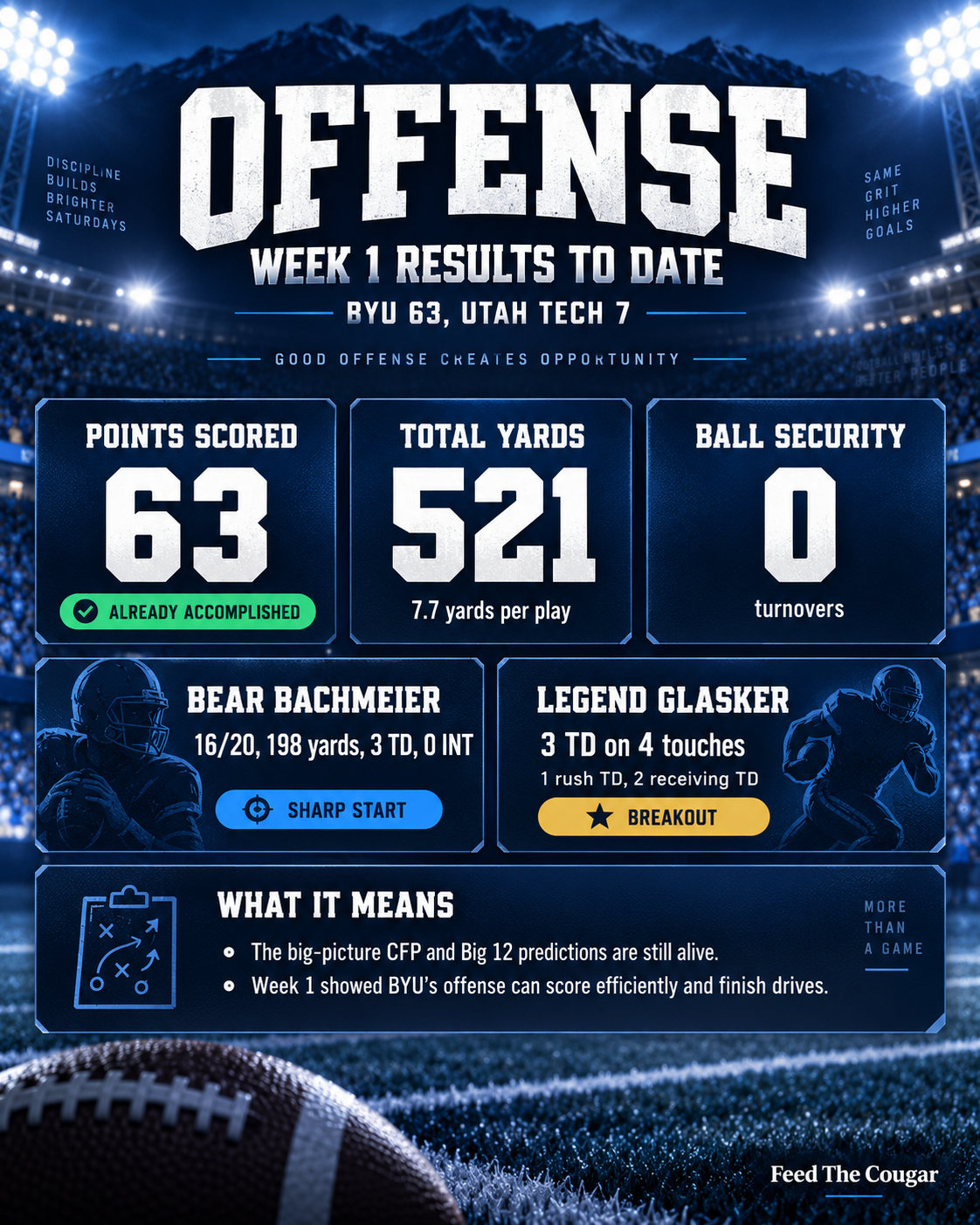
For BYU to reach Arlington and spend November near the top 10, the offense has to be good enough to support those goals. Week 1 offered an encouraging first answer. BYU scored 63 points, produced 521 yards and averaged 7.7 yards per play against Utah Tech.
Bear Bachmeier completed 16 of 20 passes for 198 yards and three touchdowns without an interception. The Cougars rushed 46 times and spread the work throughout the roster. None of those numbers should be extrapolated across a Big 12 season.
Utah Tech is not TCU. It is not Utah. It is not Notre Dame. But there is a way to evaluate a heavily favored team in an opener.
Did it look sloppy? Did it turn the ball over? Did it struggle to finish drives?
Did the quarterback look uncomfortable? BYU’s answer to all four was no. The Cougars scored touchdowns on a variety of short fields and long drives, finished possessions and never turned the ball over.
If the big preseason predictions are going to survive into November, the offense does not need to score 63 every week. It needs to remain efficient. Week 1 checked that box.
⸻ Legend Glasker Has Already Entered the Conversation There was no formal offensive statistical prediction attached to Glasker, but his name appears later in the special-teams section for a reason. Linton and Jordan clearly believed the freshman possessed unusual open-field ability.
His first college game did nothing to discourage them. Glasker scored on a nine-yard run on his first collegiate touch. He later caught touchdown passes of 26 and 33 yards.
He finished with three touchdowns on four offensive touches. That is not a sustainable ratio unless Glasker plans on rewriting several sections of the NCAA record book. It is, however, evidence that BYU has found another explosive piece. The hosts may have guessed the wrong method for Glasker’s first big play. They did not appear to be wrong about the player.
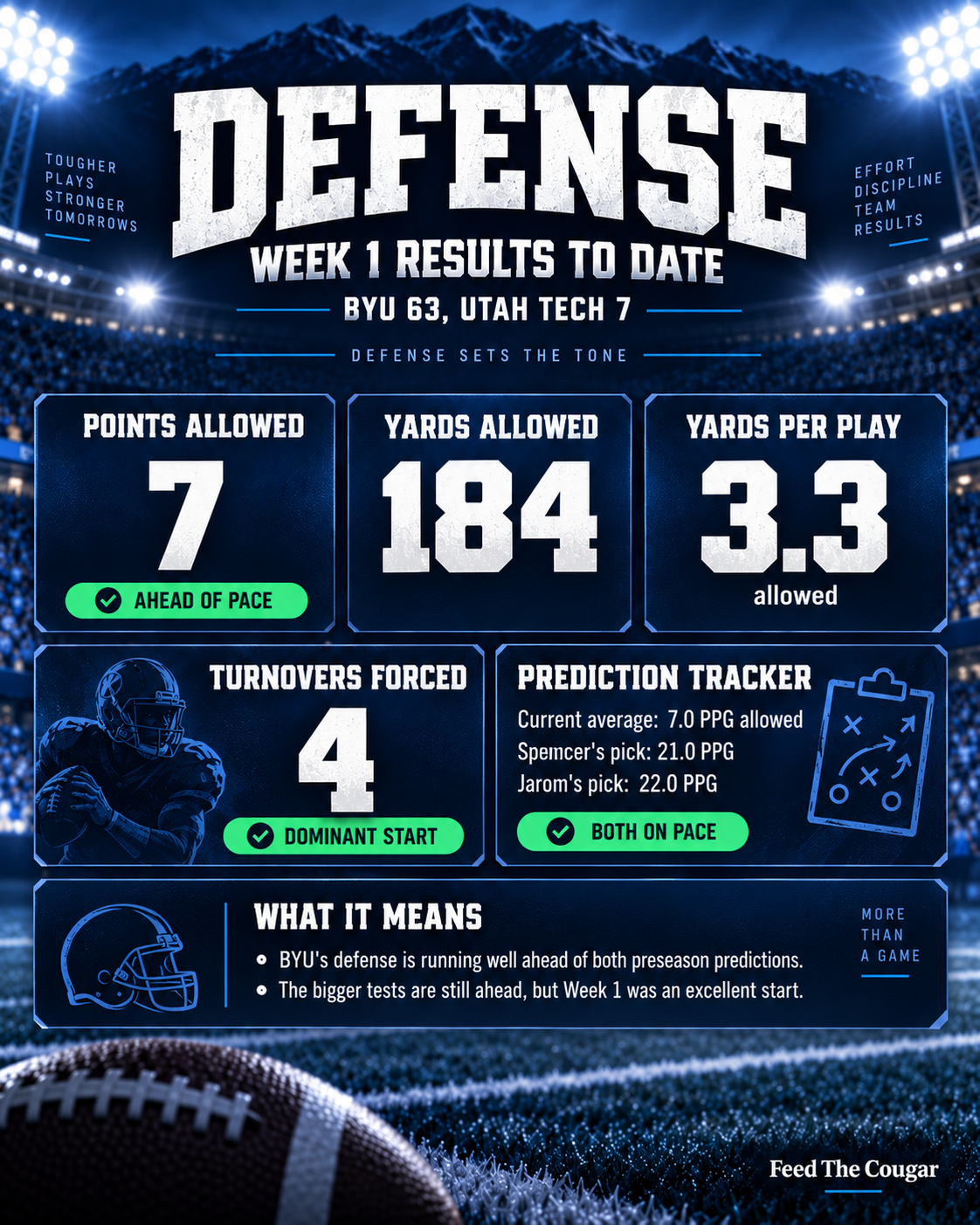
DEFENSE Spencer: BYU Allows 21 Points Per Game Probability: 74% — HIGHLY LIKELY Week 1 result: BYU is allowing 7.0 PPG. Of all the predictions on the board, this remains one of the strongest. BYU opened the season by allowing seven points.
Utah Tech finished with 184 total yards, averaged 3.3 yards per play and committed four turnovers. That is domination. Again, opponent context matters.
Nobody is going to compare Utah Tech’s offense to the attacks BYU will see later in the season. But when a good defense plays an opponent it should overwhelm, it is supposed to overwhelm it. BYU did.
Spencer predicted 21 points per game. After allowing seven in the opener, the Cougars have already built themselves a mathematical cushion. Over a 12-game regular season, a 21-point average would equal 252 total points allowed.
BYU has surrendered seven. That leaves 245 points over the final 11 games, or approximately 22.3 points per game, and BYU would still finish exactly at Spencer’s predicted average. That matters.
⸻ Jarom: BYU Allows 22 Points Per Game Probability: 62% — LIKELY Week 1 result: BYU is allowing 7.0 PPG. Jarom initially agreed with 21 before shifting to 22 simply to avoid matching Spencer exactly. That extra point may eventually matter.
A 22-point season average would allow BYU to surrender 264 points over 12 games. Subtract Utah Tech’s seven, and the Cougars could allow roughly 23.4 points per game over the final 11 and still hit Jarom’s number. In other words, both defensive predictions are currently in excellent shape.
The question is whether BYU can continue producing this kind of efficiency when the opposing quarterbacks become more dangerous and the offensive lines become bigger. Nobody expects seven points every week. They do not need seven.
The hosts gave BYU room to regress from its opener and still hit their predictions. ⸻ What Week 1 Told Us About the Defense The seven points are impressive. The more interesting numbers may be 184 yards and four turnovers.
That combination usually tells you a defense did more than simply stiffen in the red zone. It controlled the game. BYU did not allow Utah Tech to establish sustained possessions. The defense repeatedly gave the offense favorable opportunities, and the score became lopsided quickly.
That is the formula BYU has used during its rise in the Big 12. The Cougars do not need a defense that looks spectacular on every snap. They need one that gets off the field, forces mistakes and prevents touchdowns. One week into 2026, the formula remains intact.
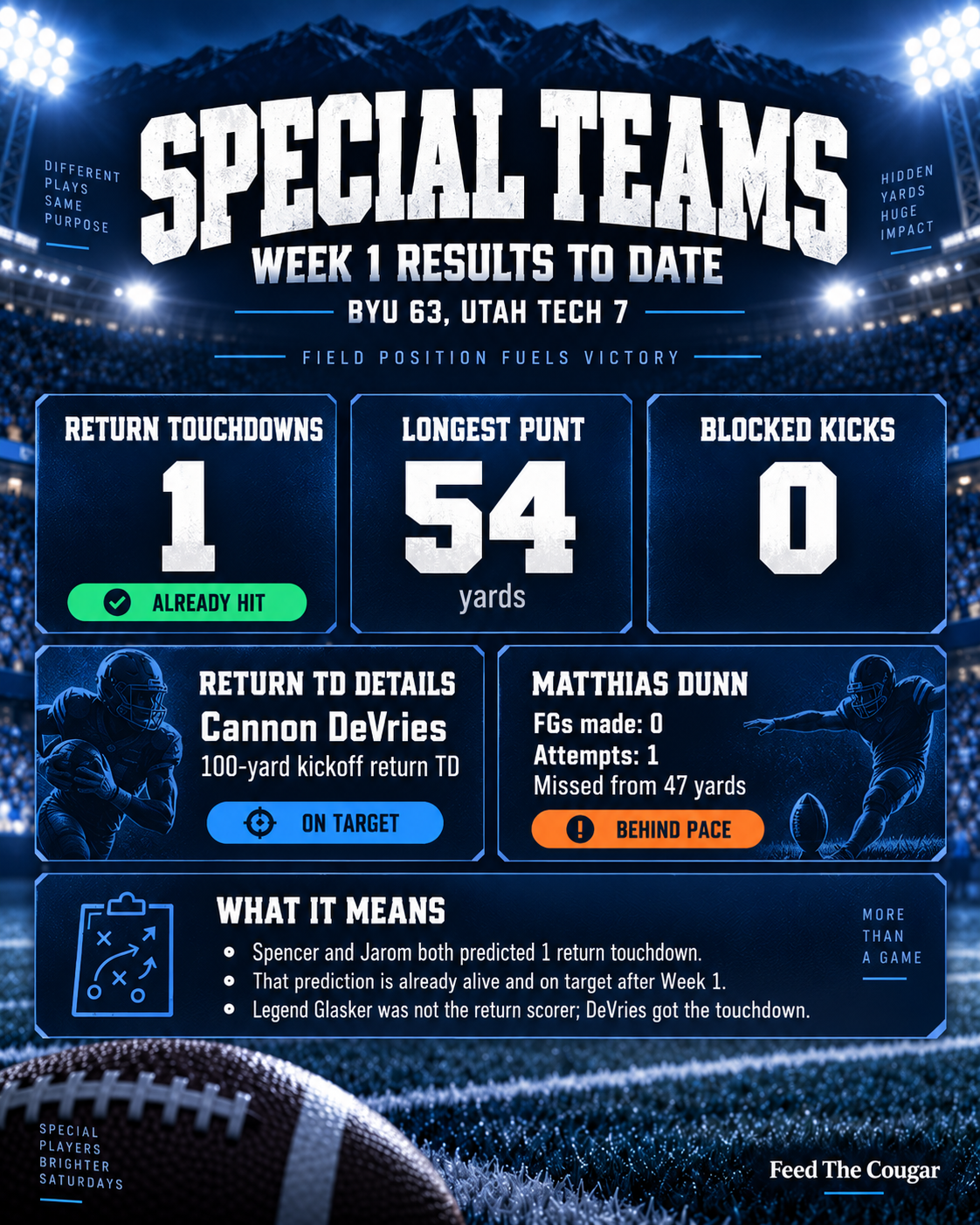
SPECIAL TEAMS This is where the prediction scoreboard became fun almost immediately. Linton and Jordan made five specific special-teams predictions. One almost hit perfectly before the third quarter was one second old.
Another already looks shaky. And the punting predictions have an early number to chase. ⸻ Spencer: Matthias Dunn Makes 17 Field Goals Probability: 61% — LIKELY Week 1 result: 0 made, 1 attempted.
This prediction did not get off to the ideal start. Dunn attempted a 47-yard field goal and missed. That leaves him 0-for-1.
It would be easy to overreact to that number, but the larger problem for Dunn’s field-goal total was not the miss. It was BYU scoring touchdowns. The Cougars crossed the goal line nine times.
Kickers cannot accumulate field goals if the offense continually finishes drives. Spencer’s prediction of 17 makes over 12 regular-season games required an average of 1.42 field goals per game entering the season. With zero in Week 1, Dunn now needs 17 over the final 11 games.
That increases the required average to 1.55 per game. Still very achievable. But Spencer’s prediction has moved slightly behind pace.
⸻ Jarom: Dunn Makes 20 Field Goals Probability: 36% — UNLIKELY Week 1 result: 0 made, 1 attempted. Jarom’s prediction was aggressive before kickoff. It became slightly more aggressive afterward.
Dunn now needs 20 field goals in 11 remaining regular-season games to hit Jarom’s number. That is 1.82 made field goals per game. The problem is not simply whether Dunn can make them.
BYU has to attempt them. An offense that keeps turning scoring opportunities into touchdowns can wreck an otherwise reasonable field-goal projection. Jarom needs volume.
And now he needs a little more of it. ⸻ Spencer: Longest Field Goal Is 52 Yards Probability: 41% — UNLIKELY Week 1 result: Longest attempt was 47 yards, missed. There is no real damage to this prediction yet.
The season is long. One 52-yard opportunity in October could settle it. But the first data point showed that BYU was willing to send Dunn out from 47.
That is useful. The attempt missed, but the coaching staff’s willingness to try it suggests the range is not unrealistic. The next question is whether BYU will trust Dunn when the line of scrimmage pushes an attempt beyond 50.
⸻ Jarom: Longest Field Goal Is 51 Yards Probability: 45% — UNLIKELY Week 1 result: Longest attempt was 47 yards, missed. There is practically no difference between the logic here and Spencer’s 52. Jarom moved down a yard to be different.
He may eventually benefit from that technicality. For now, both predictions remain completely alive. ⸻ Spencer: Longest Punt Is 62 Yards Probability: 58% — LIKELY Week 1 result: 54 yards.
Now we have a benchmark. BYU’s longest punt against Utah Tech traveled 54 yards. Spencer needs eight more.
One good punt with a little room to roll could erase that gap instantly. This is why season-long longest-punt predictions are unusual. You are not predicting consistency.
You are predicting one event. One snap can settle the category. ⸻ Jarom: Longest Punt Is 64 Yards Probability: 55% — LIKELY Week 1 result: 54 yards.
Jarom needs 10 more yards than the current season high. That remains entirely reasonable. A 64-yard punt does not require BYU’s punter to average 50 yards all season. It requires the right field position, a clean strike and perhaps a favorable bounce.
Nothing from Week 1 changes our original evaluation. ⸻ Spencer: BYU Blocks One Kick Probability: 63% — LIKELY Week 1 result: Zero. No movement.
Blocked kicks are too rare to draw conclusions after one game. BYU can go six or seven weeks without one and still hit Spencer’s prediction on a single snap. This remains one of the easiest special-teams predictions on the board because Spencer only needs one.
⸻ Jarom: BYU Blocks Two Kicks Probability: 38% — UNLIKELY Week 1 result: Zero. Jarom doubled Spencer’s number. That sounds minor.
It is not. There is a significant difference between asking a team to produce one rare event and asking it to do it twice. BYU has enough athleticism to get there.
But after one game, Jarom still needs both. ⸻ THE FIRST PREDICTION TO MOVE: BYU SCORES A RETURN TOUCHDOWN Spencer: One return touchdown Jarom: One return touchdown Our probability: 58% — LIKELY Week 1 result: BYU already has one. This is the first prediction that made the tracker worthwhile.
Utah Tech kicked off to begin the second half. Cannon DeVries took it 100 yards for a touchdown. One kickoff.
One touchdown. Exactly the number Linton and Jordan predicted for the entire season. There is a technical point worth keeping in mind.
Their prediction is not officially perfect yet. They predicted one return touchdown. BYU currently has one.
If the Cougars finish the year with exactly one, they nailed the total. If BYU scores a second return touchdown, they will have underestimated it. Either way, the difficult part has already happened.
BYU has produced a return score. ⸻ BOTH PICKED LEGEND GLASKER TO SCORE IT Probability: 24% — HIGHLY UNLIKELY Week 1 result: The first return TD belonged to Cannon DeVries. Here is where the prediction became entertaining.
Linton and Jordan did not merely say BYU would return a kick for a touchdown. They named Legend Glasker. Then Glasker went out and scored three touchdowns against Utah Tech.
He just scored all three of them on offense. DeVries took the kickoff to the house. If the prediction was strictly “BYU will have one return touchdown, and Glasker will score it,” then the combination has already missed because BYU’s first return touchdown came from somebody else.
If they were simply predicting Glasker would score a return touchdown at some point during the season, there is technically still life. But the odds are now even longer. That does not make their evaluation of Glasker foolish.
Quite the opposite. Three touchdowns on four offensive touches was a rather dramatic demonstration of why they chose him in the first place. They saw the explosiveness.
They just put it in the wrong column. ⸻ AFTER ONE WEEK, WHO LOOKS BETTER? It is far too early to declare a winner between Linton and Jordan.
But Spencer owns the slightly more conservative card. His 17 field goals are easier to reach than Jarom’s 20. One blocked kick is considerably easier than two.
His defensive number of 21 points per game looked aggressive before the opener and looks comfortable after BYU allowed seven. Jarom’s No. 10 initial CFP ranking may ultimately prove a little safer than Spencer’s No. 9.
But most of the big predictions are shared. That is the real takeaway. Both hosts believe BYU is an Arlington-level football team.
Both believe BYU will spend November around the top 10. Both believe the Cougars will remain around the playoff line at season’s end. Both believe BYU’s defense will again be one of the program’s strengths.
After one game, nothing significant has happened to disprove any of those central ideas. ⸻ WHAT WEEK 1 ACTUALLY CHANGED Utah Tech was not going to answer the biggest questions about BYU’s 2026 season. It was never supposed to.
But Week 1 did establish the first numbers on the board. BYU is 1-0. The defense is allowing 7.0 points per game.
Matthias Dunn is 0-for-1 on field goals. BYU’s longest punt is 54 yards. The Cougars have zero blocked kicks.
And most notably: BYU already has its first special-teams return touchdown. Cannon DeVries just stole Legend Glasker’s prediction. That is why this scorecard should be worth revisiting every week. Some preseason predictions take three months to settle. Others need exactly one kickoff.
More BYU football originals
 The CFP May Get Bigger. BYU’s Standard Against Notre Dame Shouldn’tRead the original →
 Sione Moa Is Cleared. BYU Still Has to Decide How Much He Can Give Notre DameRead the original →
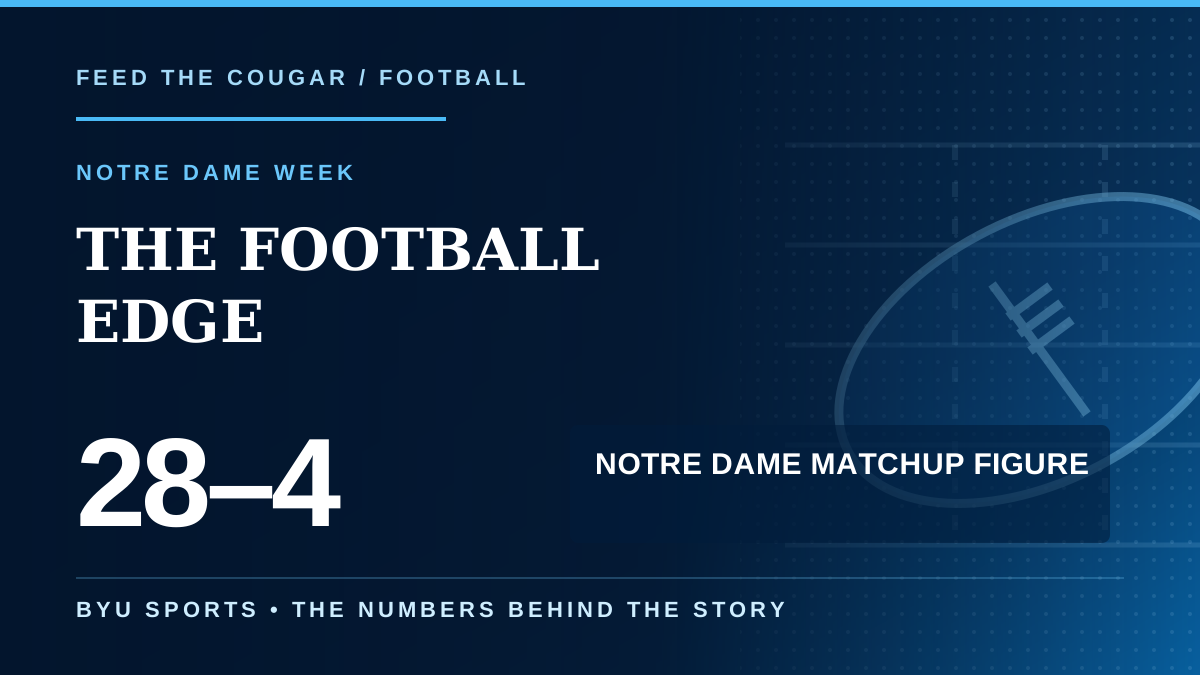 Notre Dame Has 68 Blue-Chips to BYU’s 12. The Records Are Nearly IdenticalRead the original →
Questions about a source, update or correction? Contact the editor. Story updates are reflected in the published timestamp above.