
FEED THE COUGAR ORIGINAL · Football
Do BYU fans have a Persecution Complex?
From Mormon pioneers driven west to anti-LDS chants, conference exclusion, postseason snubs and the continuing debate over 1984, BYU fans have a long history of feeling like outsiders. Maybe the persecution complex is real—but so are some of the reasons behind it.
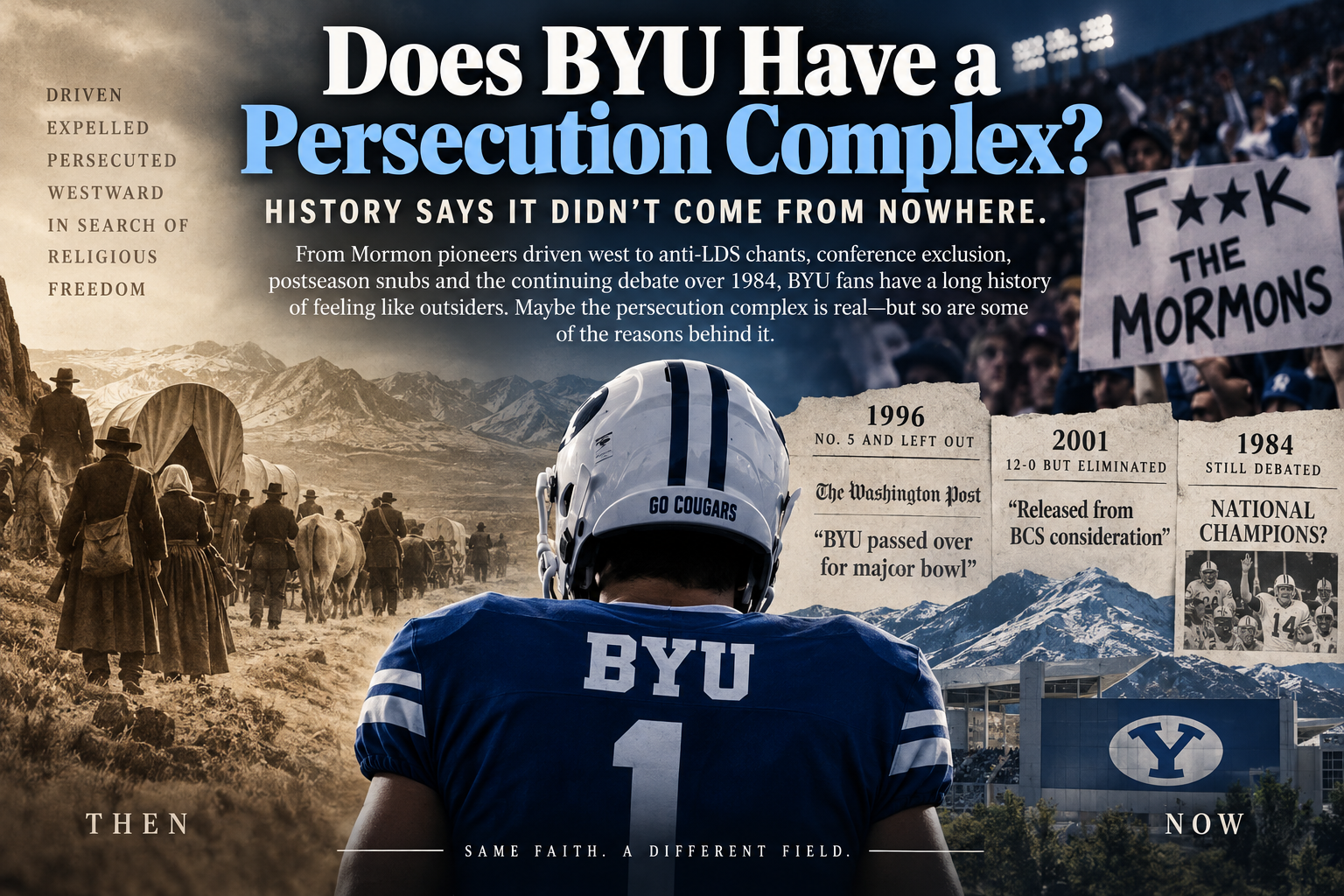
Ben Criddle recently used an interesting phrase to describe a certain segment of BYU fandom: a persecution complex. He’s not entirely wrong. Spend enough time around Cougar fans and you’ll hear the familiar complaints. Officials don’t respect BYU. National media doesn’t respect BYU. Pollsters underrate BYU. The playoff committee moves the goalposts. The major conferences never wanted the Cougars. And, inevitably, somebody brings up 1984.
At some point, it is fair to ask whether BYU fans have been conditioned to see disrespect everywhere. But the more interesting question is this: Where did that conditioning come from? Because BYU’s persecution complex was not invented on a message board. It is rooted in a cultural memory that predates BYU football by nearly a century.
Before There Was BYU, There Was Actual Persecution The history matters, and the word persecution should not be used casually. Latter-day Saints did not come to Utah because somebody thought the Wasatch Front would be a pleasant place to build suburbs. They came west after repeated conflict, expulsion and violence.
The Library of Congress describes the early history plainly: the church moved from New York to Ohio, Missouri and Illinois while facing persecution. After violence drove the Saints from Nauvoo and Joseph and Hyrum Smith were killed, Brigham Young led the migration west. (Library of Congress) Missouri was especially traumatic.
In 1838, Gov. Lilburn Boggs issued the order commonly known as the “Extermination Order,” directing that Latter-day Saints be expelled from the state. Missouri’s official historical materials acknowledge that the order was used to justify violent action against the Mormon population. (Missouri Secretary of State)
The Saints rebuilt in Nauvoo, Illinois. Conflict followed them there. On June 27, 1844, an armed mob stormed Carthage Jail and killed Joseph and Hyrum Smith. Continued threats forced the evacuation of Nauvoo in 1846. (National Park Service) Then came the trek west.
Families crossed Iowa, established Winter Quarters and eventually traveled more than 1,000 miles to the Great Salt Lake Valley. The National Park Service describes the destination as a new home and refuge. More than 700 pioneers died during the winter and spring of 1846-47 from disease, exposure and malnutrition. (National Park Service) The Library of Congress puts the purpose of the migration even more directly: the pioneers went west seeking refuge from religious persecution. (Library of Congress)
None of that makes a missed holding call comparable to an armed mob. But cultural memory does not work that neatly. For generations of Latter-day Saints, Missouri, Nauvoo, Carthage and the pioneer trek were not remote historical footnotes. They were family stories, church lessons, monuments, holidays and identity.
So when the university most closely associated with that faith encounters hostility directed at the religion itself, it lands on unusually sensitive ground. And sometimes the hostility is not imagined. Seven Incidents Are Not a Feeling
Since 2021, at least seven BYU road games in football or men’s basketball have produced reports of profane anti-Mormon chants followed by an apology, acknowledgment or disciplinary response from the host school or conference: USC in 2021. Oregon in 2022. Providence in 2024.
Arizona in 2025. Colorado in 2025. Cincinnati in 2025.
Oklahoma State in 2026. USC apologized after an anti-LDS chant at a 2021 football game. Oregon apologized after its student section was recorded chanting “F— the Mormons” in 2022. (USC Annenberg Media)
Providence apologized after a similar chant during a 2024 basketball game. Arizona followed after its student section used the chant during BYU’s 96-95 victory in Tucson in February 2025. (The Cougar Chronicle) The Big 12 later fined Colorado $50,000 after its fans used the chant during BYU’s 2025 football victory in Boulder. (ESPN)
When it happened again at Oklahoma State in February 2026, the conference imposed another $50,000 fine. The Associated Press identified Oklahoma State as at least the fourth such incident involving BYU in roughly a year, following Arizona, Colorado and Cincinnati. (Associated Press) The point is not that every hostile chant represents institutional persecution. Student sections are often crude, and college sports has never lacked for bad behavior.
The point is that this is a documented pattern: At least seven incidents since 2021. Five from December 2024 through February 2026. At least $100,000 in Big 12 fines.
That is not a grievance invented by BYU fans. It happened. College Football Added Its Own Evidence The sensitivity is not only religious. BYU has also spent decades outside college football’s power structure.
Consider 1996. BYU went 13-1 and finished No. 5 in the country. Yet it was excluded from the Bowl Alliance’s Orange, Sugar and Fiesta bowls while lower-ranked teams from favored conferences received invitations.
The disparity was significant enough to appear in the Congressional Record, which contrasted BYU’s record and ranking with selections such as 8-5, No. 20 Texas; 11-2, No. 7 Penn State; 10-2, No. 13 Virginia Tech; and 11-2, No. 6 Nebraska. (GovInfo)
The financial difference was substantial. The Washington Post reported that the Cotton Bowl paid BYU about $2 million, while Alliance bowls paid approximately $8.5 million per team. The exclusion cost roughly $6.5 million. (The Washington Post)
BYU then beat No. 14 Kansas State and finished 14-1 and No. 5. If you are looking for the beginning of BYU’s modern outsider narrative, 1996 is a reasonable place to start.
In 2001, BYU Was Eliminated Before It Lost Five years later, BYU was 12-0. The Cougars were the nation’s only undefeated team and still had one regular-season game remaining at Hawaii. Then the BCS announced that BYU had been “released” from consideration for one of its major bowls.
BYU eventually lost to Hawaii, which ended the undefeated argument. But the sequence still mattered. A 12-0 team was told, before its season was complete, that winning the next game would not be enough to reach the BCS. (BYU Cougars) For fans who had already watched a 13-1, No. 5 team get excluded from the Bowl Alliance, the message was unmistakable:
The system had rules, and BYU was not writing them. Even 1984 Is Still a Fight Then there is 1984. BYU went 13-0 and finished No. 1 in both the Associated Press and coaches polls. It was recognized as national champion by the AP, UPI/coaches, the Football Writers Association of America and the National Football Foundation. Historical records list BYU as the consensus national champion. (Sports Reference)
The résumé can be criticized. BYU’s schedule was weak by championship standards, and Michigan was only 6-5 when the Cougars faced the Wolverines in the Holiday Bowl. That is a legitimate argument.
But saying BYU was not the national champion ignores how college football determined its champion in 1984. There was no playoff. There was no single governing championship game. The major polls and recognized selectors chose BYU. Even the final AP vote shows how narrow the margin was:
BYU — 38 first-place votes, 1,160 points Washington — 16 first-place votes, 1,140 points Florida — 6 first-place votes, 1,092 points BYU won by 20 points. Twenty-two of the 60 voters—36.7 percent—put another team first. (BYU Cougars)
That is why the argument never dies. BYU fans are not merely defending a trophy. They are defending the legitimacy of the system that awarded it. So Does Criddle Have a Point?
Yes. There is a persecution complex within BYU fandom. Some fans turn ordinary criticism into evidence of bias. A weak schedule can be a weak schedule. A bad ranking does not necessarily mean somebody hates BYU. Officials miss calls. Writers have opinions. Selection committees make mistakes.
And not everyone who criticizes BYU’s church, Honor Code, football team or 1984 schedule is a bigot. BYU fans lose credibility when every criticism is placed in the same category. But the opposite argument is just as lazy.
It is impossible to examine the record and conclude that BYU fans invented their outsider status from nothing. The church connected to BYU was driven from Missouri, attacked in Illinois, lost its founding prophet to mob violence and crossed the continent seeking refuge. The university that emerged from that tradition later spent decades outside college football’s most powerful conferences and postseason structures.
A 13-1, No. 5 BYU team was excluded from the Bowl Alliance. A 12-0 BYU team was removed from BCS consideration before finishing its season.
BYU’s national championship remains routinely dismissed even though it was awarded by both major polls and multiple recognized selectors. And in recent years, opposing student sections have repeatedly shifted from taunting BYU’s team to attacking its religion. None of that proves every slight is persecution.
It does explain why BYU fans are alert to it. So perhaps Criddle is right. Cougar fans do have a persecution complex.
But that complex did not appear out of thin air. It was built from historical memory, institutional exclusion and a series of very real incidents. The fair conclusion is not that BYU is always persecuted.
It is that BYU fans have learned, sometimes correctly and sometimes not, to expect the institution to be treated as an outsider. That expectation can distort judgment. It can also reflect experience.
Before dismissing the complex as paranoia, college sports should acknowledge the harder truth: BYU fans did not invent the feeling of being unwelcome. They inherited part of it—and college sports has supplied enough evidence to keep it alive.
More BYU football originals
 The CFP May Get Bigger. BYU’s Standard Against Notre Dame Shouldn’tRead the original →
 Sione Moa Is Cleared. BYU Still Has to Decide How Much He Can Give Notre DameRead the original →
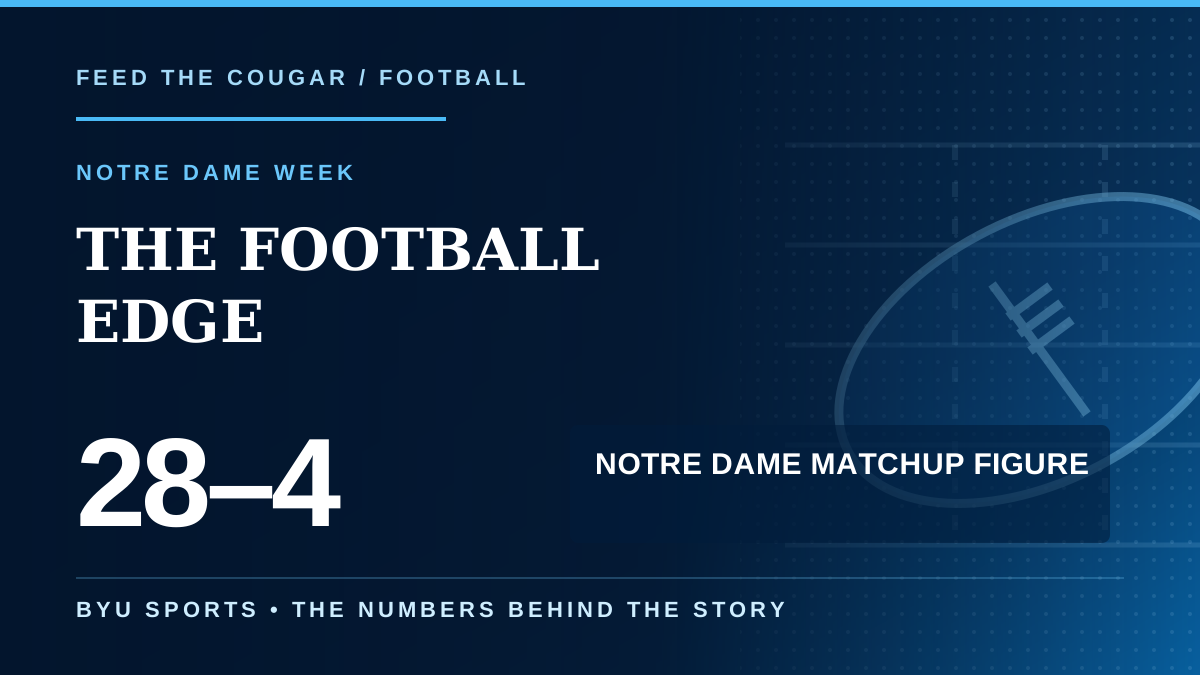 Notre Dame Has 68 Blue-Chips to BYU’s 12. The Records Are Nearly IdenticalRead the original →
Questions about a source, update or correction? Contact the editor. Story updates are reflected in the published timestamp above.