
FEED THE COUGAR ORIGINAL · Football
Five Numbers That Will Decide BYU vs. Iowa State
Five matchup numbers explain why BYU is favored, why Iowa State is dangerous and what will decide Friday night.
Prepared with AI assistance. Feed the Cougar is responsible for sources and corrections. How our daily articles work →
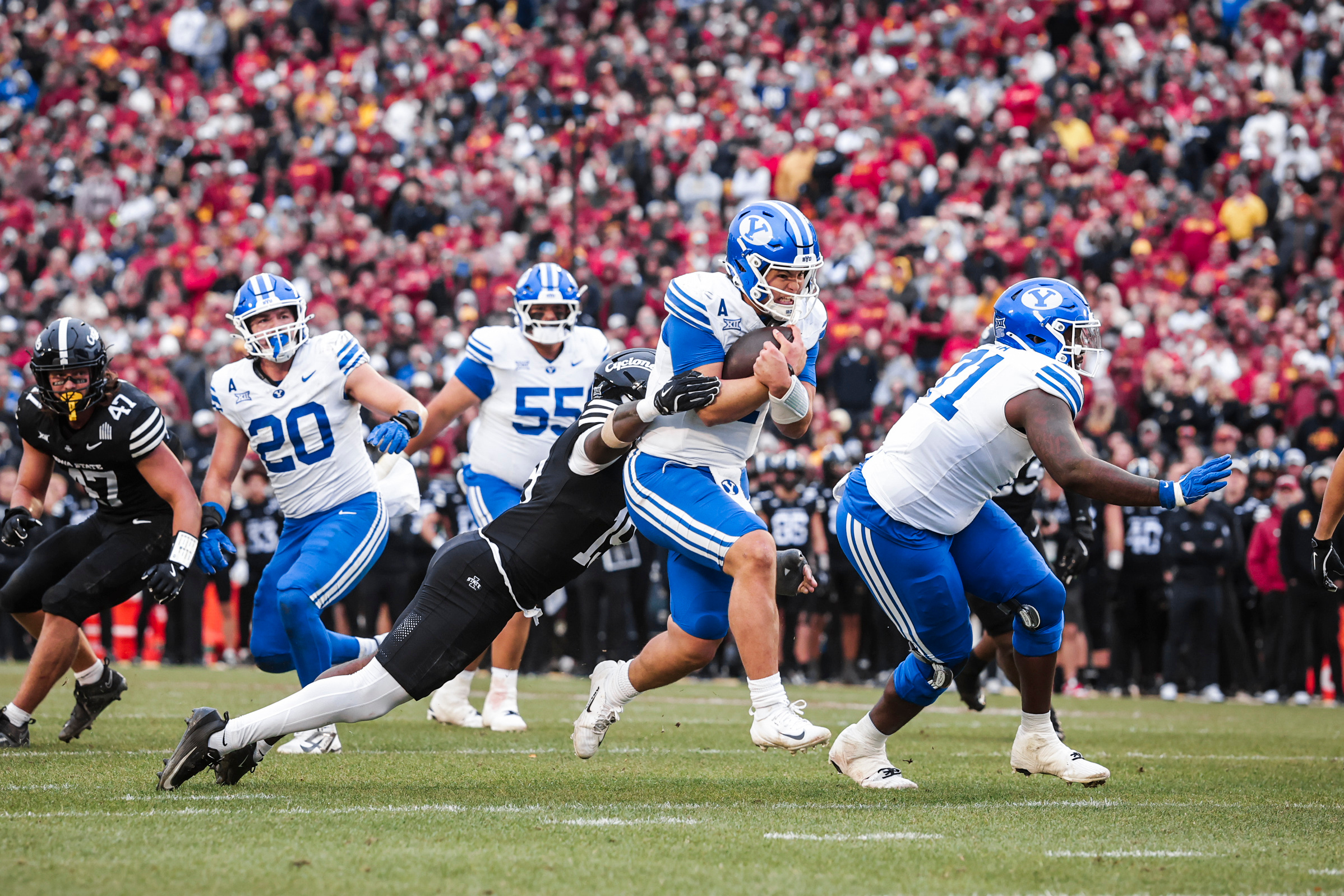
Five Numbers That Will Decide BYU vs. Iowa State
BYU converts 57.4% of its third downs. Aiden Flora averages 8.1 yards per carry. BYU allows just 2.73. Those numbers tell us considerably more about Friday night than the teams’ 4–0 and 3–2 records.
BYU enters the matchup as the more consistent team, while Iowa State has shown a much higher offensive ceiling than its record suggests. The clearest way to understand the matchup is through five numbers that point directly to where the game could swing.
1. BYU on third down: 57.4%
BYU has converted 27 of 47 third downs this season, giving the Cougars one of the strongest conversion rates in the country. Iowa State’s defense has allowed opponents to convert only 20 of 66 attempts, or 30.3%, which makes this one of the most important strength-on-strength matchups of the game.
The key for BYU will be avoiding third-and-long. Bear Bachmeier has been effective when the Cougars stay on schedule, but Iowa State’s defense becomes much more difficult when it can anticipate the pass. If BYU repeatedly reaches third-and-3 or third-and-4, its 57.4% conversion rate should translate into sustained drives. False starts, sacks and negative runs would give Iowa State exactly the situations it wants.
2. Flora averages 8.1 yards per carry. BYU allows 2.73.
No statistical matchup is cleaner than this one.
Aiden Flora has rushed for 594 yards and is averaging 8.1 yards per carry. BYU, meanwhile, has allowed only 300 rushing yards through four games and just 2.73 yards per attempt. Flora has almost twice as many rushing yards by himself as BYU has surrendered to every opponent combined.
His 212-yard, three-touchdown performance against West Virginia showed how quickly Iowa State can change a game when Flora reaches the second level. BYU does not necessarily need to hold him below four yards per carry, but it has to prevent the kind of run that turns an ordinary drive into an immediate touchdown.
3. Flora has 17 runs of 10+ yards. BYU has allowed 10.
This may be the most revealing statistic of the entire matchup.
Flora has already produced 17 runs of at least 10 yards, including touchdown runs of 42, 61 and 63 yards. BYU has allowed only 10 runs of 10 or more yards all season, just two of 20-plus, and no run longer than 25 yards.
That means BYU’s success against Flora should not be judged only by his final rushing total. If he finishes with 90 yards on 20 carries without breaking a long touchdown, the Cougars will probably be comfortable with the result. If two of his carries go for 40 or 50 yards, Iowa State can change the game without ever putting together a long drive.
BYU’s linebackers and safeties have to make the first missed tackle expensive for Flora rather than catastrophic for the defense. The first defender needs to force him to commit to a lane, and the second has to arrive under control.
4. BYU gained 216 yards at TCU. Iowa State just gained 577.
BYU proved something important in its 17–10 win at TCU: it can win when the offense does not play well. The Cougars finished with only 216 total yards, while Bachmeier’s 66 rushing yards and two touchdowns supplied most of the offense’s biggest moments. The defense held TCU to 259 yards and recorded four sacks.
That formula worked in Fort Worth, but relying on it again would be dangerous. Iowa State produced 577 total yards against West Virginia, with 265 on the ground and 312 through the air. Another 216-yard performance from BYU’s offense would require the defense to be nearly perfect.
The Cougars do not need 500 yards Friday night, but they probably need more offensive margin than they had against TCU. Sustained drives would also keep Flora on the sideline and prevent Iowa State from building rhythm.
5. BYU allows 1.85 yards per carry after halftime
BYU’s run defense has become even more difficult as games progress. Opponents are averaging just 1.85 yards per carry after halftime, and that number drops to 1.48 in the fourth quarter.
That matters against an Iowa State offense built around a running back capable of wearing down a defense and creating explosive plays. If Flora is still averaging six or seven yards per carry in the third quarter, the Cyclones will be able to control the playbook and stay out of obvious passing situations. If BYU gradually forces those gains down to two and three yards, Iowa State’s 34.5% third-down conversion rate becomes much more important.
The contrast is especially interesting because BYU has shown it can close games defensively. Iowa State’s best chance may be to create its explosive plays before the Cougars’ front settles into the game.
The prediction
These five numbers point toward a competitive game, but they also explain why BYU should have the advantage. The Cougars have been better on third down, significantly better against the run and more consistent from week to week. Iowa State’s path is more explosive: break a Flora run, create a short field and force BYU to play from behind.
My FTC prediction is BYU 31, Iowa State 23.
Iowa State should create at least one big play, and Flora is too dangerous to expect BYU to completely shut him down. The difference should be BYU’s ability to sustain more drives and force Iowa State to earn its rushing yards in smaller pieces. If Flora is repeatedly facing a second defender after four or five yards instead of running into open field, the Cougars should eventually control the game.
The statistic I would watch most closely is not Flora’s final yardage total. It is the number of times he reaches 10 yards. BYU has allowed only 10 such runs all season. If the Cougars keep that number low Friday night, they will probably leave LaVell Edwards Stadium 5–0.
More BYU football originals
 The CFP May Get Bigger. BYU’s Standard Against Notre Dame Shouldn’tRead the original →
 Sione Moa Is Cleared. BYU Still Has to Decide How Much He Can Give Notre DameRead the original →
 Notre Dame Has 68 Blue-Chips to BYU’s 12. The Records Are Nearly IdenticalRead the original →
Questions about a source, update or correction? Contact the editor. Story updates are reflected in the published timestamp above.