
FEED THE COUGAR ORIGINAL · Basketball
How Tough Is BYU Basketball’s Nonconference Schedule? Projecting the Cougars’ Record, NET and Quad Opportunities
BYU basketball’s 2026–27 nonconference schedule offers a strong mix of résumé-building opportunities and winnable games. We break down the projected NET rankings, Quad 1 and Quad 2 chances, toughest matchups and why a 12–2 start is a realistic target for the Cougars.
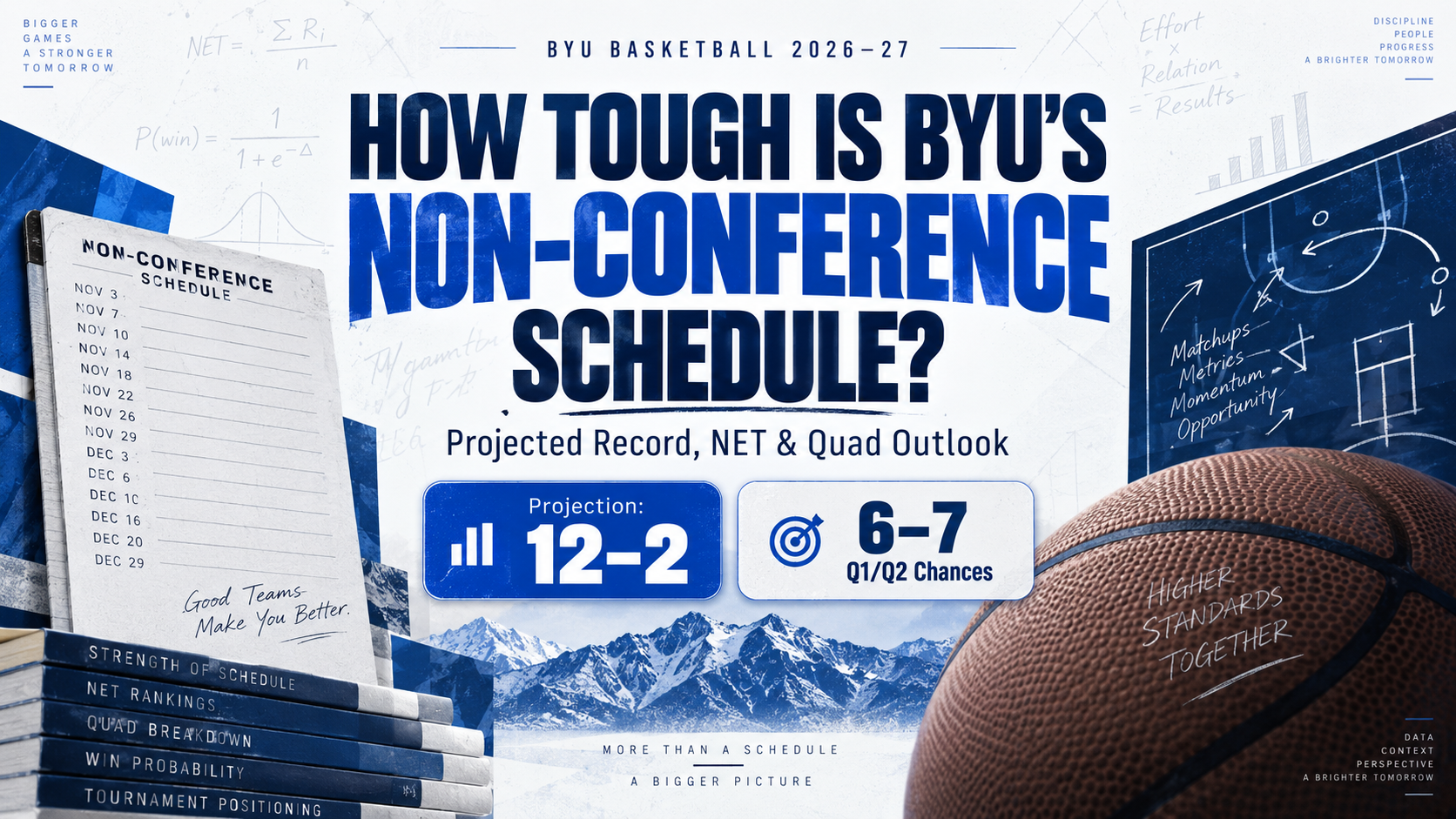
BYU basketball did not build the kind of nonconference schedule that looks terrifying from top to bottom. It may have built something better. The Cougars will play 14 nonconference games in 2026-27: eight inside the Marriott Center and six at neutral sites, with no true road games before Big 12 play. Those six neutral-site games include Ohio State and Northwestern at the Delta Center, three games at the Maui Invitational and San Diego State in Palm Springs.
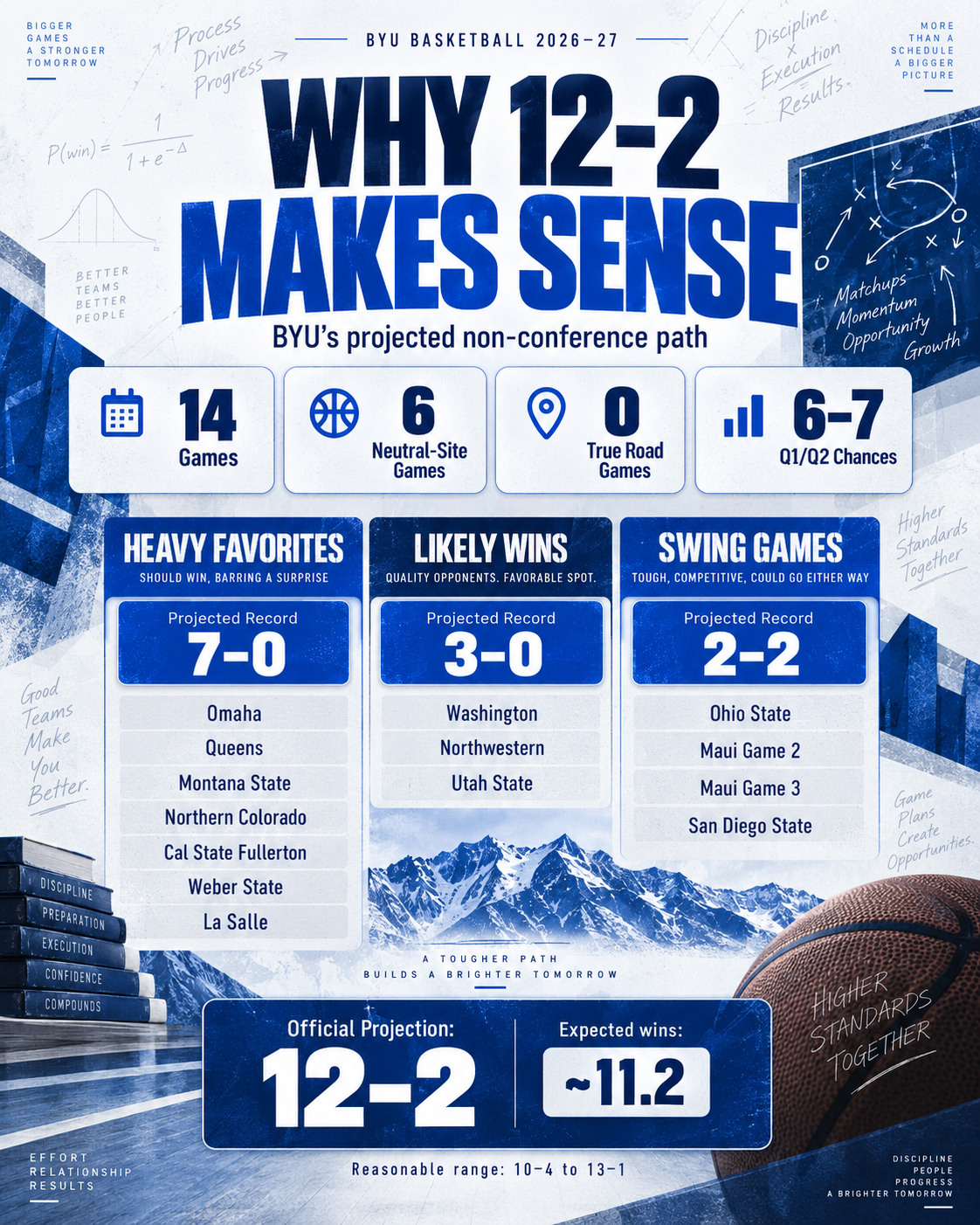
That structure gives Kevin Young's team two very different kinds of games. There is a group BYU should win comfortably — Omaha, Queens, Montana State, Northern Colorado, Cal State Fullerton, Weber State and La Salle. Then there is the résumé-building portion: Ohio State, Washington, two additional Maui opponents, Northwestern, Utah State and San Diego State.
The result is a schedule that could produce six or seven Quad 1 or Quad 2 opportunities without forcing BYU to play a single true road game. That is about as favorable a nonconference résumé-building setup as a team could reasonably ask for. And based on the numbers, 11-3 looks like the statistical center of the projection, while 12-2 is very realistic.
First, a word about projected NET rankings
There is no official 2026-27 NET ranking yet. The NCAA generally does not begin releasing NET rankings until the season is underway, so every NET number below is a projection rather than an official ranking. The NCAA quadrant system remains based on opponent NET and game location:
Quad 1: home 1-30, neutral 1-50, road 1-75 Quad 2: home 31-75, neutral 51-100, road 76-135 Quad 3: home 76-160, neutral 101-200, road 136-240 Quad 4: home 161+, neutral 201+ and road 241+. For these projections, we are combining last season's final NET, current preseason computer expectations, returning personnel and normal year-to-year movement. That means the exact quadrant of several games could change dramatically by March. But we can already see where the schedule is headed.
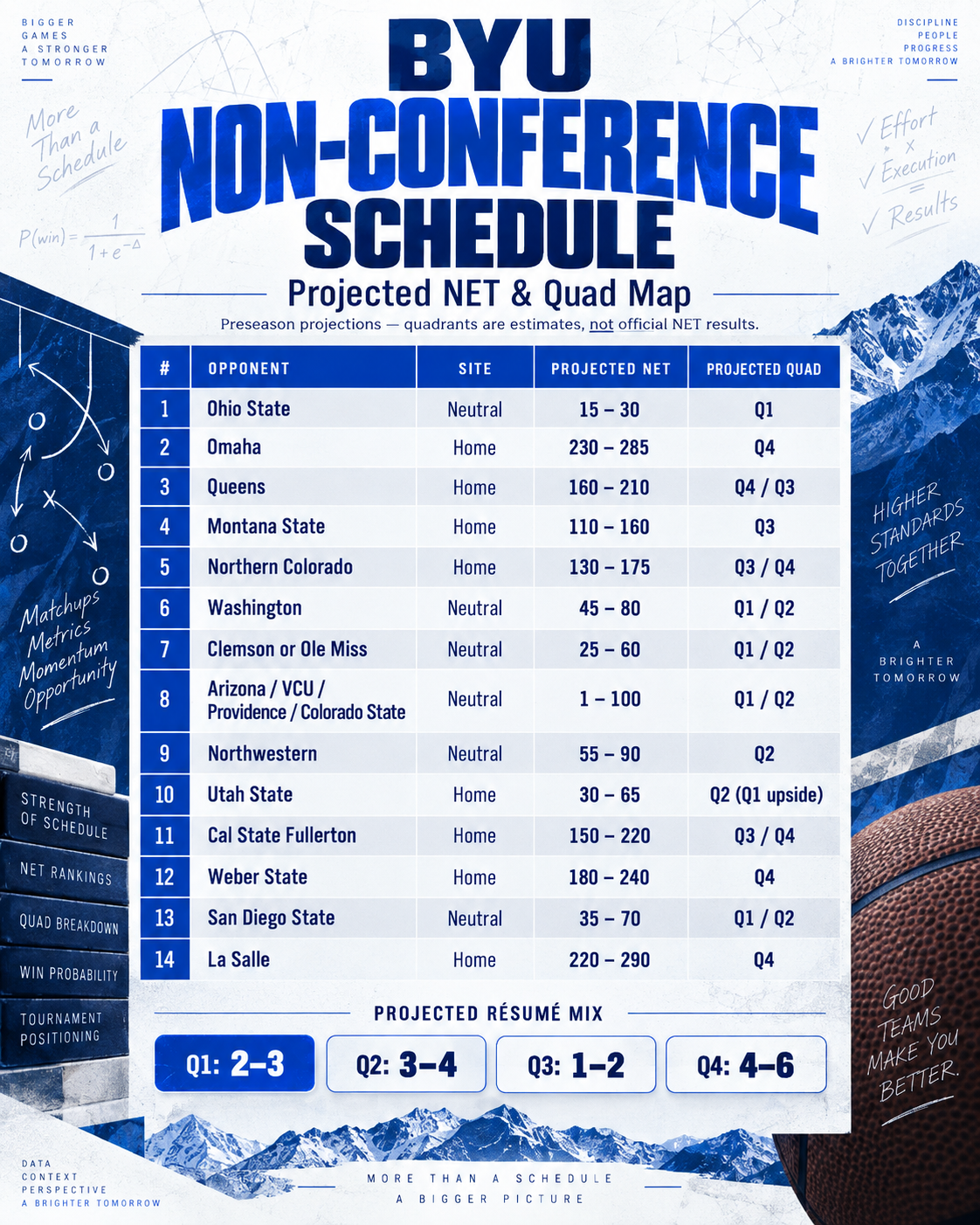
November 2: Ohio State — Delta Center
Projected NET: 15-30 Projected Quad: Q1 BYU win probability: 55-60% There isn't much of a warmup. Ohio State finished last season No. 29 in the NET, then climbed as high as No. 16 in Bart Torvik's August preseason projection.
That makes this one of BYU's most valuable nonconference games. If Ohio State finishes inside the top 50, which appears likely, a neutral-site victory is Quad 1. If the Buckeyes live up to Torvik's current top-20 expectation, this could become one of BYU's best résumé wins all season.
BYU gets one major advantage: the game may technically be neutral, but the Delta Center is going to feel a lot closer to a BYU home game than an Ohio State home game. Projection: BYU win, but narrowly.
Omaha — November 6
Projected NET: 230-285 Projected Quad: Q4 Win probability: 97%
Omaha finished around No. 258 in last year's NET, putting this firmly into buy-game territory. This game matters less for résumé value than for efficiency.
Against opponents in this range, merely winning isn't enough to impress predictive metrics. BYU wants to control the game, defend efficiently and avoid an ugly close result. Projection: BYU win.
Queens — November 10
Projected NET: 160-210 Projected Quad: Q4, with Q3 upside Win probability: 94% Queens is more interesting than the name suggests. The Royals won 20 games last season and finished around No. 189 in the NET. If Queens improves into the top 160, this becomes a Q3 game rather than Q4. Either way, BYU should be heavily favored. Projection: BYU win.
Montana State — November 12
Projected NET: 110-160 Projected Quad: Q3 Win probability: 92-94% This is probably the best of BYU's lower-major home games. Montana State finished No. 128 in the NET last season and went 12-6 in Big Sky play. That puts the Bobcats directly inside the home-game Q3 window. It isn't a résumé builder, but it also shouldn't be a résumé drag. Projection: BYU win.
Northern Colorado — November 18
Projected NET: 130-175 Projected Quad: Q3/Q4 borderline Win probability: 91-93% Northern Colorado finished No. 149 in the NET last year while going 17-12. If the Bears remain inside the top 160, this stays Q3.
The larger point is that BYU's supposed “easy” games are not all 300-level NET opponents. Montana State and Northern Colorado have a reasonable chance to finish in the middle third of Division I. That helps the overall strength of schedule. Projection: BYU win.
# Maui Is Where the Schedule Changes
BYU's season could look very different after three days in Lahaina. The Cougars open against Washington, then meet Clemson or Ole Miss, followed by someone from a group containing Arizona, VCU, Providence and Colorado State. Four teams in the Maui field made the 2026 NCAA Tournament. This isn't just a tournament. It is BYU's biggest opportunity to change its March résumé before conference play.
Maui Game 1: Washington
Projected NET: 45-80 Projected Quad: Q1/Q2 borderline Win probability: 65-70% Washington finished around the NCAA bubble neighborhood last season and plays in a league capable of pushing its NET upward simply through schedule strength. If Washington finishes 50th or better, this becomes a neutral-site Q1 game. At 51-100, it's Q2. Either way, it is useful. Projection: BYU win.
Maui Game 2: Clemson or Ole Miss
Projected NET: 25-60 Projected Quad: Q1 or Q2 Win probability: approximately 55-60% Clemson finished last season No. 34 in NET, and early national bracket projections continue to view both Clemson and Ole Miss as potential NCAA Tournament teams. This is where Maui becomes difficult.
BYU isn't playing a team it should overwhelm. It is playing another NCAA-level roster with one day of preparation. This game is essentially a toss-up.
Maui Game 3: Arizona, VCU, Providence or Colorado State
Projected NET: anywhere from 1-100 Projected Quad: likely Q1 or Q2 Arizona is the monster lurking on the other side of the bracket. The Wildcats have consistently appeared around the top five nationally in preseason computer projections.
VCU finished last season No. 43 in the NET and is already appearing in preseason NCAA Tournament projections. Providence finished No. 80 but has the type of high-major schedule that can improve that ranking significantly. Colorado State has generally projected closer to the Q2 range. There is a huge difference between drawing Arizona in the championship game and Colorado State in a consolation game. The most reasonable forecast is for BYU to leave Maui 2-1. A 3-0 trip would immediately change the national perception of this team.
Northwestern — December 5, Delta Center
Projected NET: 55-90 Projected Quad: Q2 Win probability: 70-75% Northwestern finished last season only 15-19, but its No. 65 NET was much stronger than the record suggests because of the Big Ten schedule. Its predictive metrics also remained around the top 60.
It is exactly the type of opponent BYU wants. It is a game BYU should win in Salt Lake City, while Northwestern has enough schedule strength to potentially remain a Q2 opponent. Projection: BYU win.
Utah State — December 9
Projected NET: 30-65 Projected Quad: Q2, with Q1 potential Win probability: 70-75% Do not dismiss this one as simply another home game. Utah State finished last year No. 26 in NET at 28-7.
The Aggies have undergone changes, which is why their preseason projections vary considerably, but their program has consistently produced efficient basketball teams. If Utah State finishes inside the top 30 again, this becomes a Q1 opportunity inside the Marriott Center. Even if the Aggies slide into the 30s, 40s or 50s, it remains a valuable Q2 game. Projection: BYU win, but this is one of the most dangerous home games.
Cal State Fullerton — December 12
Projected NET: 150-220 Projected Quad: Q3/Q4 Win probability: 95% Fullerton finished No. 177 last season. Anything near that number makes this Q4 in Provo. Projection: BYU win.
Weber State — December 15
Projected NET: 180-240 Projected Quad: Q4 Win probability: 96% Weber finished No. 202 in NET and ranked similarly in most of the major predictive metrics. BYU should control this game. Projection: BYU win.
San Diego State — December 19, Palm Springs
Projected NET: 35-70 Projected Quad: Q1/Q2 Win probability: 60-65% This may quietly be one of the most important games on the schedule. San Diego State finished last season No. 47 in NET, while early Torvik projections have generally placed the Aztecs somewhere inside the top 100.
At a neutral site, No. 50 or better equals Q1. No. 51-100 equals Q2.
So unless San Diego State badly underperforms, this should remain a résumé-positive opportunity. It also comes immediately before Christmas, after BYU has already played Maui, Northwestern and Utah State. That is a legitimate trap. Projection: BYU win — barely.
La Salle — December 22
Projected NET: 220-290 Projected Quad: Q4 Win probability: 97-98% La Salle finished around No. 245 last season. BYU should enter Christmas with a comfortable win.
# So How Tough Is This Schedule?
The answer depends on what we mean by tough. It isn't overwhelmingly difficult because BYU has zero true road games. It also contains seven games in which the Cougars should have somewhere around a 90% or better chance of winning.
But résumé difficulty is different. Depending on how Maui unfolds and where the opponents finish in NET, BYU could reasonably end nonconference play with: 2-3 Quad 1 games 3-5 additional Quad 2 games 1-2 Quad 3 games 4-6 Quad 4 games That means roughly six or seven of 14 nonconference games could ultimately fall in Q1 or Q2.
That is a healthy NCAA Tournament schedule. BYU's own recent history suggests it can take advantage of it. The Cougars finished last season No. 23 in NET, went 23-12 overall and were particularly good on neutral courts, finishing 8-3.
And although AJ Dybantsa and Richie Saunders are gone, BYU isn't entering this schedule without an established centerpiece. Robert Wright III returns after averaging 18.1 points and 4.6 assists while shooting 46.7% from the floor, 41.0% from three and 82.1% from the line. He was named a preseason first-team All-American by Blue Ribbon. That gives BYU something rebuilt teams desperately need in November: an elite, experienced point guard.
# The Projection: 11-3 to 12-2
If we assign rough win probabilities to every game, BYU projects to approximately 11.2 nonconference victories. That makes 11-3 the mathematical center. But the schedule's construction gives BYU a very realistic path to 12-2.
Seven games should heavily favor the Cougars. Washington, Northwestern and Utah State are games BYU should also be favored to win. Then BYU essentially needs to split the remaining group of Ohio State, Maui's final two games and San Diego State. My prediction:
BYU finishes nonconference play 12-2. The most likely losses come somewhere in Maui and in one of the Ohio State/San Diego State-type neutral games. A 10-4 record would feel disappointing. An 11-3 record would be perfectly respectable.
At 12-2, BYU would likely enter Big 12 play with multiple Q1/Q2 wins and a legitimate top-25 résumé. And if the Cougars somehow go 13-1? Then the conversation changes entirely.
Because this schedule gives BYU enough quality opponents that a dominant November and December would not simply inflate its win total. It would prove the Cougars belong among the best teams in the country.
More basketball originals
 AJ Williams Is Visiting BYU. The Real Pitch Is Already on the FloorRead the original →
 BYU’s 17 National TV Games Reveal the Season’s Real Pressure PointsRead the original →
 Nebraska’s First Exhibition Shows What BYU Must Measure FridayRead the original →
Questions about a source, update or correction? Contact the editor. Story updates are reflected in the published timestamp above.