
FEED THE COUGAR ORIGINAL · Football
LaVell Edwards vs. Kalani Sitake: Two Different Men, One BYU Standard
There is really only one measuring stick for a BYU football coach.
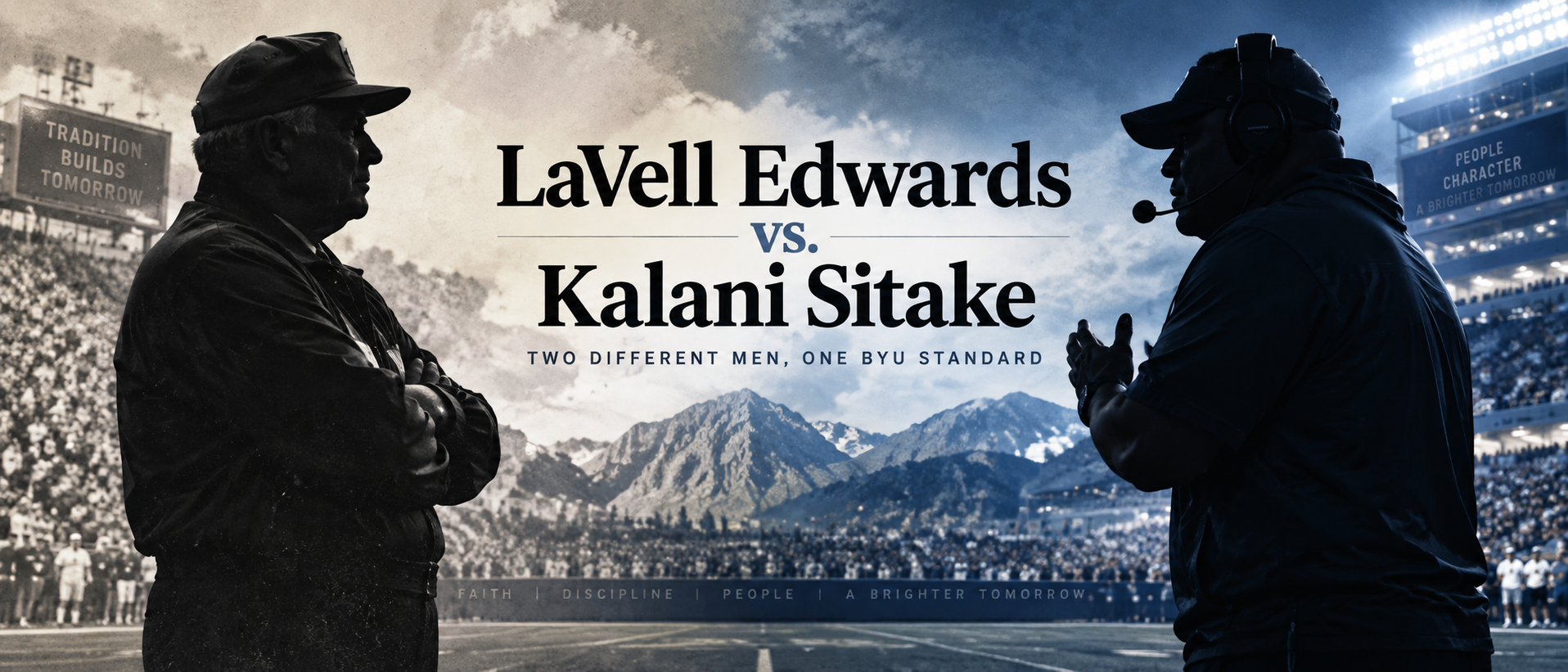
It is not Utah. It is not a bowl game. It is not a ranking in November, a recruiting class in February or even a conference championship. It is LaVell Edwards.
That may not always be fair, particularly when the college football world Edwards coached in bears increasingly little resemblance to the one Kalani Sitake operates in today, but that is how things work in Provo. Edwards did not merely win football games at BYU. He changed what people thought was possible at BYU.
Before Edwards became head coach in 1972, the Cougars had won 173 games in 49 seasons, produced only 14 winning seasons, won one conference championship and had never played in a bowl game. Over the next 29 years, Edwards went 257-101-3, won 19 conference championships, took BYU to 22 bowl games and, of course, won the 1984 national championship. (BYU Cougars) That is the standard.
But after 10 seasons, it is finally reasonable to ask a question that would have sounded premature five or six years ago. How does Kalani Sitake actually compare? The answer is more interesting than either side of the argument might expect.
The career numbers still belong to LaVell Edwards finished his career with a .716 winning percentage. Sitake enters his 11th season at 84-45, a .651 winning percentage. Put another way, Edwards won about 72 of every 100 games he coached, while Sitake has won about 65.
That is not a small difference. Edwards also produced 28 winning seasons in 29 years. Beginning in 1974, BYU went 27 consecutive seasons without a losing record. There were 10 consecutive conference championships from 1976 through 1985 and 17 consecutive bowl appearances from 1978 through 1994. (BYU Cougars)
When people talk about a “winning culture,” that is about as good a statistical definition as can be found. Winning under Edwards eventually stopped being an event. It became the default setting.
Sitake has not reached that level of consistency. His first decade included a 4-9 season in 2017 and a 5-7 season during BYU’s first year in the Big 12 in 2023. Those seasons matter when evaluating the entire résumé. But they also obscure what has happened since 2020.
Over the past six completed seasons, Sitake’s teams are 57-20, a .740 winning percentage. That is actually higher than Edwards’ .716 career percentage. BYU has won at least 10 games four times during that six-year stretch, and its 57 wins rank among the top programs nationally during that period. (BYU Cougars) And then there are the last two years.
BYU went 11-2 in 2024 and 12-2 in 2025. That is a combined record of 23-4, or .852. Only Indiana, Oregon, Ohio State and Notre Dame posted a better winning percentage over those two seasons. (BYU Cougars) That is not LaVell nostalgia.
Those are national-level numbers. The first 10 seasons are surprisingly close in some places A more useful comparison than Edwards’ 29 seasons against Sitake’s 10 is to place their first decades beside each other. Edwards went 86-32-1 from 1972 through 1981, producing a .727 winning percentage.
Sitake went 84-45 from 2016 through 2025, producing a .651 winning percentage. The two-win difference initially jumps off the page. There is an important qualification, however: Edwards accumulated those 86 wins while playing 119 games. Sitake needed 129 games to reach 84 wins. Edwards also lost only 32 times during that first decade compared with Sitake’s 45 losses.
So the winning-percentage advantage is significant. Still, some of the other numbers are remarkable. During his first 10 seasons, Edwards produced three 10-win seasons. Sitake has produced four.
Edwards produced four final AP Top-25 teams during those first 10 seasons, including BYU’s No. 20 finish in 1977. Sitake has also produced four final Top-25 teams in his first decade. (Sports Reference) Edwards had three seasons of at least 11 victories during that span. Sitake also has three.
Edwards had one 12-win season. Sitake has one. There is one enormous separation.
Edwards had already won or shared seven conference championships during his first decade. Sitake has officially won none. That number cannot simply be dismissed because of changing eras. Championships count.
It also requires context. Sitake coached seven of his first 10 seasons as an independent, meaning there was no conference championship available to win. Once BYU joined the Big 12, the Cougars struggled to 5-7 in 2023 before going 15-3 in conference play over the next two seasons, tying for the best league record in both 2024 and 2025 and reaching the Big 12 Championship Game in 2025. (BYU Cougars) In other words, Edwards has the championships. Sitake finally has the conference platform on which he can attempt to win one.
FIRST 10 SEASONS Statistic LaVell Edwards Kalani Sitake Record 86-32-1 84-45 Winning percentage .727 .651 Games coached 119 129 10-win seasons 3 4 11-win seasons 3 3 12-win seasons 1 1 Final AP Top-25 seasons 4 4 Conference-title seasons 7 0 Bowl record 2-4 6-2 The bowl number may be the most surprising statistic on the page.
Sitake owns the bowl comparison Edwards was 7-14-1 in bowls during his career. Sitake is 6-2. That gives Sitake a .750 bowl winning percentage compared with .341 for Edwards.
There is historical context here. Bowl games were different during much of Edwards’ tenure. BYU’s conference affiliation frequently locked the Cougars into predetermined matchups, and Edwards’ WAC champions often received fewer postseason options than comparable nationally ranked programs from more powerful conferences. Still, 6-2 is 6-2.
Sitake’s last two postseason victories have also come against ranked Power Four opponents. BYU beat No. 23 Colorado 36-14 in the 2024 Alamo Bowl and defeated No. 22 Georgia Tech 25-21 in the 2025 Pop-Tarts Bowl. (BYU Cougars) Whatever criticism has been directed at Sitake during his tenure, his teams have generally been ready to play in December.
The competition question changes the comparison One of the biggest mistakes in comparing Edwards and Sitake is pretending the schedules are equivalent. They are not. Edwards dominated the WAC, and that domination should never be discounted. Winning a conference championship once is difficult. Winning 10 consecutive conference championships is absurd.
At the same time, BYU now lives every week in the Power Four ecosystem Edwards spent decades trying to break into from the outside. That makes one Sitake statistic particularly meaningful. BYU reports that Sitake is 37-25 against Power Four, formerly Power Five, opponents. His .597 winning percentage against those programs is the best of any BYU head coach. (BYU Cougars)
The number becomes even more striking when looking at 2025. BYU won 10 games against Power Four opponents, the most in school history. The Cougars had won nine the year before, which had also established a school record.
BYU’s FBS opponents in 2025 finished 102-64, a .614 winning percentage. The Cougars defeated seven opponents that finished with winning records and five teams that won at least nine games. The five victories over nine-win teams established another program record. ESPN’s Football Power Index rated BYU’s 2025 strength of record No. 8 nationally and best in the Big 12. (BYU Cougars) That is the kind of second-level statistic that changes the conversation.
A 12-2 record against that schedule means something different than piling up victories against a weak slate. The peak is getting close to LaVell territory There is another number that deserves more attention. BYU’s 23 victories over 2024 and 2025 constitute the third-best two-season win total in program history.
The only better stretches came under Edwards. BYU won 24 games over 1983-84 and another 24 over 1984-85. (BYU Cougars) Think about what that means.
Sitake’s best two-year run is now one victory behind stretches that literally touch BYU’s national championship season. That does not make 2024-25 equivalent to 1983-84. The 1984 team went undefeated and finished No. 1. The trophy in the Student Athlete Building settles that argument quickly.
But Sitake is no longer being compared statistically with merely good BYU teams. His best teams are beginning to appear on lists populated by Edwards’ best teams. That is a significant development.
Sitake’s BYU is also becoming more complete Edwards’ football revolution was built around offense. In 1980, BYU led the nation in total offense at 535 yards per game, scoring at 46.7 points per game and passing at 409.8 yards per game. Jim McMahon threw for 4,571 yards, and the Cougars finished 12-1. (BYU Cougars)
It was not simply effective. It changed college football. Sitake is not an offensive revolutionary, and nobody should attempt to make him one.
His best teams have instead become increasingly balanced. The 2025 Cougars averaged 31.4 points while allowing 19.1. ESPN’s FPI rated BYU No. 10 nationally in overall efficiency, with the offense No. 17 and defense No. 14.
There have been only 14 seasons in 101 years of BYU football in which the Cougars averaged more than 30 points while surrendering fewer than 20. Three of those seasons have now come under Sitake: 2020, 2024 and 2025. (BYU Cougars) That is a culture statistic as much as it is a football statistic.
BYU is no longer required to score 45 points to prove it belongs on the field with good teams. It can win different ways. Then there is Utah No comparison of BYU coaches is going to escape this one.
Edwards went 22-7 against Utah. Sitake is 3-4. That remains an overwhelming advantage for Edwards.
But Sitake’s rivalry résumé looks considerably different today than it did four years ago. His first four meetings against Utah were all losses. BYU then broke the nine-game rivalry losing streak in 2021 and has won each of the last three meetings played between the schools, including a 22-21 win in Salt Lake City in 2024 and a 24-21 victory over No. 23 Utah in 2025. The three-game streak is BYU’s longest in the series since 1989-92. (BYU Cougars) It is still 22-7 against 3-4.
There is no creative mathematics that closes that gap. But there is also a difference between a coach who could not beat Utah and a coach who has now done it three consecutive times. Sitake has crossed that line.
Their personalities could hardly look more different Watch old footage of Edwards on the sideline and then watch Sitake for about 30 seconds. One stood with his arms folded, seemingly annoyed that someone had interrupted his Saturday afternoon. The other sometimes appears ready to hug an official.
Edwards was famously stoic, understated and armed with a dry sense of humor that players and coaches understood much better than television audiences did. BYU itself describes him as having a “stoic sideline demeanor and quick-witted humor.” (BYU Cougars)
Sitake is emotional, expressive and almost relentlessly enthusiastic. His program talks openly about love, learning, humility, toughness, accountability and being “humble and hungry.” (BYU Cougars) The personalities could not be more different.
The coaching philosophy underneath them might be remarkably similar. Former BYU assistant Ed Lamb, who observed both, once described Edwards and Sitake as “people first,” noting that both were more likely to begin by asking players about their families, academics and well-being than by immediately correcting a football mistake. (BYU Cougars)
That description fits Edwards’ own explanation of his career. He once said that football was ultimately about his relationships with players and what they did with their lives. (BYU Cougars) Sitake has said much the same thing in a louder voice.
That may be the most important connection between the two coaches. Sitake has never really tried to become LaVell Edwards. He has tried to preserve what Edwards believed BYU football should feel like.
So who built the better winning culture? Today, that answer remains Edwards. It is not particularly close when the entire résumé is considered.
There is a national championship. There are 19 conference championships. There is a .716 career winning percentage. There are 28 winning seasons in 29 years, 27 consecutive non-losing seasons and a 22-7 record against Utah. There is also something that cannot be expressed neatly on a spreadsheet.
Edwards built the thing Sitake inherited. Before LaVell, BYU was not a national football brand. Edwards made it one.
Sitake cannot duplicate that accomplishment because there is no longer a BYU football program waiting to be invented. His job has been different. BYU wandered through independence, watched the college football financial divide grow larger and finally received an invitation into the Big 12. Sitake’s assignment has been to prove that the football identity Edwards created can survive inside modern Power Four football.
The first Big 12 season suggested there was considerable work to do. The next two seasons changed the conversation. BYU is 23-4 over its last 27 games. It has gone 15-3 in Big 12 play over the last two seasons. It has tied for the best conference record twice. It has played for a Big 12 championship. It has beaten Utah three consecutive times. It has won consecutive bowls against ranked Power Four opponents. It owns 19 Power Four victories over the past two seasons alone.
And BYU’s 2025 team finished 12-2 and No. 11 in the country. (BYU Cougars) Those aren’t statistics showing that Kalani Sitake has become LaVell Edwards.
They show something more reasonable, and perhaps more important. For the first time in a long time, BYU football is beginning to operate with an expectation Edwards established decades ago. Good seasons are enjoyable.
Ten-win seasons are impressive. But the real sign of a winning culture comes when players, coaches and fans stop being surprised by them. LaVell Edwards spent 29 years teaching BYU that lesson. After 10 years on the job, Kalani Sitake may finally have his program believing it again.
More BYU football originals
 The CFP May Get Bigger. BYU’s Standard Against Notre Dame Shouldn’tRead the original →
 Sione Moa Is Cleared. BYU Still Has to Decide How Much He Can Give Notre DameRead the original →
 Notre Dame Has 68 Blue-Chips to BYU’s 12. The Records Are Nearly IdenticalRead the original →
Questions about a source, update or correction? Contact the editor. Story updates are reflected in the published timestamp above.