
FEED THE COUGAR ORIGINAL · Football
LJ Martin’s National Case: Where BYU’s Running Back Is Making His Mark
LJ Martin’s production is already substantial through three games. The more revealing question is how his workload, efficiency and role compare with the national running-back field and the Big 12.
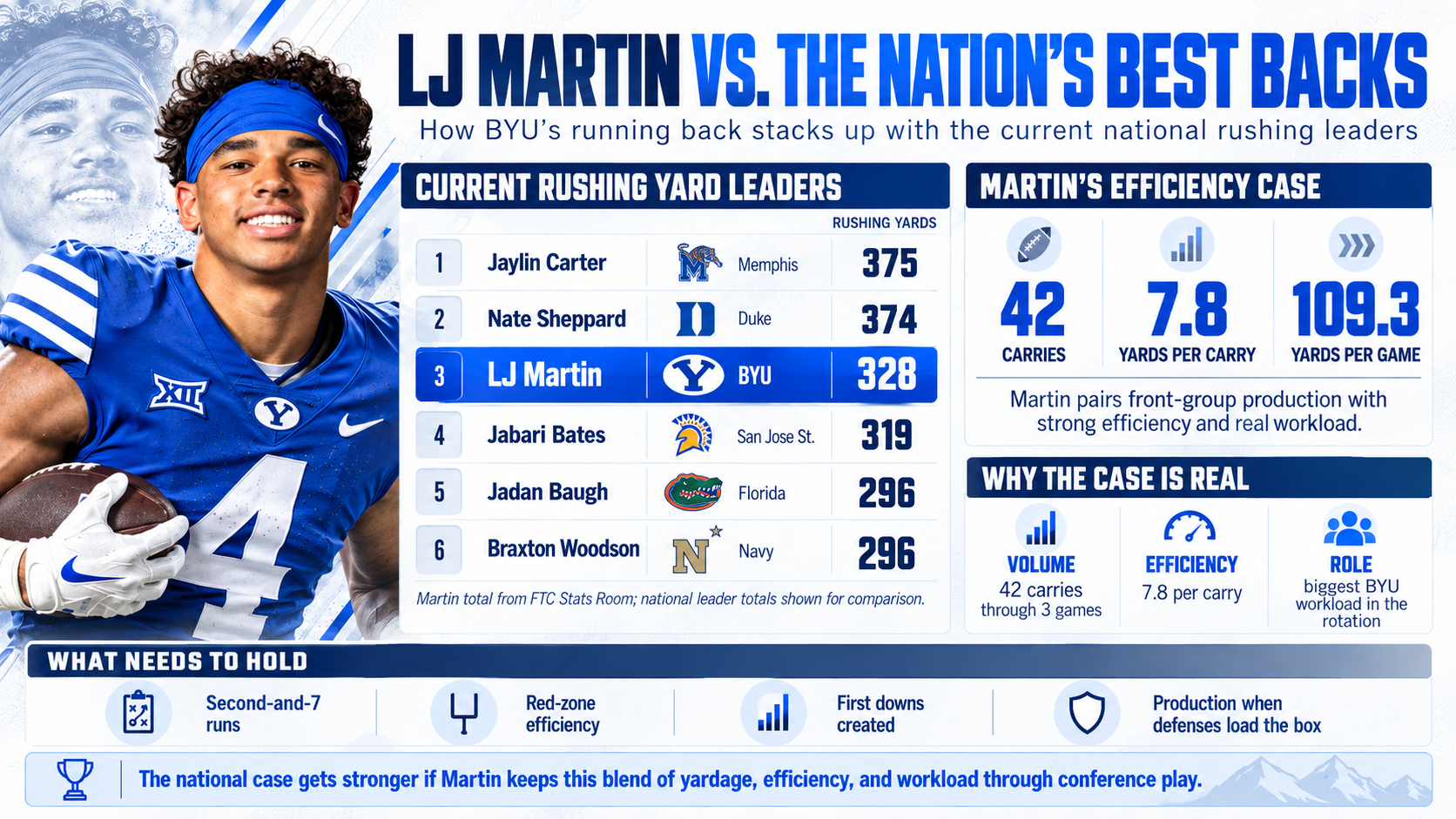
Running-back arguments usually begin with yards and end with a ranking. LJ Martin deserves a more careful conversation than that. Through three games, the BYU back has 328 rushing yards on 42 carries, a 7.8-yard average on the current FTC Stats Room feed. Those numbers put him in the national conversation as a production watch, even before the comparison table has enough qualified players to assign an official Big 12 or NCAA rank. The point is not to force a number that does not exist. The point is to understand why the number is worth watching.
Volume matters because efficiency without opportunity can be a mirage. Martin is not carrying the entire BYU offense, but 42 attempts are enough to show that the staff trusts him in the regular rotation. He has had enough touches to encounter different fronts, different game scripts and different down-and-distance situations. A 7.8 average built on a few long runs is one story. A 7.8 average that survives ordinary early-down carries, protection responsibility and late-game clock work is a more durable one.
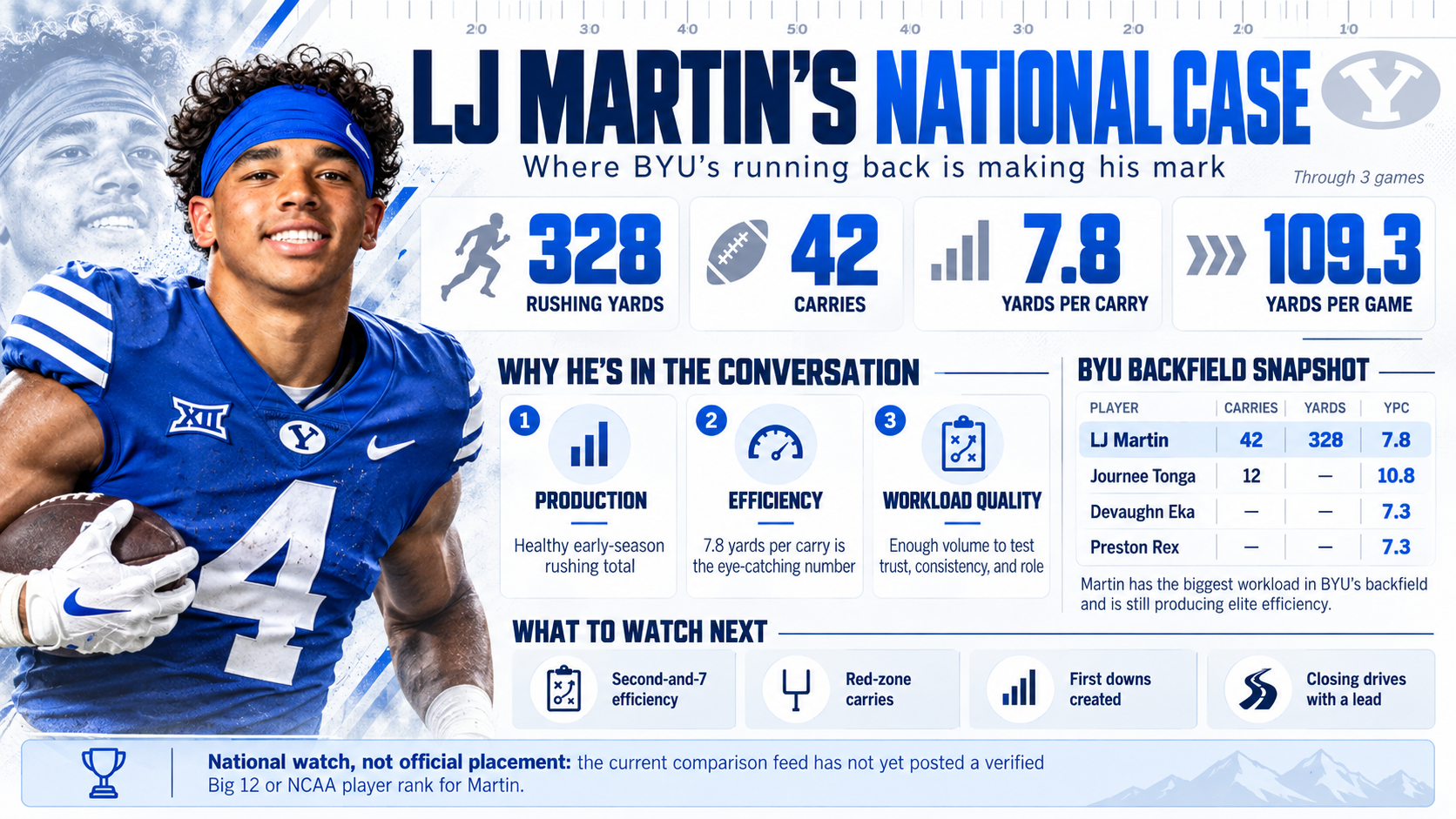
The national comparison should therefore use three lenses. The first is total rushing yards, where Martin’s 328 puts him on a healthy early-season pace. The second is yards per carry, where 7.8 is the more eye-catching number. The third is workload quality: how often he is asked to run on obvious passing downs, how often he creates a first down and whether he remains efficient when the defense knows a carry is possible. The national leaders will change as every team adds games, but these are the measures that separate a hot September from a real conference-season case.
The Big 12 angle is just as important. Conference defenses will know Martin’s tendencies, force BYU to win in tighter spaces and demand that he contribute without the benefit of a clean box. The current board shows other BYU backs producing efficiently as well—Journee Tonga at 10.8 yards per carry on 12 attempts, Devaughn Eka and Preston Rex at 7.3—but Martin has the largest workload of the group. That combination makes him the clearest test of whether BYU’s run game is a feature or merely a collection of efficient moments.
There is also a quarterback connection. When Martin is producing early, defenses cannot collapse their attention on Bear Bachmeier. That creates more favorable looks for the passing game and makes the play-action menu credible. When the run game is efficient without needing a perfect block on every snap, BYU can stay aggressive on second down. Martin’s value is therefore larger than the rushing total printed beside his name. He changes the number of answers a defense has to prepare.
The caution is equally clear. Three games are a beginning, not a verdict. National rankings are sensitive to opponent quality, game state and minimum qualifications. The FTC comparison feed has not yet posted a verified player rank for Martin, so this article should be read as a national watch rather than an official placement. That distinction protects the credibility of the story. It is better to say a player is moving into the conversation than to manufacture a precise rank from an incomplete field.
The next evidence will come in the carries that do not look special. Watch Martin on second-and-seven, inside the red zone and after BYU has taken a lead. Track first downs, contact balance and whether his average remains above water when the defense sells out to stop the run. If those numbers hold, the Big 12 conversation will arrive naturally, and the national one will be much harder to dismiss. Martin has already supplied the opening argument. The next three games will tell us how sturdy it is.
More BYU football originals
 Which BYU Players Are National Statistical Leaders?Read the original →
 BYU’s First Three Weeks by the Numbers: What the Stats Say About This TeamRead the original →
 The CFP May Get Bigger. BYU’s Standard Against Notre Dame Shouldn’tRead the original →
Questions about a source, update or correction? Contact the editor. Story updates are reflected in the published timestamp above.