
FEED THE COUGAR ORIGINAL · Football
LJ Martin’s Injury Turns BYU’s Run Game Into a Five-Week Management Problem
BYU has enough production behind its star back to survive a Friday night. The harder question is how the Cougars distribute the burden through Notre Dame, UCF, Arizona State and possibly Utah. The numbers suggest BYU has enough running-back depth to survive without its star. The TCU game also showed why the Cougars cannot simply transfer Martin’s workload to Bear Bachmeier.
Prepared with AI assistance. Feed the Cougar is responsible for sources and corrections. How our daily articles work →
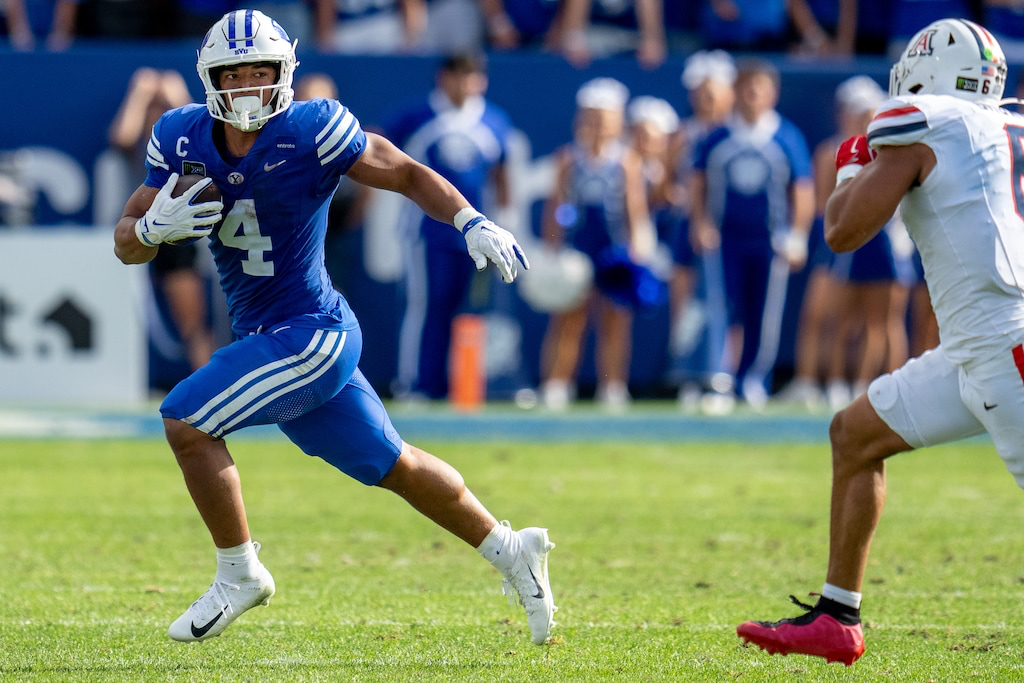
BYU knew it would face Iowa State without LJ Martin. What changed Wednesday was the size of the problem.
Martin is expected to miss four to six weeks with the lower-body injury he suffered at TCU, according to reports detailed by the Deseret News and The Salt Lake Tribune. That removes the reigning Big 12 Offensive Player of the Year from Friday’s game and almost certainly from upcoming matchups with Notre Dame, UCF and Arizona State. A four-week recovery could put the Utah game within reach. The longer end of the timetable could also cost him the Baylor game.
This is no longer about surviving one night. BYU needs a running-game plan that can last a month.
The season totals offer legitimate encouragement. Preston Rex, Journee Tonga and Devaughn Eka have combined for 49 carries, 338 yards and four touchdowns. That works out to 6.9 yards per attempt. The Tribune lists Rex at 18 carries for 94 yards, Tonga at 19 for 157 and Eka at 12 for 87.
Those are promising numbers, but they require context. Forty-nine carries spread across four games remain a small sample, and some of that production came after BYU had established control against overmatched opponents. Change-of-pace efficiency does not automatically transfer to third-and-2 carries against a defense expecting the run.
The TCU game provided the first look at that difference.
After Martin left with two carries, Rex finished with 21 yards on eight attempts while Tonga gained 28 yards on seven, according to the official box score. That is 49 yards on 15 carries, or 3.3 per attempt. Poor weather, low snaps and predictable situations contributed, but the larger point remains: BYU’s season-long depth numbers did not immediately translate once Martin disappeared.
Bear Bachmeier supplied the missing production. He rushed 15 times for 66 yards and scored both BYU touchdowns in the 17-10 victory. Before TCU, Bachmeier had totaled only 12 rushing attempts in BYU’s first three games.
That is not a sustainable replacement plan.
Bachmeier’s legs are central to the offense, particularly on read concepts, third downs and broken plays. But turning him into a 15-to-20-carry quarterback every week would solve the running-back shortage by increasing the physical risk to the one offensive player BYU can least afford to lose. The Cougars need his running ability. They do not need him absorbing Martin’s entire share of the contact.
Friday’s matchup gives BYU a reasonable place to start building the committee. Iowa State has surrendered 746 rushing yards through five games, an average of 149.2 per game, while ranking 84th nationally in rushing defense. The Cyclones have been considerably better against the pass, allowing 172.4 yards per game, according to the Big 12’s statistics.
That defensive profile should encourage patience with the running backs, even if the first few carries produce little. Iowa State can now structure its plan around Bachmeier and an inexperienced backfield instead of reserving answers for Martin, but it has not consistently demonstrated that it can shut down a committed rushing attack.
The solution should begin with workload distribution rather than an attempt to identify Martin’s immediate successor. Tonga’s 8.3-yard season average makes him the most explosive option in the small early-season sample. Rex has received the most work behind Martin and handled 10 offensive touches at TCU, including two receptions. Eka gives BYU a third back with fresh legs, although 12 college carries are not enough to define what his role should become.
BYU can also ease the burden with quick throws, receiver motion and touches that stretch the defense horizontally. Those plays are not technically runs, but they can force linebackers to hesitate and create more favorable boxes without adding another designed carry for Bachmeier.
Martin’s absence is especially significant because of what the Cougars are losing beyond his 344 yards and 7.8-yard average. He rushed for 1,305 yards and 12 touchdowns last season and now ranks sixth in BYU history with 2,885 career rushing yards. Those numbers represent more than explosiveness. They represent protection experience, short-yardage trust and a proven ability to carry the offense late in close games.
“This is college football. It’s always next man up,” tight end Roger Saleapaga told The Tribune.
The sentiment is right. The arithmetic suggests “next men” would be safer.
What matters Friday is not which running back receives the first carry. Watch how BYU divides the work, whether the backs protect Bachmeier, how often the offense stays ahead of the chains and how many designed runs are placed on the quarterback. If Rex, Tonga and Eka can collectively handle 25 productive attempts, BYU can preserve both its offensive identity and its most important healthy player.
The Cougars do not need to discover another LJ Martin. They need three backs to replace portions of his job—and a plan sturdy enough to last until he returns.
More BYU football originals
 The CFP May Get Bigger. BYU’s Standard Against Notre Dame Shouldn’tRead the original →
 Sione Moa Is Cleared. BYU Still Has to Decide How Much He Can Give Notre DameRead the original →
 Notre Dame Has 68 Blue-Chips to BYU’s 12. The Records Are Nearly IdenticalRead the original →
Questions about a source, update or correction? Contact the editor. Story updates are reflected in the published timestamp above.