
FEED THE COUGAR ORIGINAL · Football
The Computers Can’t Agree on BYU Football: Who Is Overrating, and Underrating the Cougars?
BYU’s polls, predictive systems and résumé rankings are telling different stories. The disagreement is useful if you understand what each model rewards.
Prepared with AI assistance. Feed the Cougar is responsible for sources and corrections. How our daily articles work →
BYU’s ranking story is not a single number. It is a disagreement between systems that ask different questions. Polls ask how impressive the Cougars look. Predictive systems ask how they are likely to perform against a future opponent. Résumé systems ask what they have already accomplished. Through the current Feed the Cougar ranking board, those questions produce a spread from the national top 10 to the low 20s.
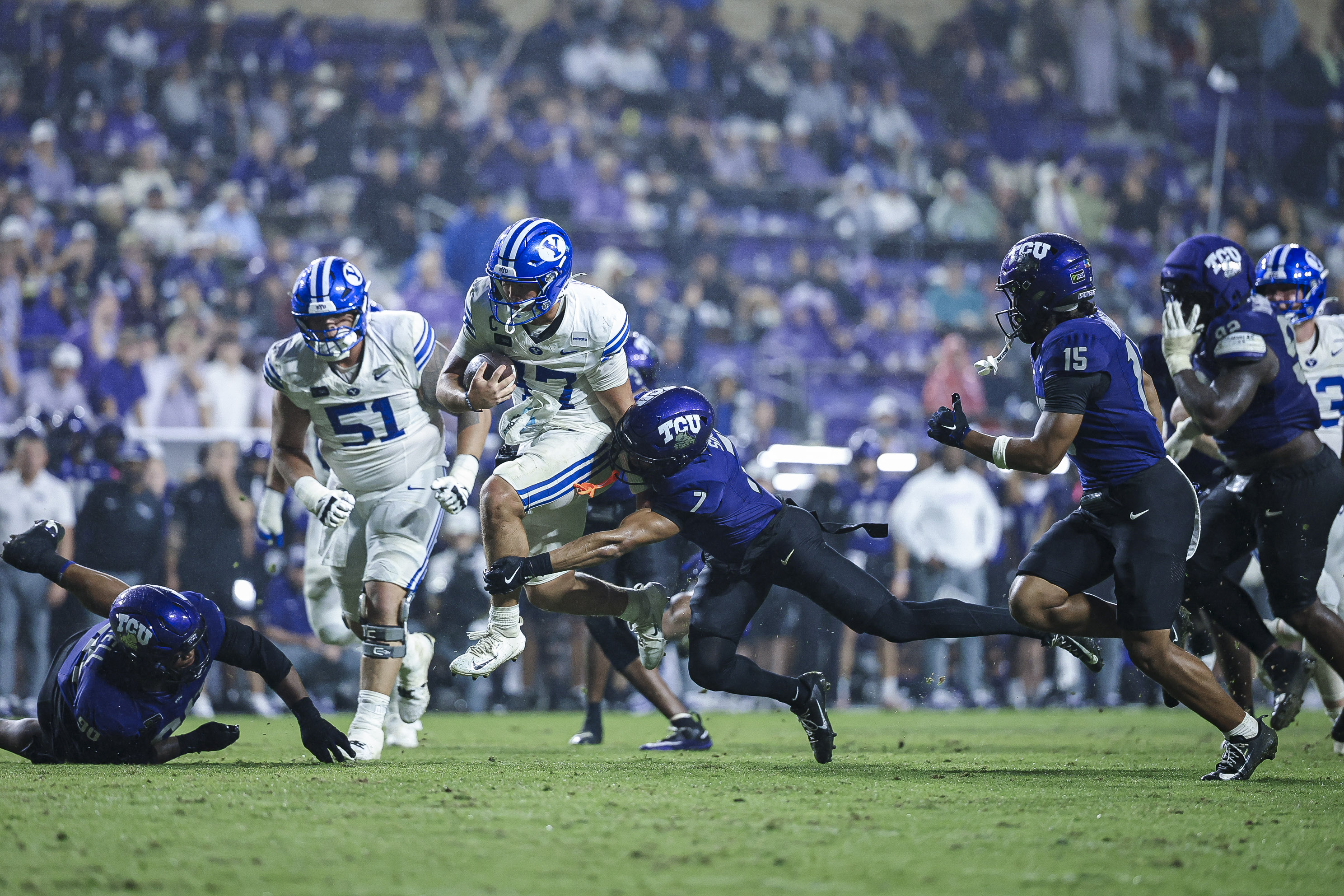
The public perception is strong. BYU is No. 10 in the AP poll and No. 8 in the coaches poll. The résumé case is easy to understand: the Cougars are 4–0, 2–0 in the Big 12 and just won 17–10 at TCU. The defense held TCU to 259 yards, created four sacks and finished the game while the offense operated in difficult weather. A team that keeps winning has earned a high floor.
The computer picture is more cautious. Feed the Cougar lists ESPN SP+ at No. 14, FEI at No. 14, Sagarin at No. 21, Massey at No. 13, Congrove at No. 8, Colley at No. 11, Billingsley at No. 10 and TeamRankings Predictor at No. 18. The FTC composite is No. 14 across its primary models. KFord and Anderson & Hester are not included when their current pages do not provide a usable BYU rank. That is a data-quality rule, not an editorial penalty.
Why do the systems disagree? Predictive models punish games that look unstable. BYU’s 17–10 win at TCU featured 216 total yards and passing production in the 60s, depending on the official table. A résumé model sees a road conference win. A predictive model sees an offense that may struggle if it has to win from behind. Both interpretations can be true.
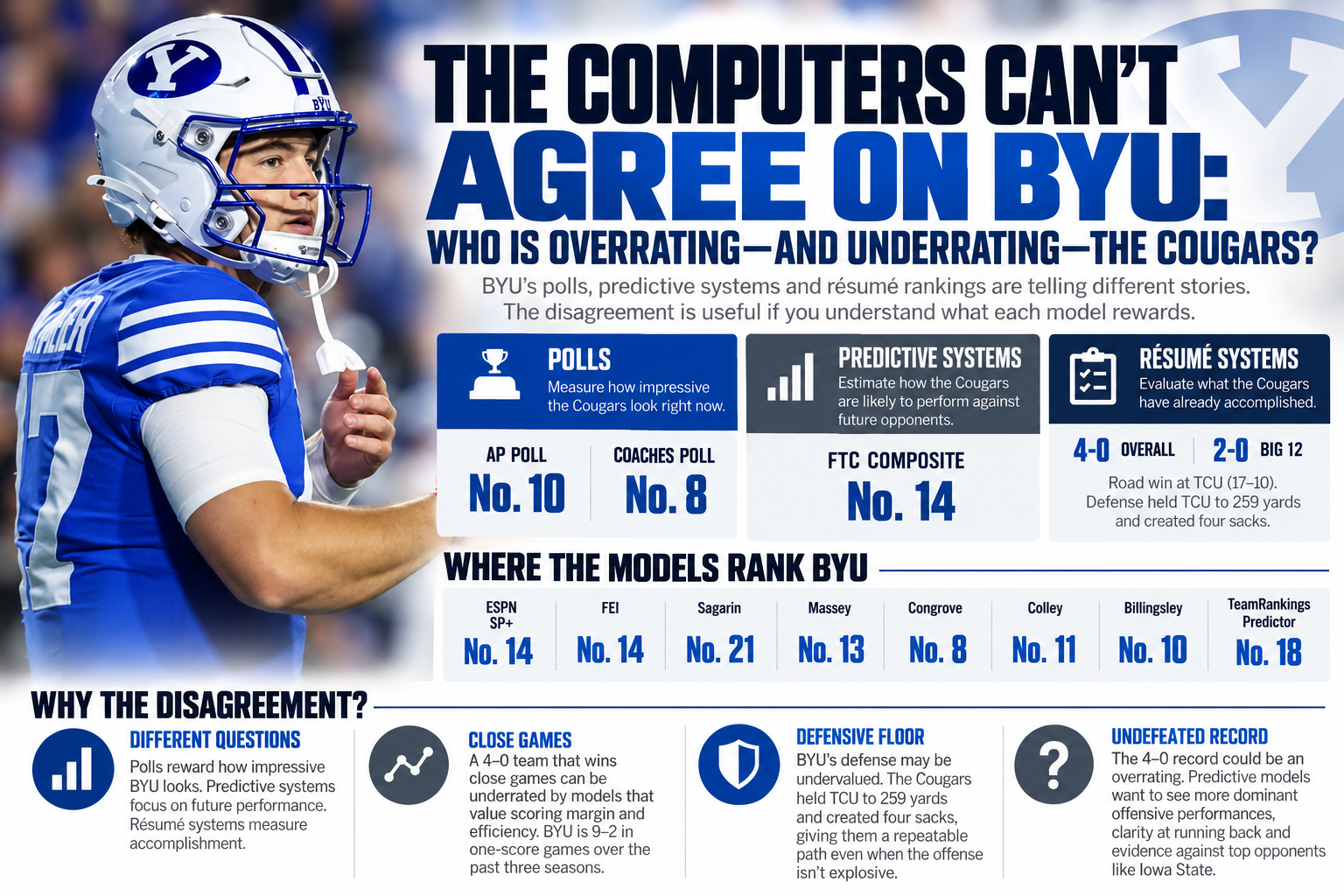
The models also see schedule and margin differently. A 4–0 team that wins close games can be underrated by a system that values scoring margin and opponent-adjusted efficiency. Conversely, a résumé model can overrate an undefeated team before it has collected enough high-end wins. BYU’s 9–2 record in one-score games over the past three seasons makes the distinction important. Close-game skill is real, but models are careful about assuming every future close game will break the same way.
The most likely undervaluation is BYU’s defensive floor. The Cougars have shown they can win when the offense is not explosive, and the front has produced timely pressure. A defense that holds TCU to 259 yards and creates four sacks gives BYU a repeatable path. Some systems will lag that improvement until the opponent-adjusted sample grows.
The potential overrating is the undefeated record itself. Four wins are meaningful, but they do not erase the need to explain the offense at TCU, the injury questions in the running back room or the next test against Iowa State’s Aiden Flora. A skeptical model is not dismissing BYU; it may be asking whether the Cougars can control a game before the final possession.
The right answer is not to choose polls over computers. Use them as a range. Polls describe current respect. SP+, FEI and similar systems describe expected performance. Résumé models describe accomplishment. BYU’s composite around No. 14 says the market sees a very good team with unresolved questions. That is a fair place to be entering Iowa State week.
The next game can move both opinions. If BYU controls Flora, converts third downs and wins with more than one offensive formula, predictive systems will catch up. If Iowa State creates explosive runs and forces another low-yardage night, the cautious models will look prescient. The disagreement is not a flaw in the ranking room. It is a map of what BYU still has to prove.
That range is useful for readers because it prevents false certainty. A No. 8 poll ranking does not mean BYU is guaranteed to finish No. 8. A No. 21 predictive ranking does not mean the Cougars are fraudulent. It means the systems are weighting the evidence differently. As BYU adds conference wins and more opponent-adjusted defensive performances, the models will have more evidence to separate early-season noise from a durable identity. The ranking story should update as the evidence changes, not as a headline demands.
Sources: Feed the Cougar rankings, BYU’s TCU recap, Big 12 football statistics, and Iowa State’s 2026 statistics.
*Hero photo: Jaren Wilkey / BYU Athletics.
More BYU football originals
 The CFP May Get Bigger. BYU’s Standard Against Notre Dame Shouldn’tRead the original →
 Sione Moa Is Cleared. BYU Still Has to Decide How Much He Can Give Notre DameRead the original →
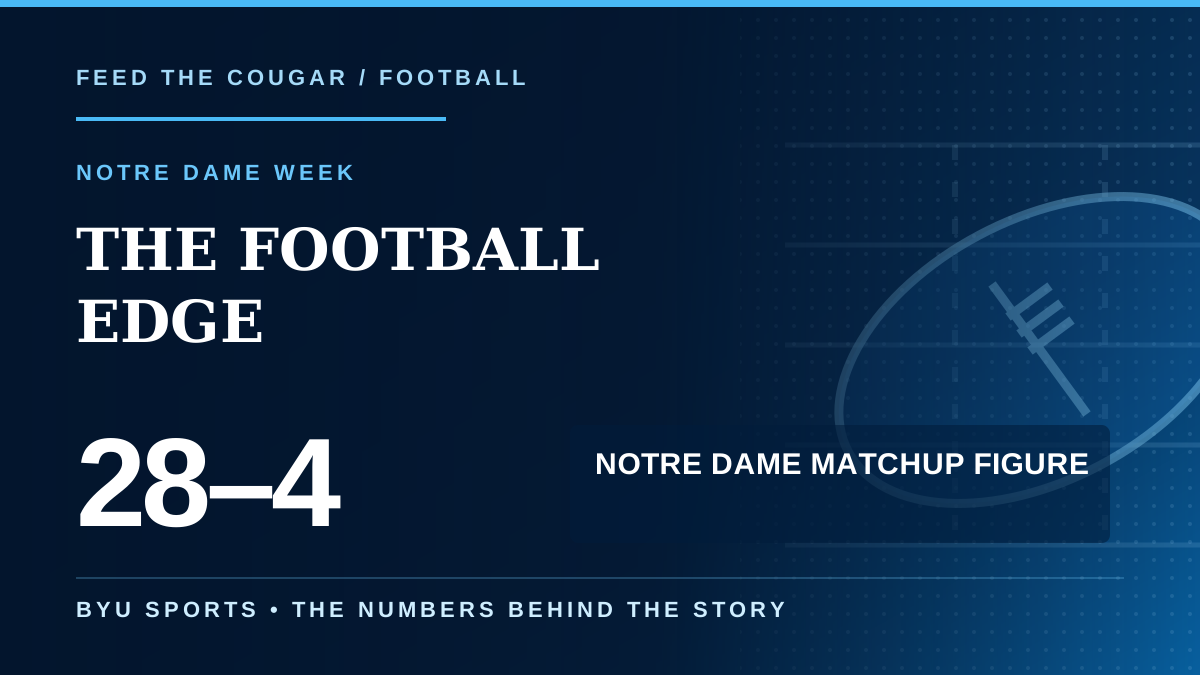 Notre Dame Has 68 Blue-Chips to BYU’s 12. The Records Are Nearly IdenticalRead the original →
Questions about a source, update or correction? Contact the editor. Story updates are reflected in the published timestamp above.