
FEED THE COUGAR ORIGINAL · Football
The Gross Injustice of the ESPN FPI System
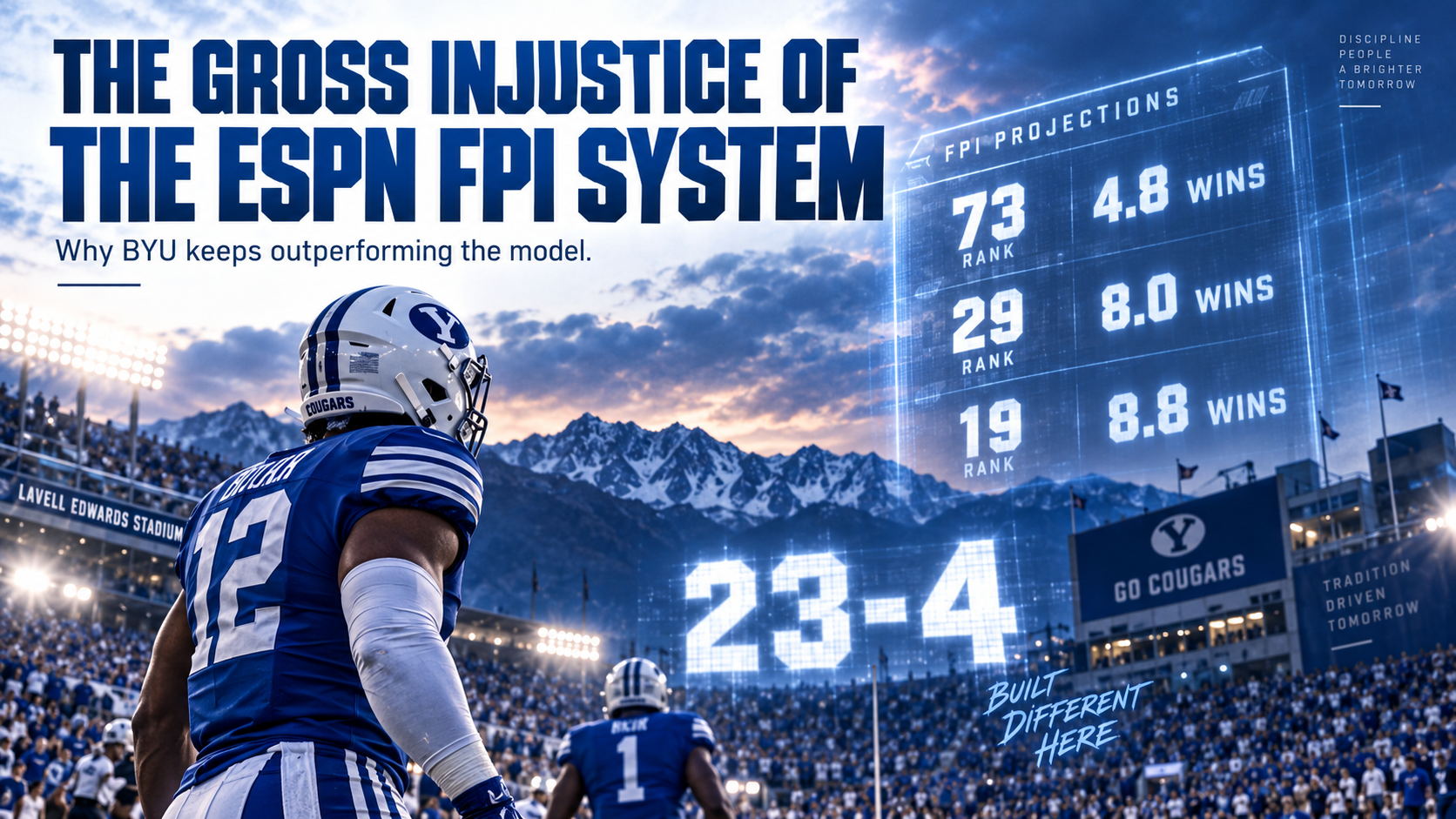
There is nothing wrong with a computer trying to predict college football. With more than 130 teams, uneven schedules, constant roster turnover and enormous differences in talent, systems such as ESPN’s Football Power Index can be useful. The problem comes when a prediction is treated like a verdict.
BYU has spent the past two seasons exposing that problem. In 2024 and 2025, the Cougars dramatically outperformed what FPI projected. Now, early in 2026, ESPN’s model is once again more skeptical of BYU than several other major rankings. The 2024 miss was enormous.
Before the season, FPI ranked BYU No. 73 nationally and projected only 4.8 wins. The Cougars instead won 10 regular-season games, finished 11-2 after beating Colorado in the Alamo Bowl and ended the year No. 13 in the AP poll. That is not a small forecasting error. FPI underestimated BYU’s regular-season win total by 5.2 games.
One season can be dismissed as an outlier. College football produces strange teams every year. Turnovers swing games. Quarterbacks develop unexpectedly. Close games break one direction. Then BYU did it again.
Entering 2025, FPI had adjusted upward, placing BYU around No. 29 and projecting roughly eight regular-season victories. BYU won 11, reached the Big 12 Championship Game, finished 12-2 and ended the season No. 11 in the AP poll. Across the 2024 and 2025 regular seasons, FPI projected approximately 12.8 BYU victories.
BYU actually won 21. That is an underestimation of 8.2 wins in just two seasons. At that point, the more interesting question is not whether FPI occasionally misses. Every model does. The question is whether something about BYU is particularly difficult for FPI to measure.
What FPI is actually doing
FPI is primarily a predictive model. It is designed to estimate how strong a team should be going forward, not simply reward what that team has already accomplished. That distinction matters.
FPI evaluates offensive, defensive and special-teams efficiency, adjusts for opponent strength and game location, and incorporates preseason information such as previous performance, returning production, quarterback experience and recruiting pedigree. Those are reasonable inputs.
Recruiting rankings, for example, have obvious predictive value. Programs loaded with four- and five-star players usually perform better than programs without them. But BYU has often built teams differently.
The Cougars have relied heavily on player development, veteran players, transfers and athletes whose college production eventually becomes much better than their original recruiting rankings suggested. That creates a possible blind spot.
A three-star recruit who becomes an all-conference player does not retroactively become a five-star recruit in the database. FPI eventually sees his production, but a preseason model may still be influenced by what that player was expected to become years earlier. BYU’s coaching staff may know in August that a player has made a significant jump.
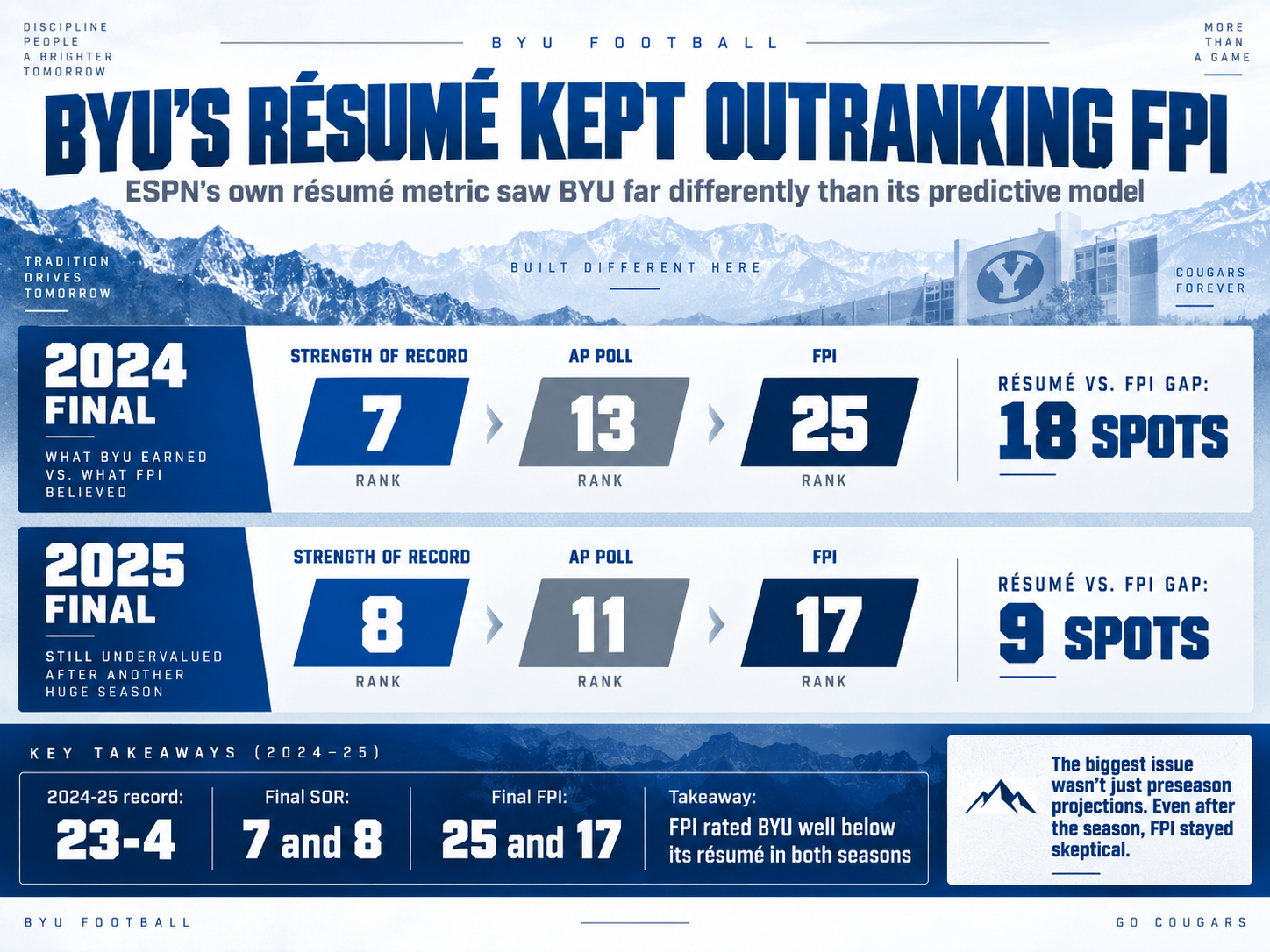
The computer may need October to believe it. ##The 2024 contradiction The strangest part of BYU’s 2024 season came after the Cougars had already proven the preseason projection wrong. As BYU climbed to 8-0, ESPN’s own Strength of Record metric ranked the Cougars among the very best résumés in the country.
FPI still had BYU much lower. By the end of the season, BYU was No. 13 in the AP poll and roughly No. 7 in Strength of Record.
Final FPI had the Cougars around No. 25. That gap tells us almost everything we need to know.
Strength of Record was evaluating what BYU had accomplished. FPI was evaluating what its underlying statistical profile suggested BYU should be. Those are different questions.
The injustice comes when FPI is presented during playoff discussions as though it answers both. A predictive rating can be valuable when trying to determine who would be favored next Saturday. It should not automatically override a résumé built by actually winning games.
Another computer saw BYU differently
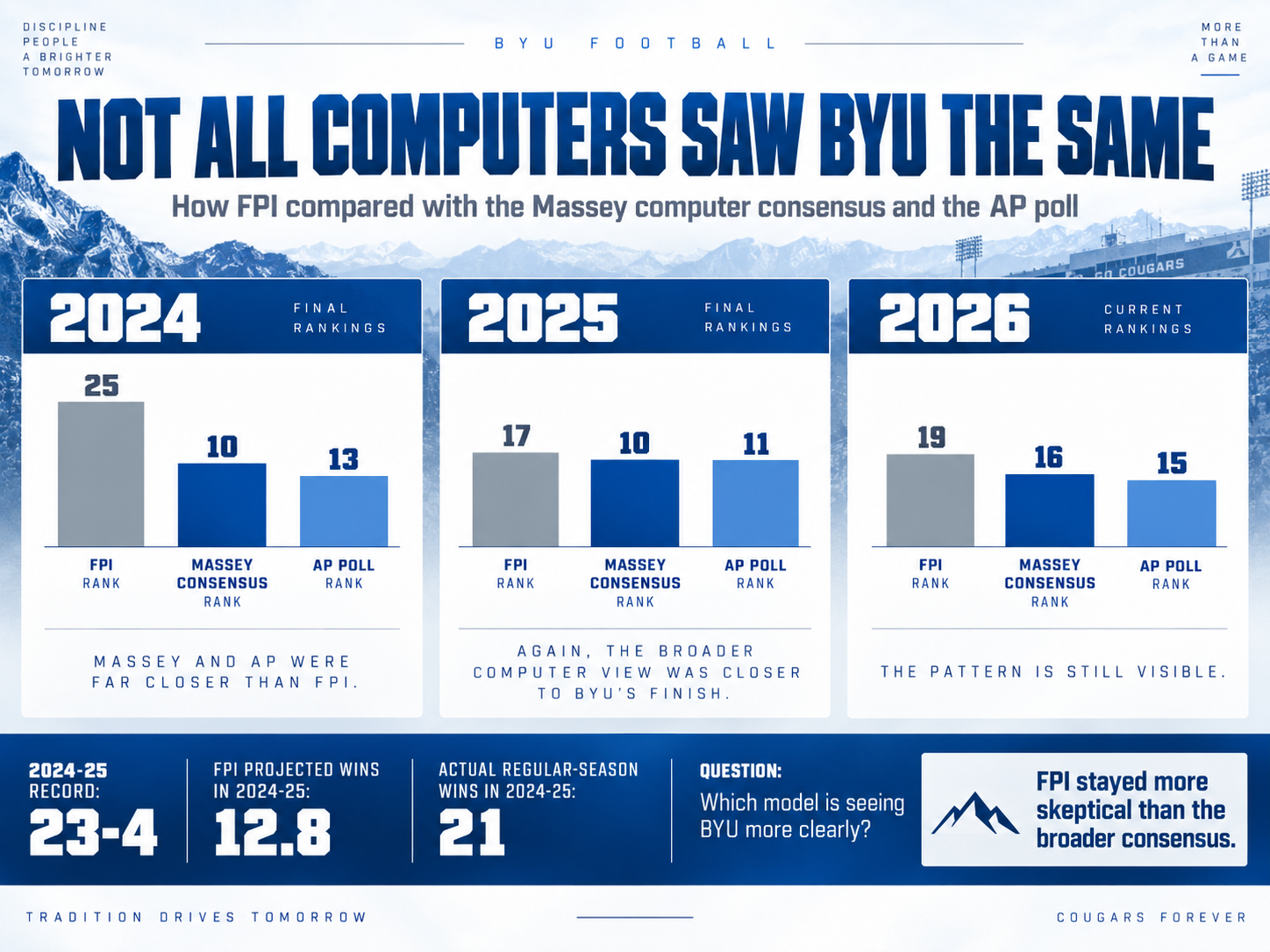
This is also why the argument should not be framed as BYU versus analytics. Another major computer system viewed the Cougars far more favorably. The Massey College Football Ranking Composite combines dozens of independent computer rankings, creating a broad mathematical consensus rather than relying on one model.
At the end of 2024, the Massey computer consensus had BYU tied around No. 10 nationally. FPI had BYU around No. 25.
The AP poll had BYU No. 13. In 2025, the Massey consensus again placed BYU around No. 10, almost exactly where the AP poll eventually landed at No. 11.
That is significant because it shows that computer analysis itself is not the problem. The issue is what each model values. Massey systems tend to place greater emphasis on actual game results, schedule strength, scoring margin and location as the season develops. Preseason assumptions fade as more current-season information becomes available.
For BYU, that appears to matter. FPI asks heavily, “What should this team be?” Massey increasingly asks, “What has this team shown us?”
Over the past two seasons, the second question has treated BYU much more favorably. Now comes 2026 BYU entered this season after going 23-4 over the previous two years. FPI showed more respect than it had in 2024, placing the Cougars around No. 20 and projecting roughly 8.7 wins.
After BYU opened the season with a 63-7 victory over Utah Tech, FPI moved the Cougars to around No. 19 and projected about 8.8 victories. The AP poll has BYU No. 15.
The broader Massey computer consensus is around No. 16. That is not a massive disagreement, but the direction is familiar.
FPI remains more skeptical. Perhaps it will be right. Maybe BYU finishes 8-4 or 9-3, and the model finally predicts the regression that has not arrived during the previous two seasons. But if BYU again wins 10, 11 or 12 games, the discussion becomes harder to dismiss.
The real problem
FPI is not anti-BYU. There is no evidence of some hidden ESPN penalty designed to punish Provo. The stronger argument is that BYU may be the kind of program FPI naturally struggles to evaluate: one that develops players beyond their recruiting profiles, relies on veteran improvement, performs well in high-leverage situations and repeatedly produces results better than preseason assumptions suggest.
And when another collection of computer models consistently rates BYU closer to its actual finish, it becomes fair to question which model is describing the team more accurately. The numbers are straightforward. In 2024, FPI projected 4.8 wins.
BYU won 10 regular-season games. In 2025, FPI projected roughly eight. BYU won 11.
Now, in 2026, FPI projects roughly 8.8. Maybe this is finally the season the computer wins the argument. But after 23 victories in two years, BYU has earned something FPI has been slow to provide.
The benefit of the doubt. And perhaps that is the grossest injustice of FPI: not that the model exists, but that we sometimes forget it is predicting what a team ought to be while the scoreboard is telling us what that team actually is.
More BYU football originals
 The CFP May Get Bigger. BYU’s Standard Against Notre Dame Shouldn’tRead the original →
 Sione Moa Is Cleared. BYU Still Has to Decide How Much He Can Give Notre DameRead the original →
 Notre Dame Has 68 Blue-Chips to BYU’s 12. The Records Are Nearly IdenticalRead the original →
Questions about a source, update or correction? Contact the editor. Story updates are reflected in the published timestamp above.