
FEED THE COUGAR ORIGINAL · Football
Vampire Cougs: Why BYU Football Comes Alive After Dark
BYU’s late-night success is more than a nickname. The Cougars’ remarkable record after 7 p.m., combined with dramatic wins over Arizona, Kansas State and Utah, reveals a team that has repeatedly been at its best when games get late, strange and uncomfortable.
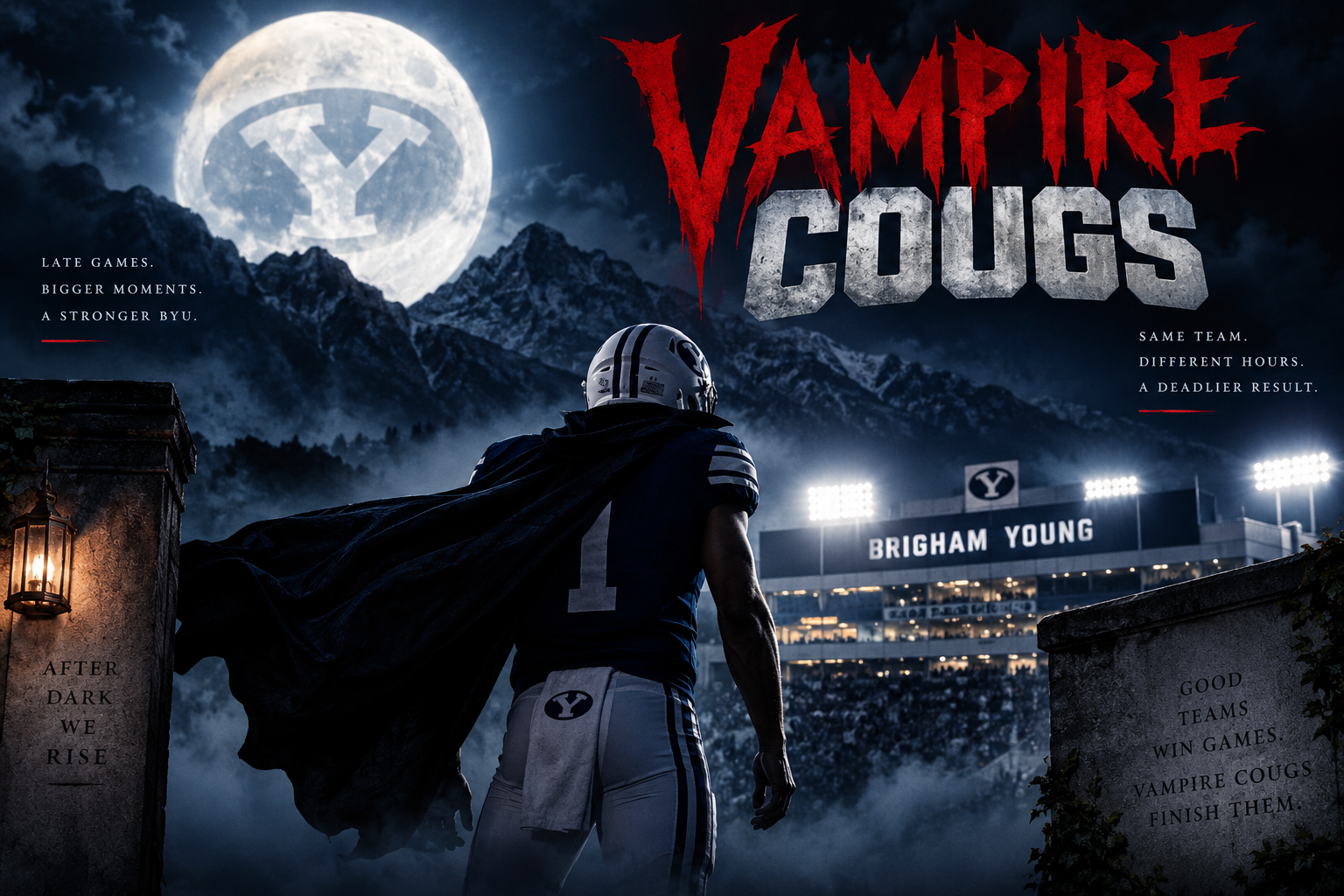
There was lightning over Tucson, a long delay, an Arizona crowd that had waited through the weather and a BYU football team that appeared to be running out of answers. Maybe the Cougars simply needed the sun to go down.
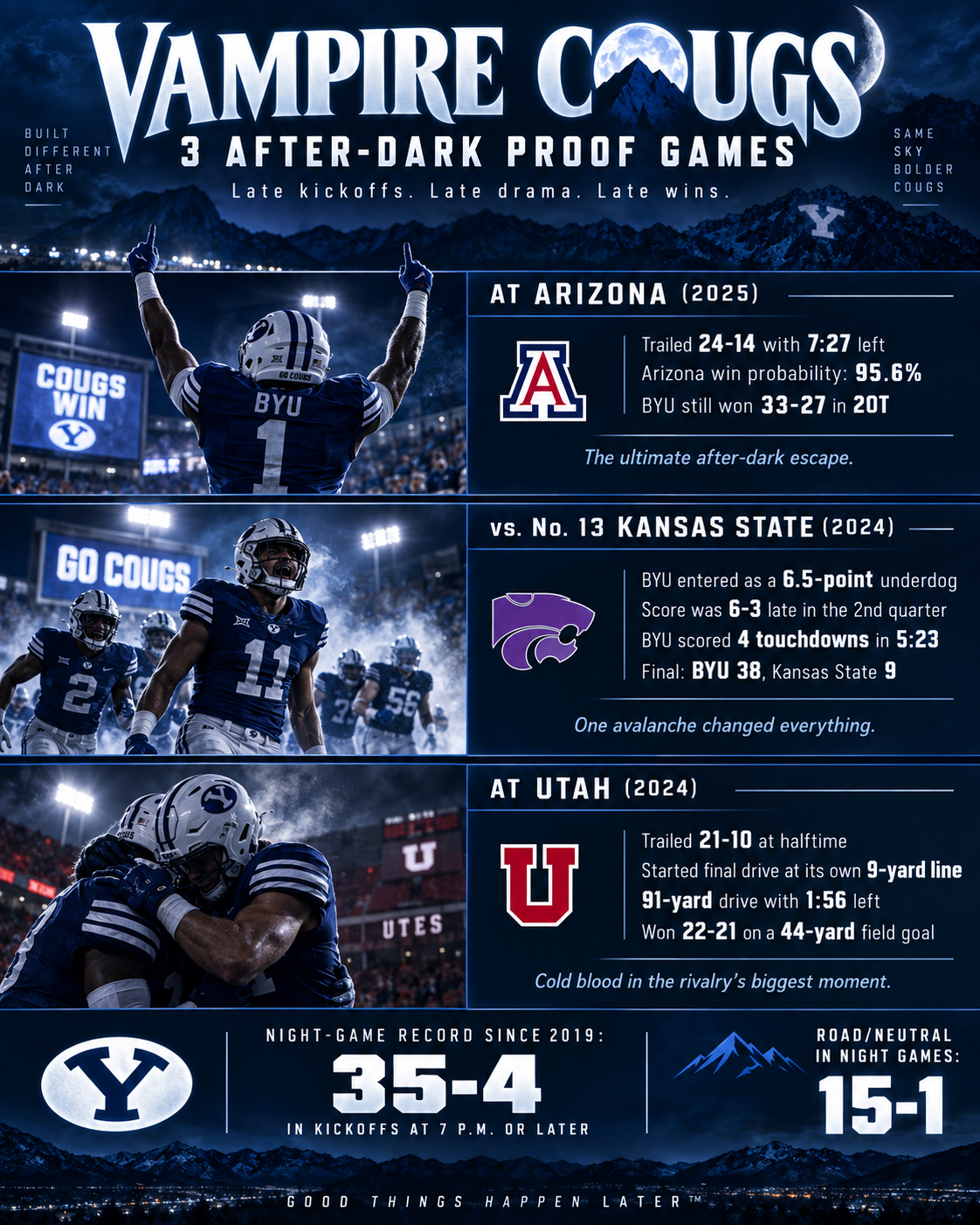
Last October, BYU led Arizona 14-0 before the Wildcats scored 24 consecutive points. With 7:27 remaining, Arizona owned a 24-14 lead and ESPN analytics gave the Wildcats a 95.6% probability of winning. BYU’s chances were down to 4.4%.
Then came the part BYU fans have seen often enough that somebody finally gave it a name. The Vampire Cougs woke up. BYU scored 10 points in the final 7½ minutes, forced overtime and eventually escaped Tucson with a 33-27 double-overtime victory. Bear Bachmeier and LJ Martin kept grinding, the defense found enough stops, and a game Arizona controlled somehow ended with BYU celebrating after five hours of football.
Technically, that game doesn't even qualify for the statistic that created the nickname. It kicked off at 5:05 p.m. local time.
But a lightning delay of more than an hour suspended play during the first half. The game resumed at roughly 7:03 p.m. and didn't end until 10:07. In other words, Arizona started against ordinary BYU. It finished against Vampire BYU.
The numbers are getting difficult to dismiss
The nickname started circulating among fans because BYU’s nighttime record had become almost comical. A Deseret News examination last fall found that, beginning with the 2019 season, BYU was 32-4 in games kicking off at 7 p.m. or later, an .889 winning percentage. In games beginning earlier, BYU was 24-20 at that point.
Then BYU kept winning at night. The Cougars beat West Virginia 38-24 in an 8:30 p.m. kickoff, pushing the official night-game streak to 33-4. They later hammered TCU 44-13 at 8:15 p.m. and went to Cincinnati for an 8 p.m. local kickoff and won 26-14.
That puts BYU at 35-4 in 7 p.m.-or-later kickoffs since 2019 entering the heart of the 2026 season. It is an 89.7% winning percentage. Including last week's 6 p.m. win over Utah Tech, BYU is approximately 30-22 in earlier kickoffs over the same period, a 57.7% winning percentage.
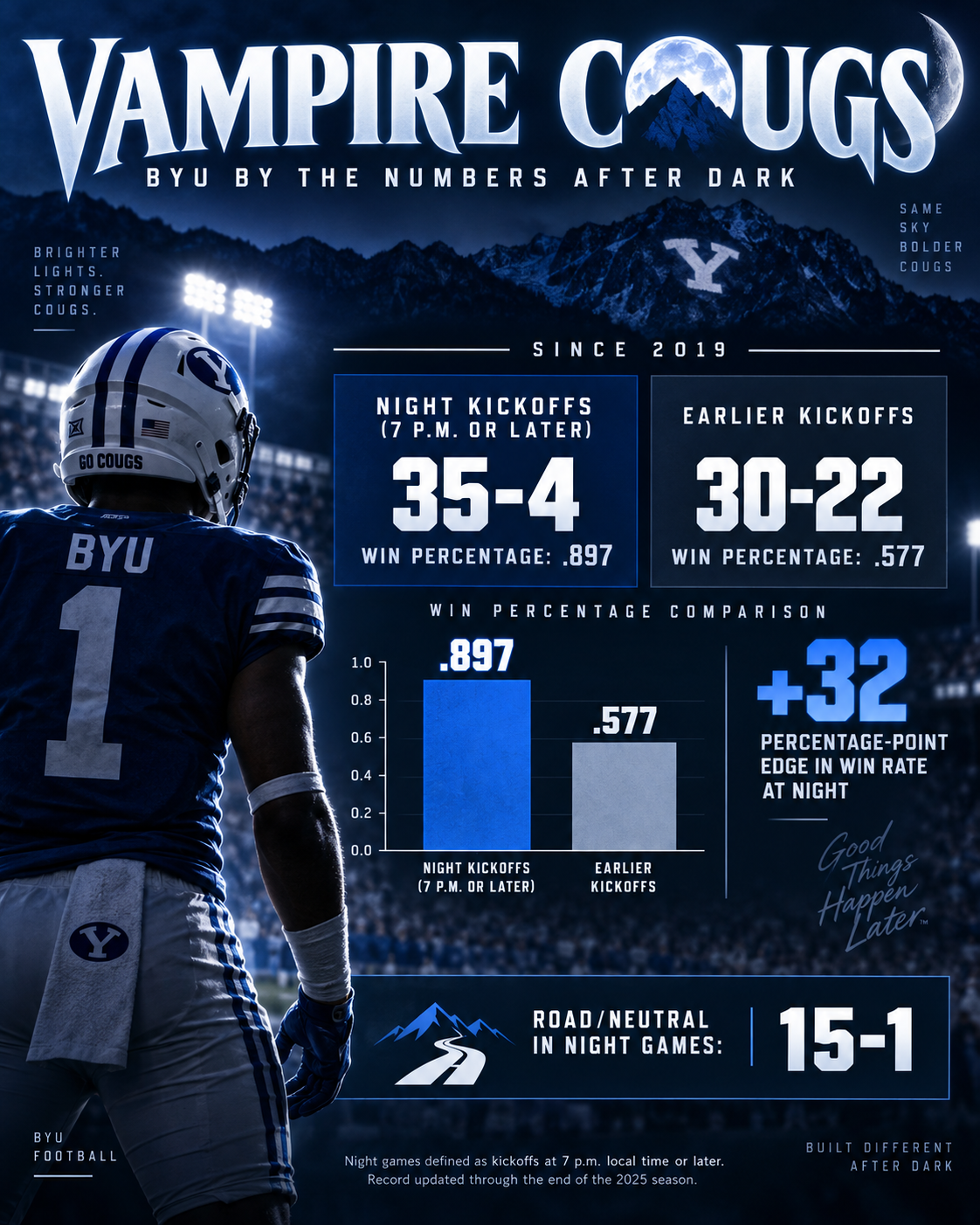
That is a difference of roughly 32 percentage points. | Since 2019 | Record | Win % | | ----------------------- | --------: | --------: | | 7 p.m. or later kickoff | 35-4 | 89.7% | | Earlier kickoff | 30-22 | 57.7% |
There are explanations. BYU plays many night games in Provo. Television has sometimes placed more difficult road assignments in afternoon windows. The competition isn't perfectly equal. Fair enough.
Except BYU hasn't been hiding exclusively inside LaVell Edwards Stadium. Using the same 7 p.m. local-time definition, BYU is 15-1 in night games played away from Provo, counting road and neutral-site games since 2019. The list includes Tennessee, Navy, Houston, Boise State, USC, Utah State, Wyoming, Colorado, Cincinnati and others. The lone loss in that group was at West Virginia in 2023. Something is happening here.
Kansas State found out quickly
Go back to Sept. 21, 2024. No. 13 Kansas State arrived in Provo as a 6½-point favorite. Kickoff was scheduled for 8:30 p.m. Mountain time. Both teams were undefeated, but Kansas State was supposed to be the more complete football team.
For most of the first half, it looked that way. Kansas State led 6-3 with only 1:17 remaining before halftime. Then the lights came on and the game went crazy.
Jack Kelly forced a fumble. Tommy Prassas scooped it up and scored. Fifteen seconds later, Jakob Robinson pressured Avery Johnson into an interception by Tyler Batty.
BYU scored again. Then Parker Kingston somehow turned a punt return into one of the strangest touchdowns of the season. In a span of 5 minutes, 23 seconds, BYU scored four touchdowns.
A 6-3 deficit became a 31-6 lead. The Cougars won 38-9, handing Kansas State its largest defeat against an opponent ranked outside the top 10 in years and producing BYU's largest victory margin over a top-15 opponent in program history. That wasn't simply winning at night. That was feeding.
Then came the Holy War
Seven weeks later, the Cougars went to Rice-Eccles Stadium for an 8:15 p.m. kickoff against Utah. BYU was 8-0 and ranked No. 9, but rivalry games seldom care about rankings.
Utah led 21-10 at halftime. BYU did not score an offensive touchdown until the fourth quarter. The Cougars still trailed 21-19 when they took possession at their own 9-yard line with 1:56 remaining.
Ninety-one yards from safety. No room for error. And after a defensive holding penalty kept the drive alive, Jake Retzlaff found Chase Roberts for 30 yards, Darius Lassiter for another 12, and Hinckley Ropati ripped off 14.
With three seconds remaining, Will Ferrin walked onto the field and drilled a 44-yard field goal. BYU 22, Utah 21. The Cougar defense had shut Utah out for the entire second half.
You can add Oklahoma State from that same season to the file. The Cowboys scored with 1:13 remaining to lead 35-31. BYU answered with a 75-yard drive, and Retzlaff found Lassiter for the winning 35-yard touchdown with 10 seconds remaining. Naturally, kickoff that night had been 8:15.
Coincidence eventually becomes a trend
There is no football explanation for moonlight making linebackers faster or quarterbacks calmer. What BYU does appear to possess is a program comfortable in strange games. Late kickoffs bring long days, loud stadiums, television timeouts, emotional swings and finishes approaching midnight. Sitake's teams have repeatedly shown an ability to remain functional when games become messy.
And maybe that is the real meaning behind Vampire Cougs. It isn't that BYU suddenly becomes more talented when the sun disappears. It is that after dark, when a game gets weird, BYU has become remarkably difficult to kill. Thirty-five wins. Four losses. At some point, even Dracula would call that a trend.
More BYU football originals
 The CFP May Get Bigger. BYU’s Standard Against Notre Dame Shouldn’tRead the original →
 Sione Moa Is Cleared. BYU Still Has to Decide How Much He Can Give Notre DameRead the original →
 Notre Dame Has 68 Blue-Chips to BYU’s 12. The Records Are Nearly IdenticalRead the original →
Questions about a source, update or correction? Contact the editor. Story updates are reflected in the published timestamp above.