
FEED THE COUGAR ORIGINAL · Football
What Happened to BYU’s Offense at TCU—and Can It Be Fixed?
The TCU game was a weather game, a protection game and a warning. Iowa State gives BYU a chance to answer all three.
Prepared with AI assistance. Feed the Cougar is responsible for sources and corrections. How our daily articles work →
# BYU Survived TCU With 216 Yards. That Can’t Be the Formula Against Iowa State
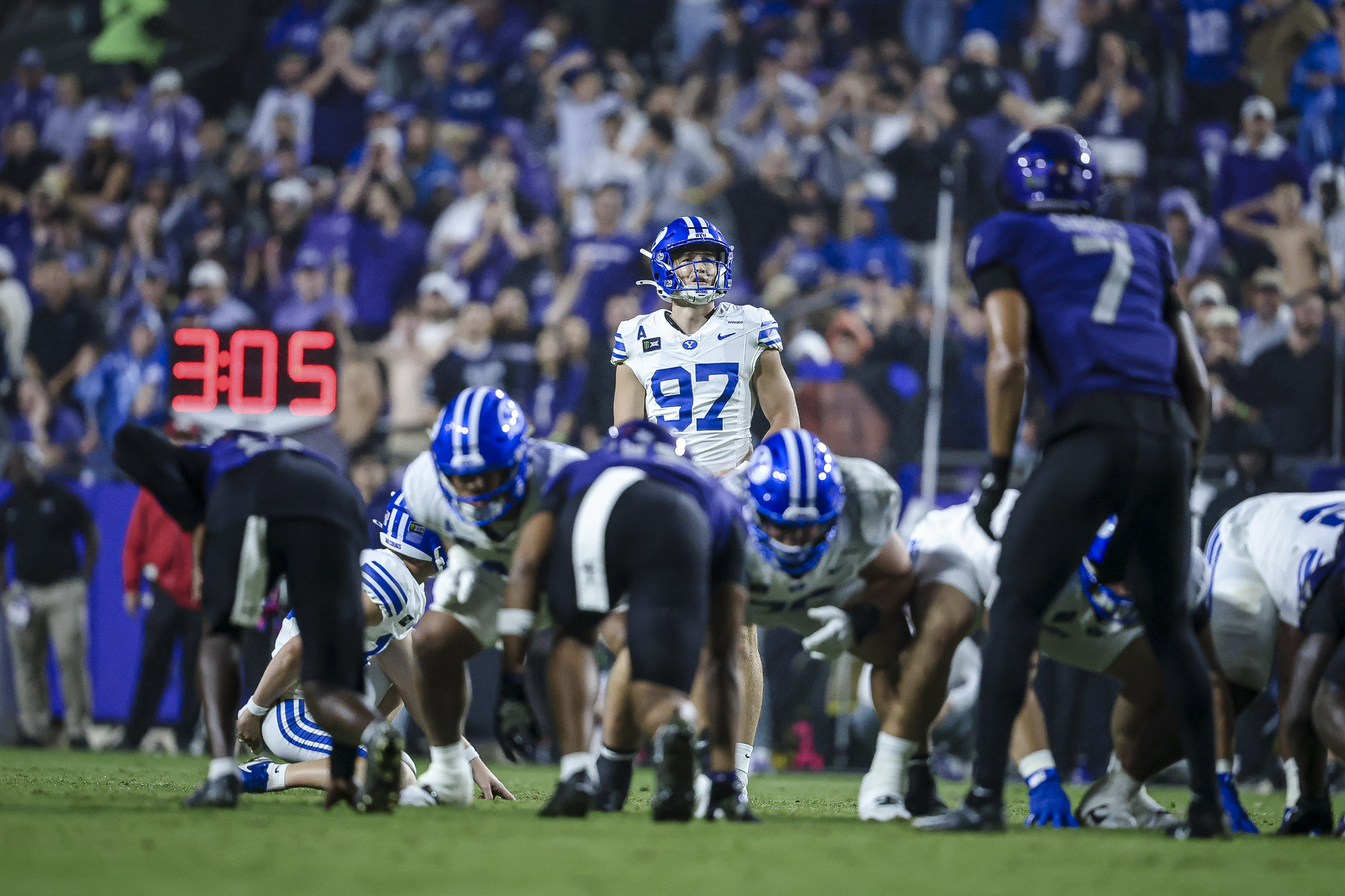
BYU deserved its 17–10 win at TCU. The Cougars went on the road in miserable weather, protected a fourth-quarter lead and leaned on a defense that held TCU to 259 total yards. But the result should not hide what happened on the other side of the ball: BYU finished with only 216 yards of offense and produced just 62 to 66 passing yards, depending on the official stat source.
That was nowhere close to the offense BYU had shown through the first three games. The Cougars entered the week averaging 37.3 points per game, but against TCU they scored only 17 and averaged 3.2 yards per play in the first half. Bear Bachmeier accounted for both touchdowns and finished with 66 rushing yards in addition to his limited passing production. BYU found a way to win, but much of the offense depended on its quarterback creating something when the original play did not.
The weather deserves some of the blame. So does TCU’s defense. Neither explains everything.
False starts, a low snap and other negative plays repeatedly put BYU behind schedule. Those mistakes mattered because the passing game never developed enough rhythm to overcome second-and-long or third-and-long situations. Once TCU could anticipate the pass, its front was able to pressure Bachmeier and force him out of structure.
That is the first thing BYU needs to fix before Iowa State.
BYU cannot live in third-and-long
The contrast with BYU’s season numbers is striking. The Cougars have converted 27 of 47 third downs this season, a 57.4% success rate. That has been one of the offense’s defining strengths.
Iowa State makes that especially important because the Cyclones have allowed opponents to convert only 30.3% of their third downs. BYU cannot expect to reach third-and-8 repeatedly and simply rely on its season conversion rate to rescue drives.
The solution begins before third down. A five-yard run on first down, a quick completion on second down or simply avoiding a false start changes the entire playbook. BYU does not need to become more aggressive against Iowa State as much as it needs to become more efficient.
Martin’s injury changed the offense
LJ Martin’s early exit also changed what BYU could do. He carried twice for 16 yards before leaving, and the Cougars shifted toward a committee backfield while using Bachmeier more heavily as a runner.
That adjustment worked well enough to win. Journee Tonga, Preston Rex and Legend Glasker gave BYU additional rushing production, while Bachmeier became the most dependable option when the Cougars needed yards.
The concern is what happens if that becomes the primary plan against Iowa State.
Bachmeier’s running ability is one of BYU’s biggest offensive advantages, but there is a difference between using his legs as a weapon and asking them to rescue stalled drives. The Cougars should still feature designed quarterback runs, particularly in short-yardage and red-zone situations, but they need the running-back committee and passing game to carry more of the workload.
The passing game does not need to become complicated
The answer to 62 or 66 passing yards is not simply calling more passes.
BYU needs easier completions.
Quick throws, tight-end targets, motion before the snap and play-action off productive early-down runs can give Bachmeier answers without requiring the offensive line to hold up for four or five seconds. A seven-yard completion on second-and-8 is more valuable than forcing a deep ball and facing third-and-8 again.
Those throws would also make life easier for an offensive line dealing with its own personnel changes. The goal should be to get the ball out, establish rhythm and eventually force Iowa State’s safeties to respect more than the run.
That is when Bachmeier’s legs become even more dangerous.
216 yards worked once
The biggest lesson from Fort Worth is that BYU now knows it can win an ugly game. The defense produced four sacks, limited TCU to 259 yards and gave the offense enough opportunities to survive a difficult night.
But Iowa State just showed the opposite offensive extreme by producing 577 yards against West Virginia. The Cyclones gained 265 on the ground and 312 through the air. Another 216-yard night from BYU would place an enormous burden on the defense.
That is why the TCU performance should be treated as an exception worth learning from rather than a formula worth repeating.
BYU does not need to reinvent its offense before Iowa State. It needs to eliminate the mistakes that made the offense so small against TCU: pre-snap penalties, negative plays and too many situations where Bachmeier had to create after the original design broke down.
The Cougars should continue using his legs. They just need the quarterback run to complement the offense rather than rescue it.
If BYU gets back to manageable downs, creates a handful of easy completions and forces Iowa State to defend the entire field, the 216-yard performance will look like what it probably was: an ugly-weather road game that BYU managed to win anyway.
If the same problems show up again Friday night, Iowa State has enough offense to make them much more expensive.
Sources: BYU’s official TCU recap, TCU’s official game report, Big 12 football statistics, and The Salt Lake Tribune’s postgame analysis.
More BYU football originals
 The CFP May Get Bigger. BYU’s Standard Against Notre Dame Shouldn’tRead the original →
 Sione Moa Is Cleared. BYU Still Has to Decide How Much He Can Give Notre DameRead the original →
 Notre Dame Has 68 Blue-Chips to BYU’s 12. The Records Are Nearly IdenticalRead the original →
Questions about a source, update or correction? Contact the editor. Story updates are reflected in the published timestamp above.