
FEED THE COUGAR ORIGINAL · Football
Why BYU Football's Transfer Portal Strategy Is Different
BYU added just nine transfers while the average Big 12 program brought in nearly 28. Rather than rebuilding through the portal, the Cougars targeted specific needs with high-quality additions while protecting opportunities for developing talent already in the program. The numbers reveal a deliberate strategy built around recruiting, development, retention and selective portal use.
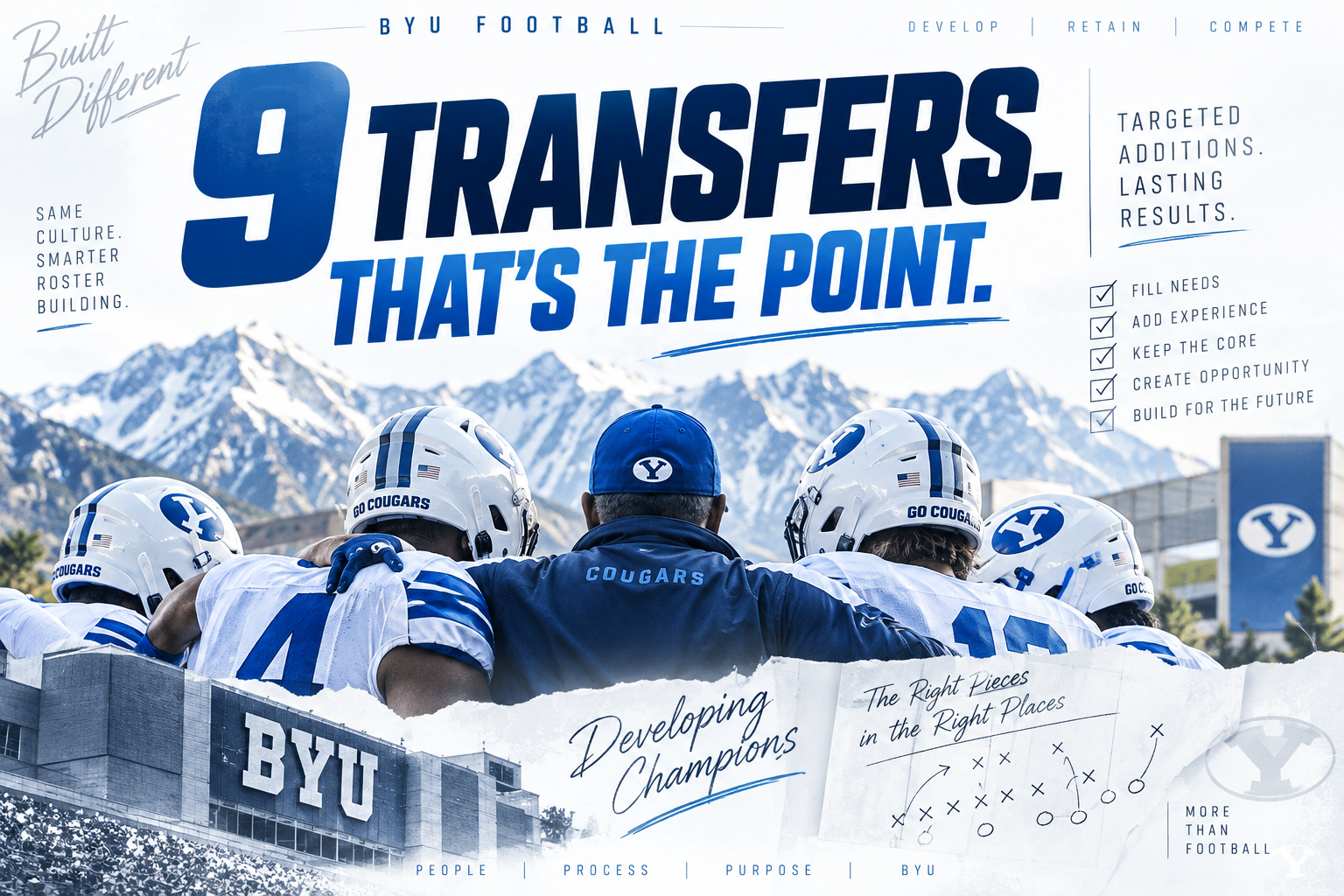
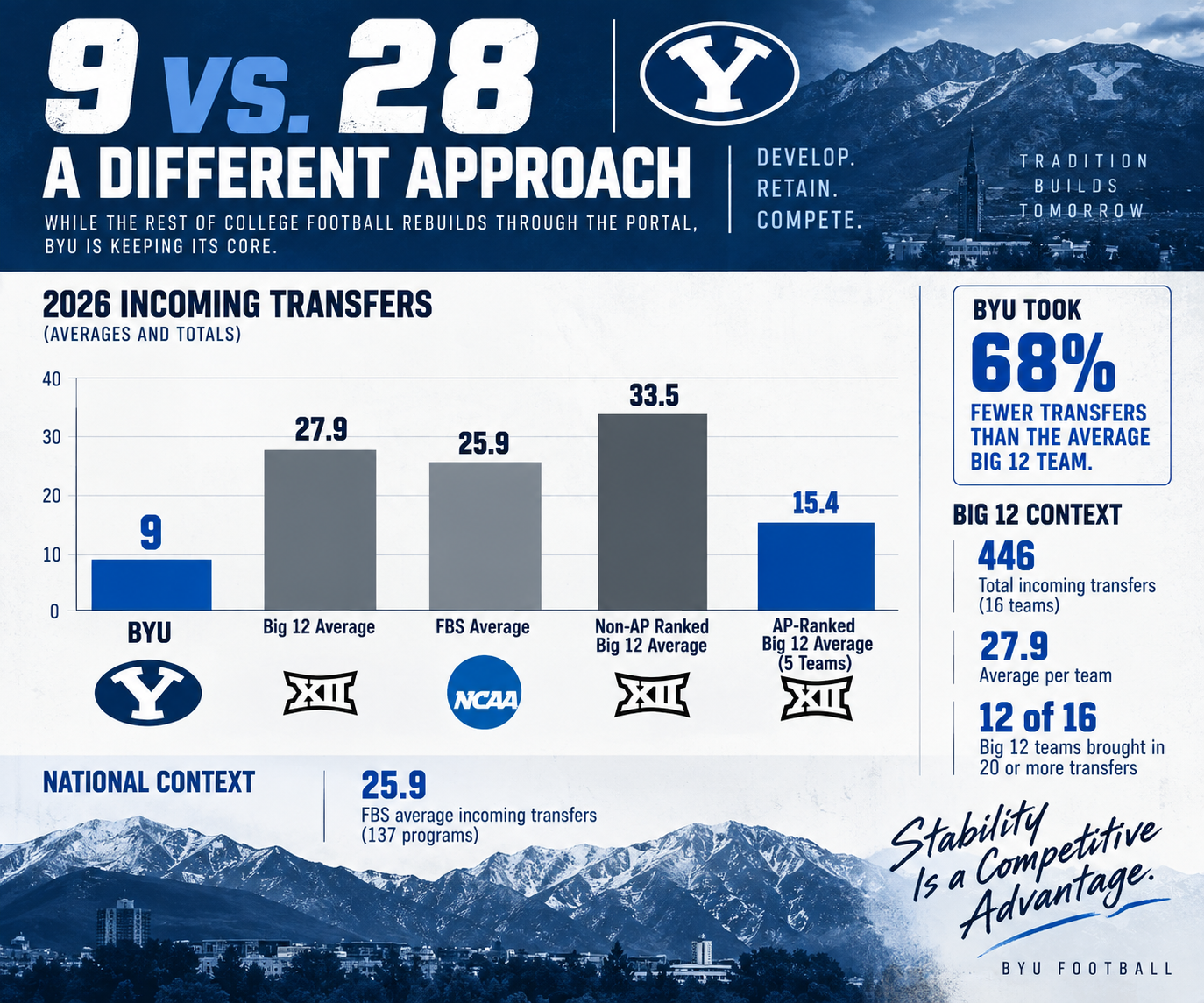
College football rosters are increasingly rebuilt every winter. BYU just did something very different. The Cougars added nine transfers for 2026. The Big 12 average was roughly 28 incoming transfers, while the FBS average was about 26. BYU took roughly one transfer for every three added by the typical conference opponent.
But the revealing number is 87.22. That was the 247Sports composite average of BYU's nine transfers, which BYU reported as the 15th-highest average transfer rating in the country. The Cougars didn't completely sit out the portal. They were unusually selective about whom they took and where they took them. Nine wasn't inactivity. It was roster triage.
BYU attacked the holes
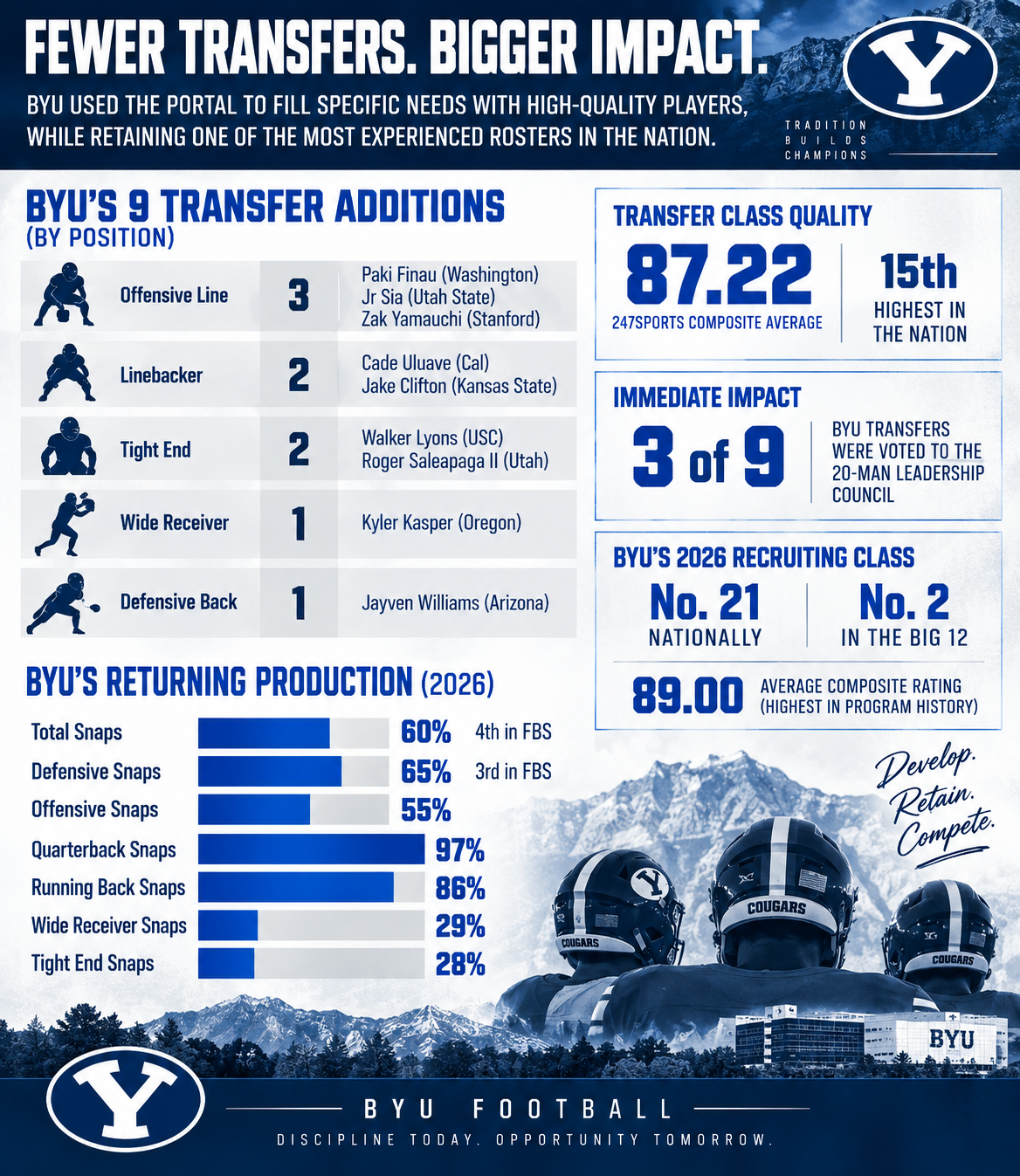
Break the nine additions down by position and the strategy becomes clearer: three offensive linemen, two linebackers, two tight ends, one wide receiver and one cornerback. That distribution lines up remarkably well with BYU's roster questions entering 2026.
At wide receiver, BYU had to replace its top two starting receivers from 2025, who combined for more than 1,700 receiving yards. But instead of importing an entirely new receiving corps, BYU signed one transfer: 6-foot-6 Oregon transfer Kyler Kasper.
Kasper is a former consensus four-star prospect who appeared in 23 games at Oregon. He adds size and experience to a room that already included Jojo Phillips, Tei Nacua, Tiger Bachmeier and Reggie Frischknecht, while BYU also signed four high-school receivers. It is a subtle but important roster-management decision.
BYU needed help at receiver. It didn't necessarily need replacements at receiver. The Cougars added one experienced player and left opportunities for players already in the program—and the freshmen they just recruited—to earn their way onto the field.
Linebacker was different
BYU saw a more immediate need at linebacker and acted accordingly, adding Cade Uluave from Cal and Jake Clifton from Kansas State. Clifton wasn't a developmental lottery ticket. He arrived as a two-year starter at Kansas State. Uluave was even more coveted: BYU identified him as 247Sports' top-rated transfer linebacker when announcing the class.
Yet BYU didn't clear out the room. Isaiah Glasker remained one of the leaders of the defense. Siale Esera, Ace Kaufusi, Maika Kaufusi and Miles Hall remained in the program, while Pierson Watson returned after redshirting in 2025.
BYU added high-end competition where it needed it without treating every returning player as someone who needed to be replaced. The early results are revealing, too. Uluave was voted a team captain before the season. Two other transfers, Roger Saleapaga II and Walker Lyons, were also elected to BYU's 20-man leadership council. Three of nine transfers becoming immediate members of the team's player-selected leadership group is a pretty good indication that BYU wasn't simply chasing portal rankings.
The offensive line got the biggest investment
If there was one position where BYU really attacked the portal, it was offensive line. Three of the nine transfers—33% of the entire class—were offensive linemen: Paki Finau from Washington, Jr Sia from Utah State and Zak Yamauchi from Stanford. Again, there was logic behind it.
Finau had already started at guard for Washington and was brought in to compete at tackle. Sia started 10 games for Utah State in 2025 and had experience at both guard and tackle. BYU needed competition and experience up front, so it spent one-third of its limited portal additions there. That looks less like collecting talent and more like solving a depth-chart equation.
There is a cost to recruiting over your own players
The transfer portal makes replacing a player incredibly easy. But there is a potential second-order effect that doesn't appear in recruiting rankings. Every incoming veteran changes somebody else's path to playing time.
Suppose BYU recruits a player out of high school, develops him for two seasons and believes he can eventually become a Big 12 starter. When that opportunity finally arrives, bringing in two experienced transfers ahead of him may improve competition—but it may also make the player BYU spent two years developing reconsider his future. It is especially relevant in an era when that player can enter the portal himself.
BYU can't prevent transfers, and there are many reasons players leave. But indiscriminately recruiting over developing players can contribute to roster churn. BYU's numbers suggest a different calculation: bring in a transfer when the upgrade or depth is worth it, but don't add one simply because you can.
BYU can do this because it retained a lot
The nine-transfer number becomes much more meaningful alongside another statistic. CBS Sports calculated that BYU entered 2026 returning 60% of its total offensive and defensive snaps, fourth-most in the FBS. The Cougars returned 65% of their defensive snaps, third nationally, along with 55% offensively.
At quarterback, BYU returned 97% of its snaps. At running back, it returned 86%. The obvious holes were elsewhere: only 29% of wide-receiver snaps and 28% of tight-end snaps returned. Now look at where BYU went shopping.
One receiver. Two tight ends. Three offensive linemen.
Two linebackers. One corner. The nine-player class is interesting because the portal additions largely correspond to places where BYU wanted additional experience, competition or production rather than simply replacing returning players across the board.
The portal isn't the enemy
Texas Tech is proof that an aggressive portal strategy can work. The Red Raiders have successfully used transfers to rapidly elevate their roster. There is no single correct formula for building a modern college football team. BYU's situation is different because it has something worth preserving.
The Cougars entered 2026 coming off a 12-win season with Bear Bachmeier back at quarterback, LJ Martin at running back and a defense returning 65% of its snaps. Meanwhile, BYU signed a high-school class ranked No. 21 nationally with an 89.00 average composite rating.
Those young recruits need a developmental path. So do the freshmen and sophomores already practicing in Provo. If every opening is automatically filled with an established transfer, eventually recruiting and developing high-school players becomes harder to sell. BYU's approach offers something different: come here, develop, and there is evidence the coaching staff will give its own players an opportunity rather than automatically shopping for their replacement.
Nine tells the story
The average Big 12 program brought in roughly 28 transfers. BYU brought in nine. Yet those nine had the 15th-highest average transfer rating nationally, while BYU returned the fourth-highest percentage of snaps in the FBS.
The important combination is selectivity alongside retention. BYU isn't trying to win without the transfer portal. It's trying to use the portal without becoming dependent on it.
Recruit high-school talent. Develop it. Retain it. Give young players a legitimate path to the field. Then identify the places where the roster actually needs outside help and pursue quality instead of quantity. Don't replace your development program. Reward it. If BYU can keep doing that, nine transfers isn't a sign that the Cougars are behind the rest of college football. It may be evidence that they don't need 28.
More BYU football originals
 The CFP May Get Bigger. BYU’s Standard Against Notre Dame Shouldn’tRead the original →
 Sione Moa Is Cleared. BYU Still Has to Decide How Much He Can Give Notre DameRead the original →
 Notre Dame Has 68 Blue-Chips to BYU’s 12. The Records Are Nearly IdenticalRead the original →
Questions about a source, update or correction? Contact the editor. Story updates are reflected in the published timestamp above.