
FEED THE COUGAR ORIGINAL · Football
BYU vs Colorado State Preview: The Stat Colorado State Can’t Survive Without
Colorado State’s defense has created eight takeaways through two games. BYU has given the ball away zero times. That contrast could decide Saturday’s game in Fort Collins.

The Rams’ formula is already clear Colorado State’s 35-13 victory over Wyoming was not simply a rivalry win. It was a blueprint for how the Rams can turn a talent gap into a competitive advantage.
Colorado State forced four turnovers, including three interceptions, and finished with a plus-four turnover margin. The defense limited Wyoming to 273 total yards, but the takeaways were the game’s most important statistic. Every extra possession gave the Rams another chance to separate from the Cowboys, and the third Wyoming turnover directly preceded a 57-yard Colorado State touchdown pass that pushed the margin to 21-13.
The Rams were also efficient when they had the ball. Hauss Hejny completed 23 of 33 passes for 214 yards and five touchdowns against Wyoming, while adding 39 rushing yards. But the defensive takeaways made that production more valuable. Colorado State did not need to win every possession; it only needed to keep turning Wyoming mistakes into additional opportunities. Colorado State’s game recap
That formula has continued into the season. Through two games, Colorado State is averaging 46.5 points and 537 total yards per game. The Rams have converted 50 percent of their third downs, averaged 7.9 yards per play and scored 12 offensive touchdowns. Their defense has forced eight opponent turnovers while Colorado State has committed only one, producing a plus-seven turnover margin through the opening two weeks. Colorado State’s 2026 cumulative statistics The problem for Colorado State is that BYU has shown almost no interest in cooperating.
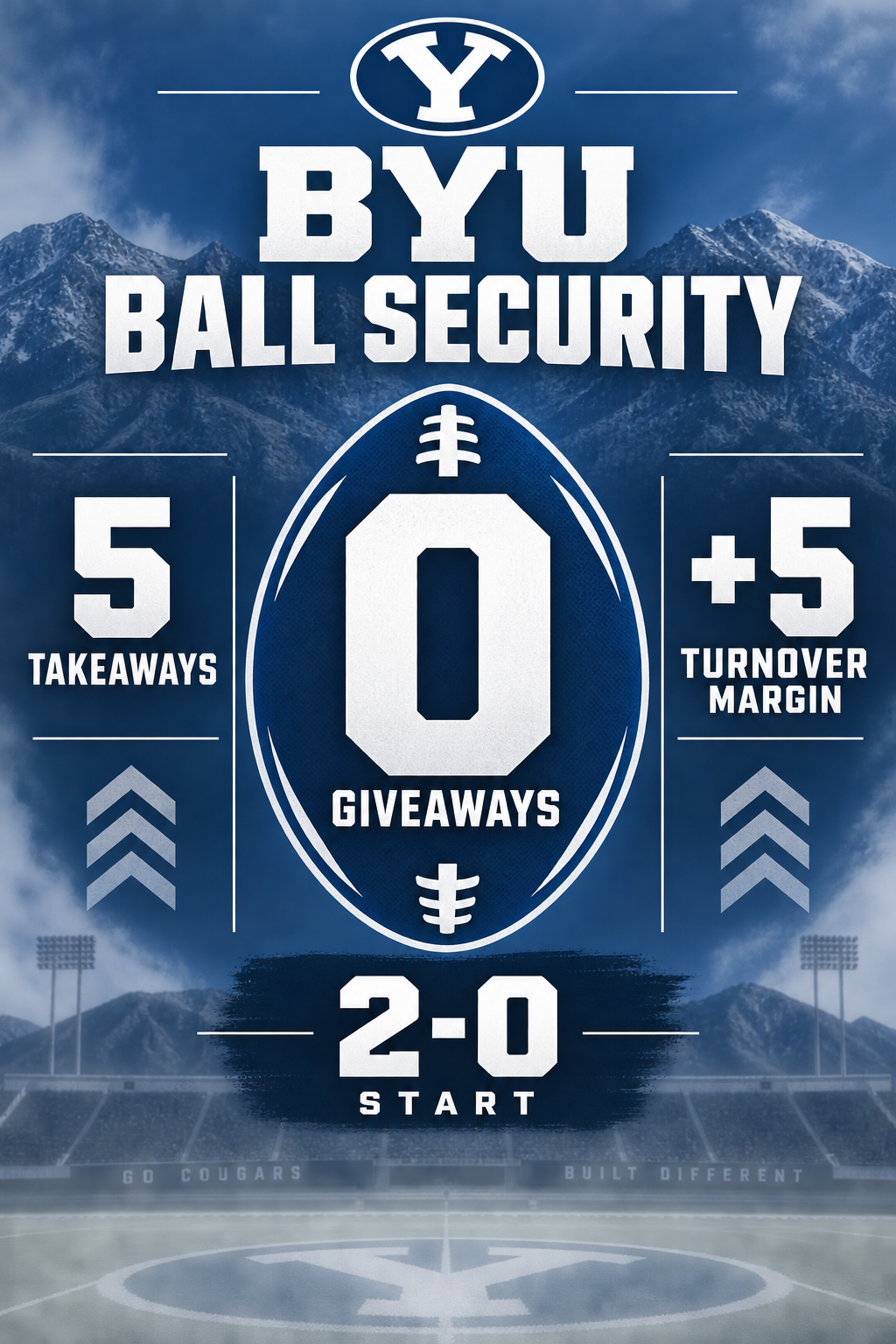
BYU has removed the easiest path to an upset The No. 15 Cougars are 2-0, and they have not committed a turnover in either game. That means Colorado State will enter Saturday’s matchup without any evidence that BYU’s offense will casually hand over a possession.
BYU has forced five turnovers while giving away none. The Cougars forced four takeaways in a 63-7 season-opening win over Utah Tech, then added an interception against Arizona in a 28-17 Big 12 victory. Against the Wildcats, Cade Uluave picked off Noah Fifita at the Arizona 26-yard line and returned the ball to the nine. Two plays later, Bear Bachmeier scored on a six-yard run.
That sequence is the turnover equation in its simplest form: one defensive play changed the field by 17 yards, and BYU turned the short field into seven points. The Cougars did not need a long drive or a series of explosive completions. The defense created the opportunity, and the offense finished it. BYU’s Arizona recap Big 12 box score
The larger numbers explain why that matters. BYU has scored 91 points in two games, averaging 45.5 per contest, while producing 886 total yards. The Cougar defense has allowed 24 points and 511 yards, an average of 12 points and 255.5 yards per game. BYU is not dependent on takeaways to function, but it has paired a clean offense with a defense that has already created five extra possessions. Through two games
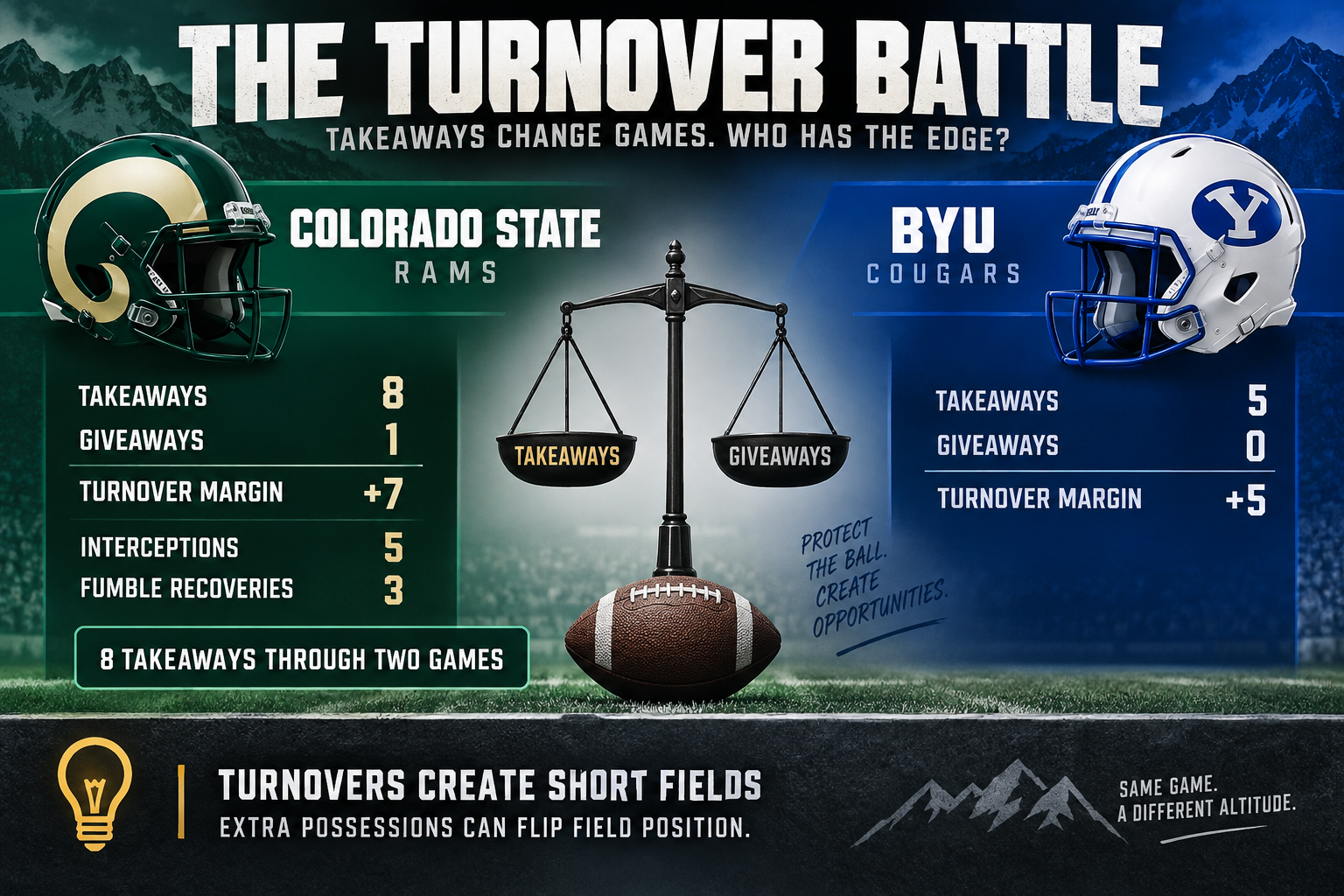
BYU Colorado State Record 2-0 2-0 Points per game 45.5 46.5 Total yards per game 443.0 537.0 Giveaways 0 1 Takeaways 5 8 Turnover margin +5 +7 The obvious caveat is sample size. Colorado State has played Wyoming and Southern Utah. BYU has played Utah Tech and Arizona. Two games cannot establish a permanent identity, and turnovers are volatile from week to week. A tipped pass, a bad snap or a quarterback taking one unnecessary risk can change a game instantly.
Still, the early evidence points in the same direction: Colorado State has been at its best when its defense creates extra possessions, while BYU has made ball security a defining strength. Can the Rams win without the turnover advantage? Yes—but the margin for error becomes much smaller.
Colorado State’s offense has enough firepower to score without short fields. Hejny has thrown for 539 yards, nine touchdowns and one interception through two games, completing 65.1 percent of his passes. The Rams have also rushed for 450 net yards, averaging 6.9 yards per carry. Those are not empty numbers. Colorado State can stress BYU vertically, create explosive plays and force the Cougars to defend the entire field.

But the Rams have not yet faced a defense with BYU’s combination of size, speed and early-season production. If Colorado State repeatedly starts drives at its own 25- or 30-yard line, it will have to string together long possessions against a Cougar defense that has already allowed only 12 points per game. Sustaining that level of efficiency for four quarters is a different challenge than capitalizing on a sudden short field.
BYU also showed against Arizona that it can win a game even when the opponent controls the early rhythm. Arizona led 17-14 at halftime and accumulated 240 yards in the first half. The Cougars adjusted, held the Wildcats to 87 yards after halftime—including minus-two rushing yards—and scored twice in the second half. BYU won 28-17 despite Arizona possessing the ball for 33:41, compared with 26:19 for the Cougars. Official Arizona-BYU box score
That is why a neutral turnover margin would not automatically make the game even. It would simply force Colorado State to win the matchup the conventional way: execute better on third down, protect Hejny, run efficiently and finish drives in the red zone. The pressure is on Colorado State’s defense
For BYU, the objective is straightforward. Protect the football, avoid negative plays and make Colorado State drive the length of the field. For the Rams, the objective is more demanding. They must continue creating the kind of disruption that fueled the Wyoming win. A sack-fumble would help. A tipped pass would help. A takeaway inside BYU territory could completely change the game. But if Colorado State finishes Saturday with zero takeaways, it will need to overcome a team that has yet to give an opponent a free possession.
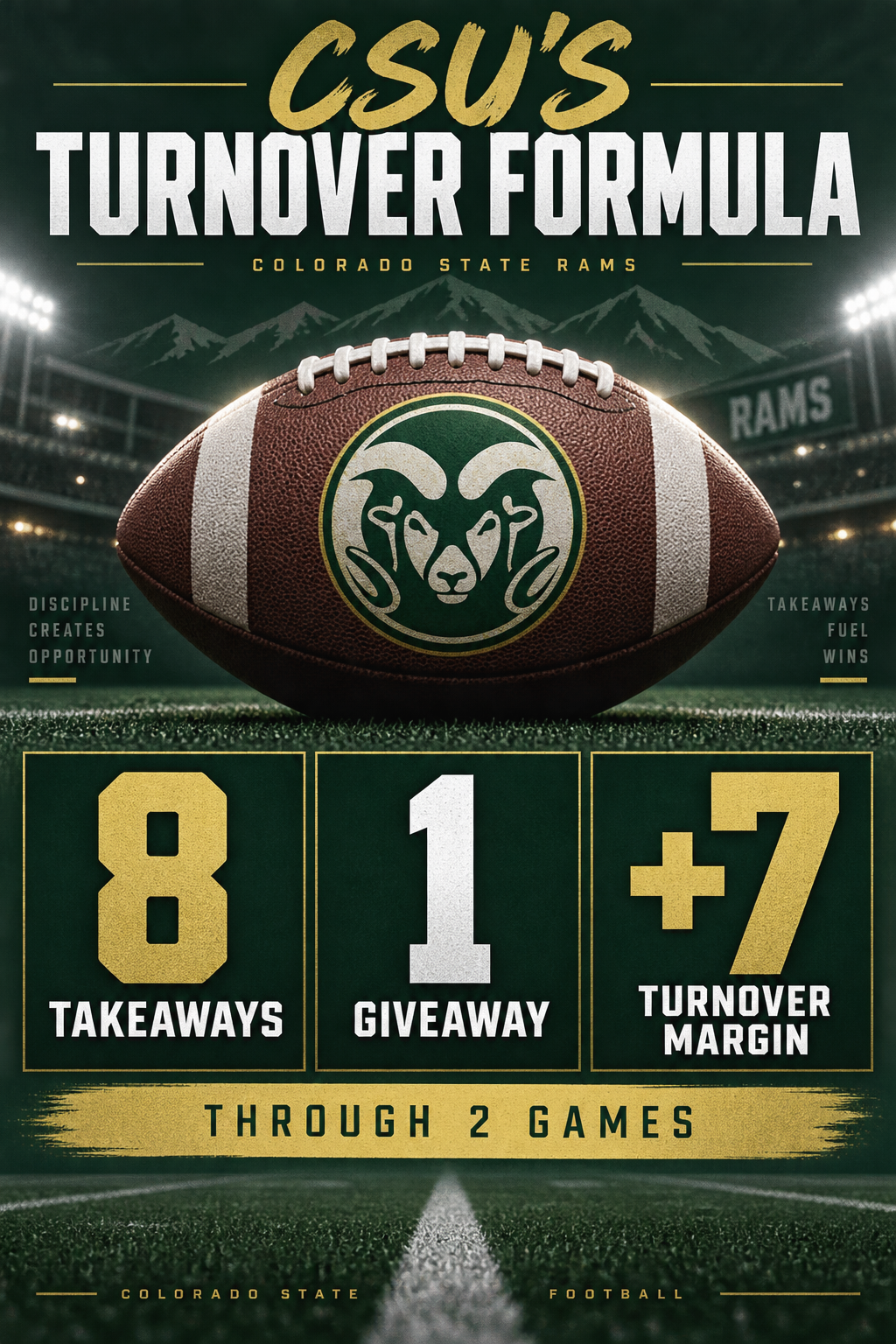
That is a difficult way to beat BYU. The Cougars are averaging nearly 45 points per game, have already won a Big 12 game, and have demonstrated that they can adjust when a game does not begin according to plan. Colorado State’s early-season turnover success is real, but it is also the Rams’ clearest path to controlling this matchup. The stat to watch is not merely whether Colorado State forces a turnover. It is whether Colorado State can win without one.
If the Rams create multiple takeaways, Saturday could look a lot like the Wyoming game: short fields, sudden momentum and a high-scoring Colorado State offense playing with a lead. If BYU remains clean, the game will likely be decided by sustained execution—and that is where the Cougars’ complete statistical profile gives them the advantage.
Colorado State does not need to dominate every category to beat BYU. It may only need one extra possession. But if the Rams cannot take that possession from the Cougars, they will have to prove they can keep up the hard way.
More BYU football originals
 BYU @ Colorado State: Where Colorado State Can Hurt BYU — and Where the Rams Could Get ExposedRead the original →
 BYU’s First Three Weeks by the Numbers: What the Stats Say About This TeamRead the original →
 The CFP May Get Bigger. BYU’s Standard Against Notre Dame Shouldn’tRead the original →
Questions about a source, update or correction? Contact the editor. Story updates are reflected in the published timestamp above.