
FEED THE COUGAR ORIGINAL · Football
Cardiac Cougars: The Numbers Behind BYU’s Late-Game Nerve
BYU has earned the “Cardiac Cougars” nickname again, going 8-2 in one-score games across 2024 and 2025. With six comeback wins in 2025 and multiple victories decided in the final minutes or overtime, the numbers show BYU has developed a real knack for surviving — and winning — high-pressure games.

There is a point in almost every close BYU football game when Cougar fans begin to recognize the feeling. The lead has disappeared. The opponent has momentum. The clock suddenly seems to move twice as fast. Every third down feels season-defining, and every possession carries the uncomfortable possibility that the game will come down to one final play.
For most teams, that kind of football is something to survive. For BYU, it has increasingly become an identity. The old nickname fits again: the Cardiac Cougars. That phrase is not something invented for the current era. BYU was using “Cardiac Cougars” more than two decades ago to describe teams that seemed incapable of taking the easy route to victory. What makes the nickname interesting today is that it is supported by more than nostalgia. Over the last two seasons, BYU has produced a remarkable collection of close wins, late rallies and games that looked lost until the Cougars found another possession, another stop or another scoring drive.
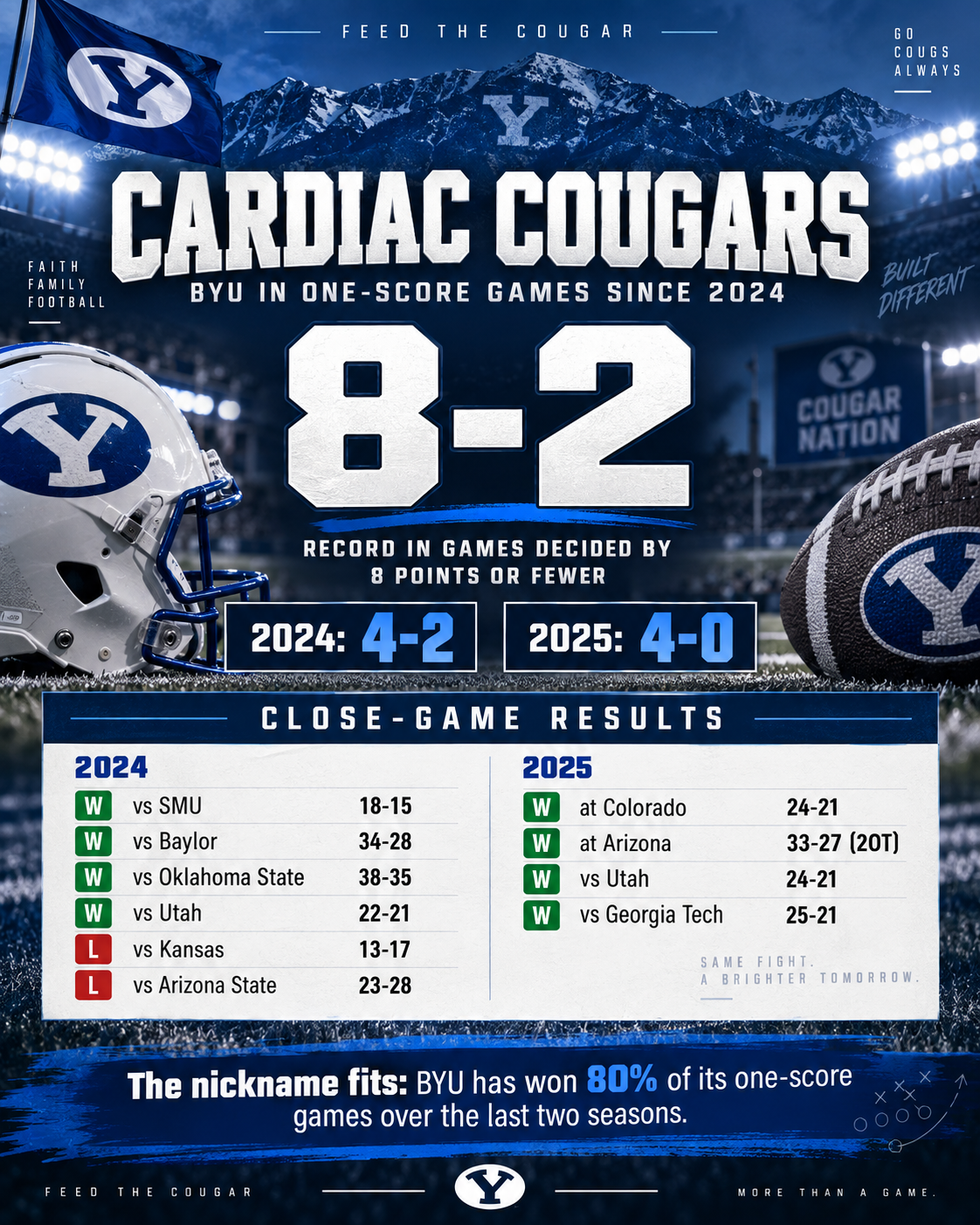
The numbers make the case. From the beginning of the 2024 season through the end of 2025, BYU went 8-2 in games decided by eight points or fewer. That is an .800 winning percentage in one-score games.
In 2024, BYU went 4-2 in those situations. The Cougars beat SMU 18-15, Baylor 34-28, Oklahoma State 38-35 and Utah 22-21. Their only one-score losses came against Kansas, 17-13, and Arizona State, 28-23. A year later, BYU became even harder to finish. The Cougars went 4-0 in one-score games in 2025, beating Colorado 24-21, Arizona 33-27 in double overtime, Utah 24-21 and Georgia Tech 25-21 in the Pop-Tarts Bowl.
Winning close games can sometimes be dismissed as luck. A tipped pass, a missed field goal or a favorable bounce can change a season. When it happens repeatedly, however, the explanation becomes more complicated. BYU has repeatedly been good when games become uncomfortable.
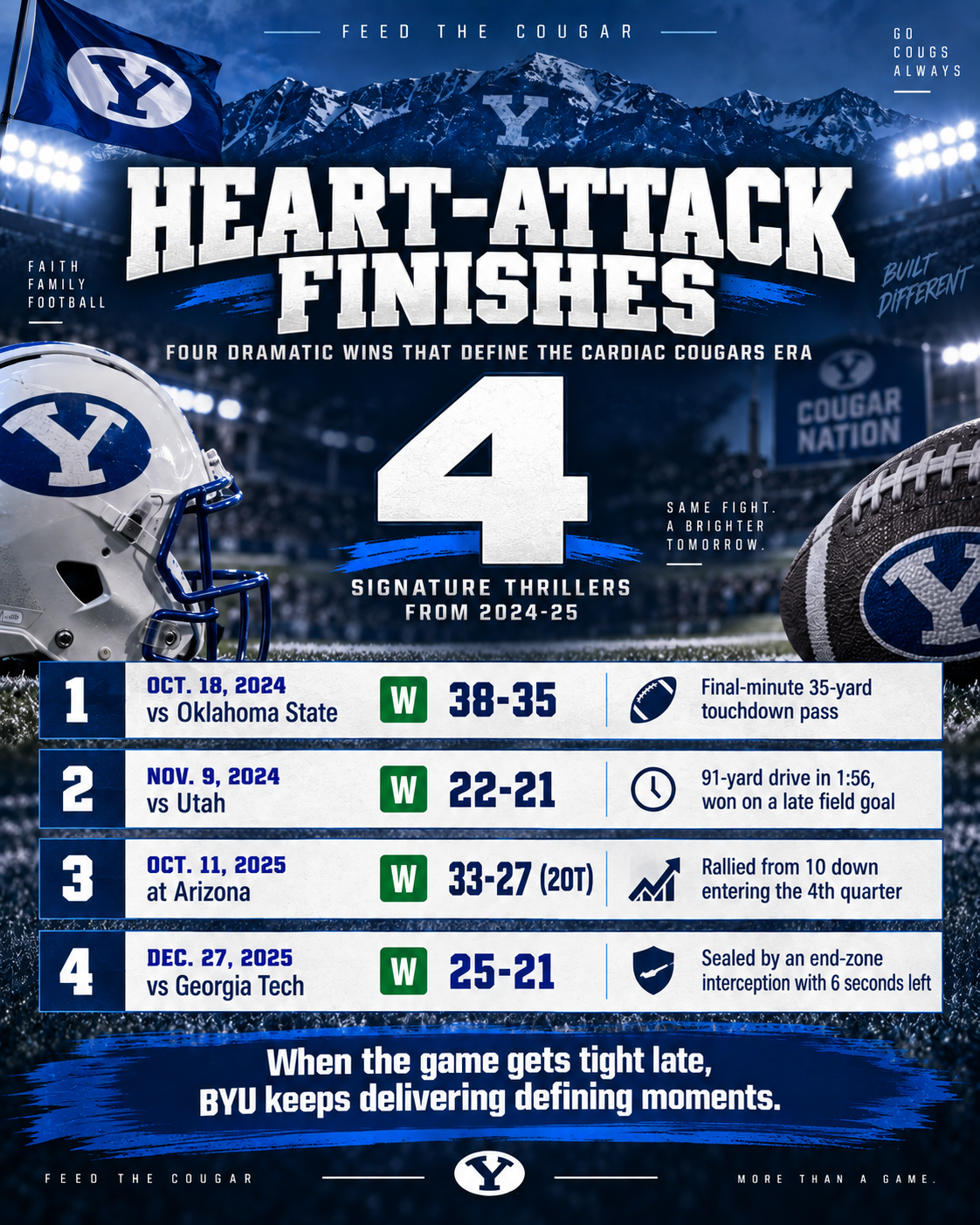
The Oklahoma State game in 2024 remains one of the clearest examples. The Cougars entered the final minute needing a touchdown and produced one, with Jake Retzlaff finding Darius Lassiter for the winning score in a 38-35 victory. It was the kind of finish that turns a strong season into something memorable. Then came Utah.
BYU received the ball at its own 9-yard line with 1:56 remaining, trailing 21-19 in Rice-Eccles Stadium. There was almost no margin for error. The Cougars needed to move nearly the length of the field quickly enough to give Will Ferrin a chance. They did.
Ferrin's field goal gave BYU a 22-21 victory and added another chapter to one of college football's most emotional rivalries. Those victories established the pattern. The 2025 team turned it into a habit.
BYU officially finished the 2025 season with six comeback victories, an extraordinary number for a team that won 12 games. The Cougars weren't simply protecting leads every week. They repeatedly found themselves behind and still found ways to change the game. At Colorado, BYU trailed 14-0 before recovering to win 24-21.
Against Arizona, the challenge became even more severe. BYU entered the fourth quarter trailing 24-14 after Arizona had scored 24 consecutive points. The Cougars were staring at the kind of road loss that usually ends quietly. Instead, they forced overtime. Then another overtime. Eventually BYU escaped Tucson with a 33-27 victory.
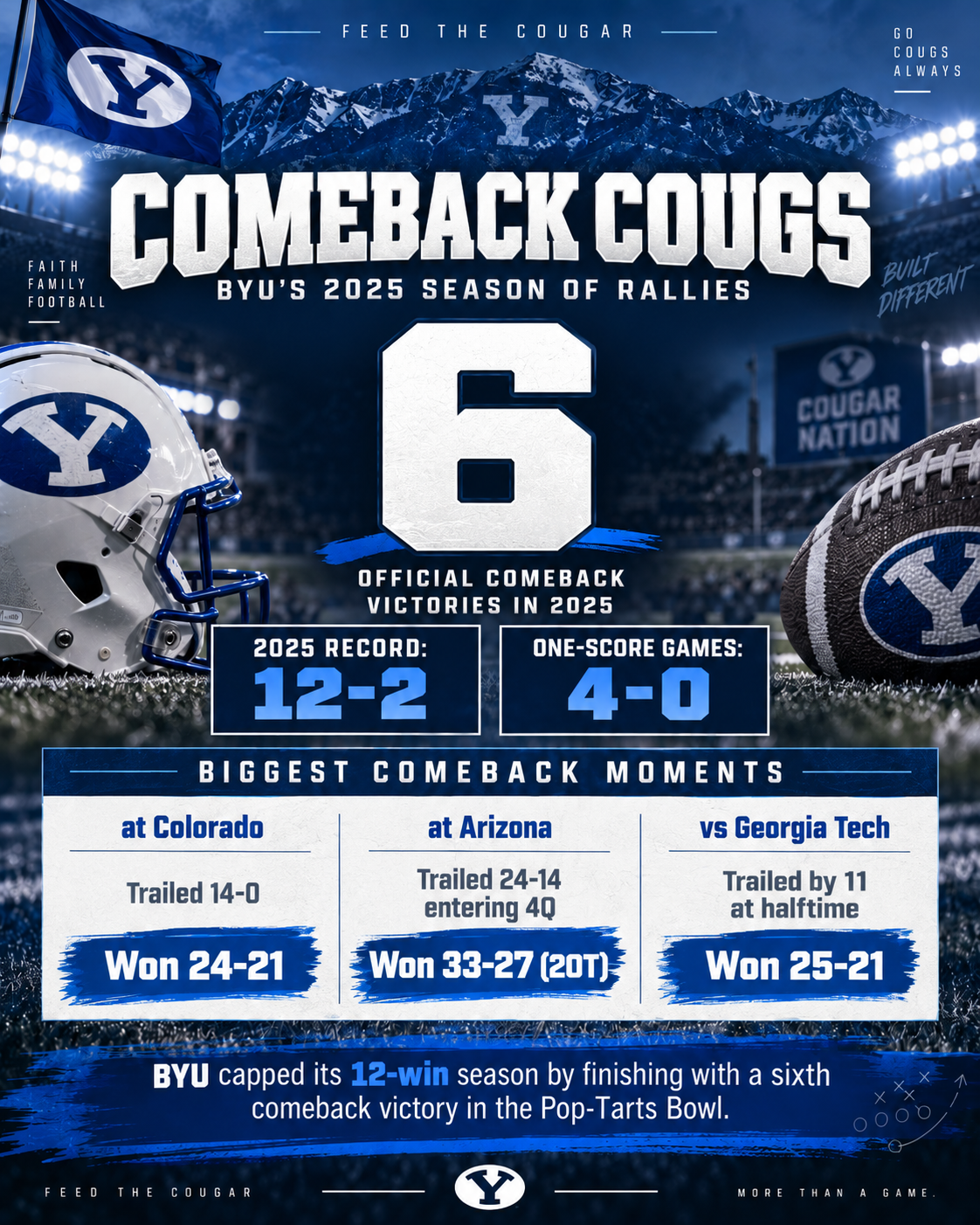
Perhaps the perfect ending to the Cardiac Cougars season came against Georgia Tech in the Pop-Tarts Bowl. BYU trailed by 11 points at halftime and faced a nationally ranked opponent with an offense capable of controlling the game. Yet the Cougars completely changed the second half. The defense shut out Georgia Tech after halftime, while the offense gradually erased the deficit.
Even then, the drama wasn't finished. Georgia Tech had one final opportunity to steal the game before Evan Johnson intercepted a pass in the end zone with six seconds remaining. Final score: BYU 25, Georgia Tech 21.
It was BYU's sixth comeback victory of the season, its 12th win overall and another game that remained undecided until essentially the final snap. That matters because close-game success tells us something that traditional statistics often miss.
Points per game can measure offensive production. Yards per play can measure efficiency. Turnover margin can reveal which team is consistently creating extra possessions. But none of those statistics completely capture what happens when a game reaches its final five minutes and both teams know one mistake could decide everything. BYU has become unusually comfortable there.
The Cougars have won with offense. They have won with defense. They have won with late field goals, touchdown drives, turnovers and overtime possessions. That variety makes the trend more convincing.
It isn't one quarterback carrying the team every time. It isn't one kicker rescuing them. It isn't the defense producing every defining play. Different players keep answering the same question.
What happens when BYU absolutely has to make a play? More often than not recently, someone makes it. That doesn't mean close-game success is guaranteed to continue forever. Football has too much randomness for that. Teams that consistently live within one possession eventually lose some of those games. BYU already experienced that reality in 2024 against Kansas and Arizona State. But an 8-2 record across 10 one-score games is difficult to ignore.
There is also something psychological happening with a team that repeatedly survives these moments. Players begin to believe that being behind is not the same thing as being beaten. A 10-point fourth-quarter deficit becomes a problem to solve rather than a reason to panic. A final two-minute drive becomes familiar territory. A defense protecting a four-point lead knows it has already faced this situation before.
And opponents know it too. When BYU stays within striking distance late, the Cougars carry evidence that the game is not finished. That may be the most important part of the Cardiac Cougars identity.
It is not simply that BYU plays close games. Lots of teams play close games. It is that BYU has developed an unusual ability to win them.
Eight wins in 10 one-score games. A perfect 4-0 record in those situations in 2025. Six comeback victories in one season. Late-game wins against Oklahoma State and Utah. A double-overtime escape at Arizona. An 11-point bowl comeback finished by an interception with six seconds remaining. At some point, the nickname stops being a joke about stressed-out fans. It becomes a statistical description. The Cardiac Cougars are back.
More BYU football originals
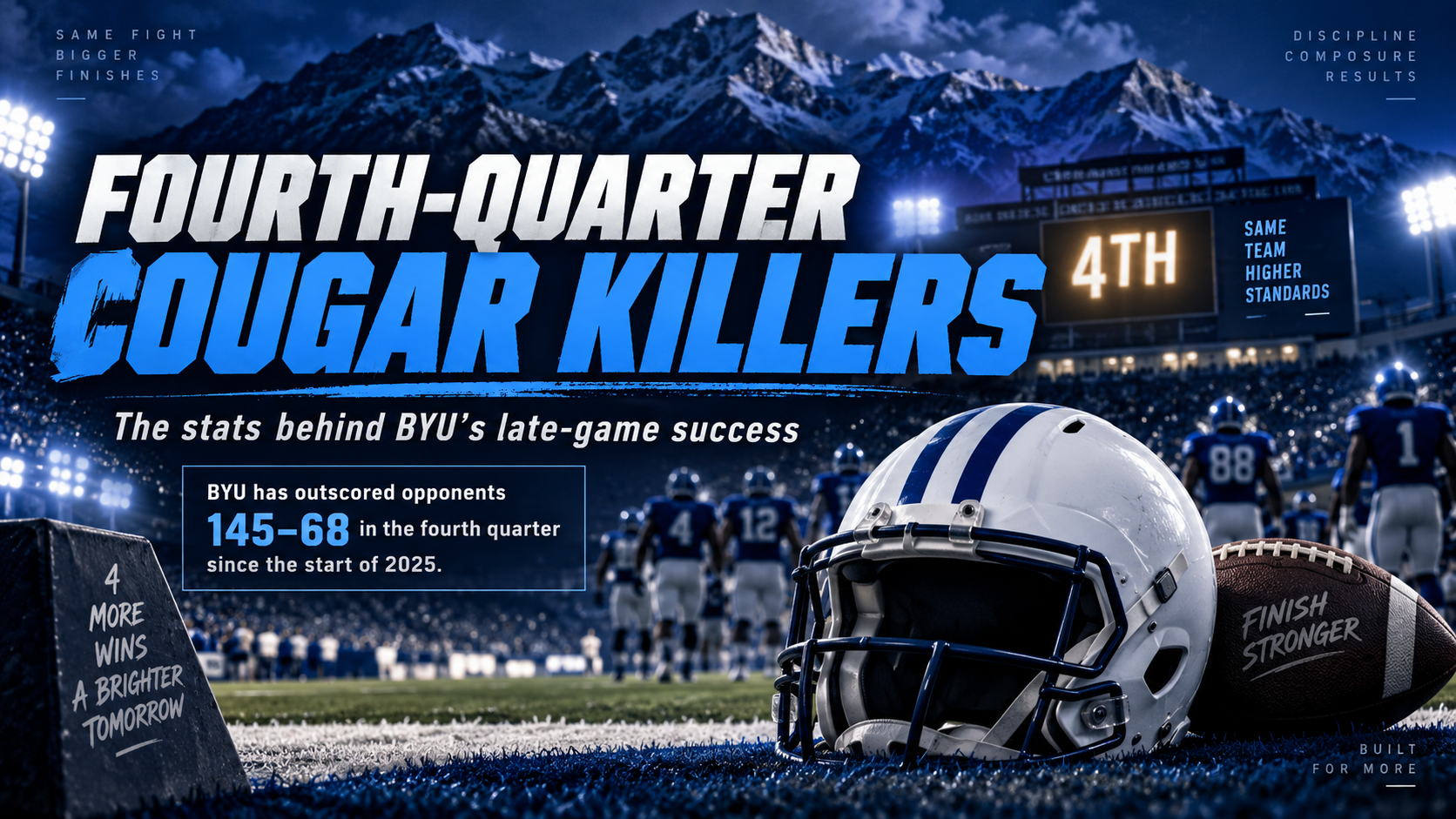 The Fourth-Quarter Cougar Killers: The Stats Behind BYU’s Late-Game SuccessRead the original →
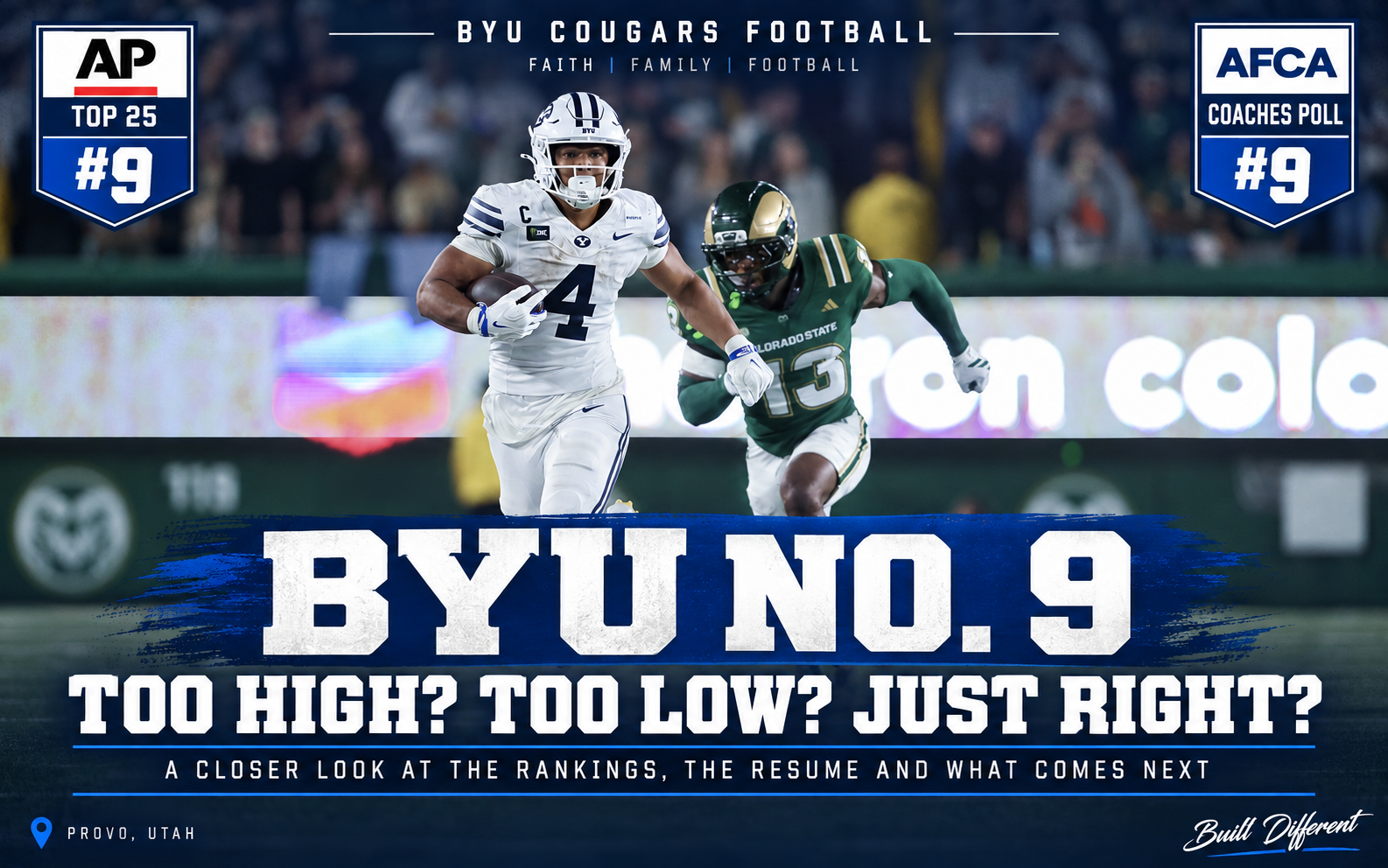 BYU Is No. 9: Too High, Too Low or Just Right?Read the original →
 The CFP May Get Bigger. BYU’s Standard Against Notre Dame Shouldn’tRead the original →
Questions about a source, update or correction? Contact the editor. Story updates are reflected in the published timestamp above.