
FEED THE COUGAR ORIGINAL · Football
How BYU moved up in today’s national polls: The votes and stats behind the jump
BYU rose to No. 11 in the AP poll and No. 13 in the Coaches Poll. Vote totals and second-half stats explain how the Cougars made the jump.

BYU did not merely benefit from teams above it losing Saturday. Voters gave the Cougars substantially more support after their 28-17 win over Arizona. The Cougars moved from No. 15 to No. 11 in Sunday’s Associated Press Top 25 and from No. 15 to No. 13 in the US LBM Coaches Poll. More revealing than the four-spot and two-spot jumps, however, are the points attached to those rankings.
- AP Top 25: No. 15 and 840 points last week; No. 11 and 966 points this week — up 126 points (15.0%) and four ranking spots.
- Coaches Poll: No. 15 and 838 points last week; No. 13 and 975 points this week — up 137 points (16.3%) and two ranking spots.
Both polls award 25 points for a first-place vote, 24 for second and so on through one point for 25th. BYU’s double-digit percentage gains therefore represent a broad improvement in where voters placed the Cougars on their ballots—not just two teams vacating spots above them.
Why the AP jump was four spots
Last week, BYU sat in a tightly packed AP group. The Cougars’ 840 points trailed No. 14 USC by 21, No. 13 Texas Tech by 60 and No. 12 Alabama by 70.
This week, BYU passed both USC and Texas Tech. The Cougars’ 966 points put them 22 ahead of the Trojans and 56 ahead of the Red Raiders. In other words, BYU gained 126 points while USC gained 83 and Texas Tech only 10.
Two major upsets supplied the other half of the climb. Oregon plunged from No. 6 to No. 21 after losing 39-31 at Oklahoma State, and Oklahoma dropped from No. 11 to No. 24 after a 17-10 loss to Michigan. Those two falls opened two places; BYU earned the other two by moving ahead of USC and Texas Tech in total ballot points.
That arithmetic also shows where the next ceiling sits. Alabama remained No. 10 and increased its advantage over BYU from 70 points to 102. The Cougars are the highest-ranked Big 12 team in the AP poll, ahead of No. 13 Texas Tech, No. 17 Utah and No. 22 Houston, but the top 10 remains a distinct tier for now.
Why the Coaches Poll moved less
BYU’s Coaches Poll support actually grew more than its AP support: a 137-point increase compared with 126. Yet the Cougars rose only two places because the teams immediately ahead of them also gained ground.
USC went from 919 to 1,023 points, and Texas Tech moved from 955 to 977. BYU did not pass either one, but it nearly erased its deficit to the Red Raiders—from 117 points last week to only two this week.
Instead, the Cougars’ two-place rise came as Oregon fell 12 spots to No. 18 and Oklahoma fell 11 spots to No. 21. The Coaches Poll therefore tells a slightly different story from the AP poll: BYU’s standing improved significantly on individual ballots, but USC and Texas Tech remained just ahead of it in the aggregate ranking.
The Arizona numbers that strengthened BYU’s case
The result had more résumé value than BYU’s 63-7 opener against Utah Tech. Arizona entered the weekend receiving 33 AP points and 42 Coaches Poll points, so voters already viewed the Wildcats as a team near the Top 25. It also was BYU’s Big 12 opener.
The most persuasive part of the win was the halftime adjustment. Arizona gained 240 yards and scored 17 points in the first half. After halftime, BYU held the Wildcats scoreless, limited them to 87 yards and allowed minus-2 rushing yards. That defensive finish was paired with a clean offensive profile:
- Quarterback Bear Bachmeier accounted for all four BYU touchdowns, throwing for 217 yards and three scores while adding 37 yards and a touchdown on the ground.
- Bachmeier completed passes to eight receivers. Kyler Kasper caught four for 51 yards and two touchdowns, while Legend Glasker’s 61-yard reception set up the fourth-quarter score that created the final margin.
- Running back LJ Martin carried 20 times for 98 yards—4.9 per attempt—and helped BYU drain the clock late.
- Tausili Akana recorded 2.5 of BYU’s three sacks. Cade Uluave added an interception that he returned inside Arizona’s 10-yard line.
Through two games, BYU has outscored opponents 91-24, an average margin of 33.5 points. The offense is averaging 45.5 points, the defense is allowing 12.0, and the Cougars have forced five turnovers. Bachmeier has produced 415 passing yards, 67 rushing yards and eight total touchdowns.
Those numbers help explain why the voters treated the Arizona win as confirmation rather than survival. BYU did trail 17-14 at halftime and did not dominate the full game. But it paired quarterback production with a decisive second-half defensive response and finished an 11-point conference win against an opponent already receiving national votes.
The distinction matters: poll movement is always relative, and losses by Oregon and Oklahoma created room. But BYU’s rise was not an automatic elevator. The Cougars increased their vote total by roughly 15% in both polls, passed two teams in the AP tally and came within two Coaches Poll points of passing Texas Tech.
BYU’s next chance to build on that support comes Saturday at Colorado State. Another win would preserve the 2-0 start’s momentum. A move into the top 10, though, likely will require either a wider separation from the teams behind BYU or another opening above it.
Sources
- Associated Press: Sept. 13 AP Top 25 movement
- CBS Sports: Sept. 13 AP Top 25 vote totals
- CBS Sports: Sept. 13 Coaches Poll vote totals
- Associated Press poll table: Sept. 8 rankings and points
- Yahoo Sports: Sept. 8 Coaches Poll rankings and points
- BYU Athletics: BYU 28, Arizona 17
- BYU Athletics: BYU 63, Utah Tech 7
- BYU Athletics: 2026 football schedule
More BYU football originals
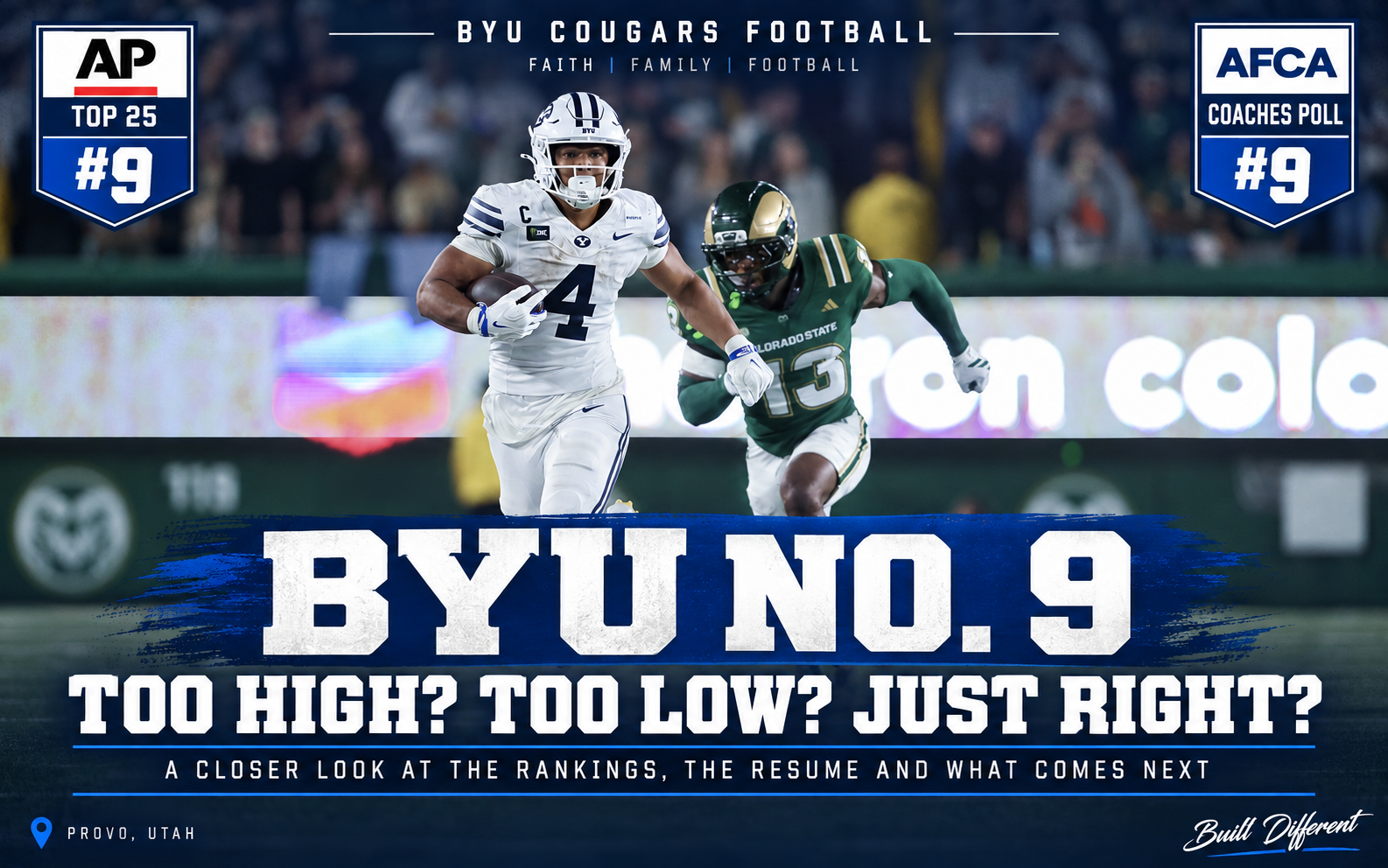 BYU Is No. 9: Too High, Too Low or Just Right?Read the original →
 BYU Football Is #11 - Why The Voters Are Buying their RésuméRead the original →
 The CFP May Get Bigger. BYU’s Standard Against Notre Dame Shouldn’tRead the original →
Questions about a source, update or correction? Contact the editor. Story updates are reflected in the published timestamp above.