
FEED THE COUGAR ORIGINAL · Football
BYU Football Is #11 - Why The Voters Are Buying their Résumé
Why BYU jumped USC and Texas Tech, what the computers still don’t believe, and whether Cougar fans’ complaints about national bias are supported by the numbers
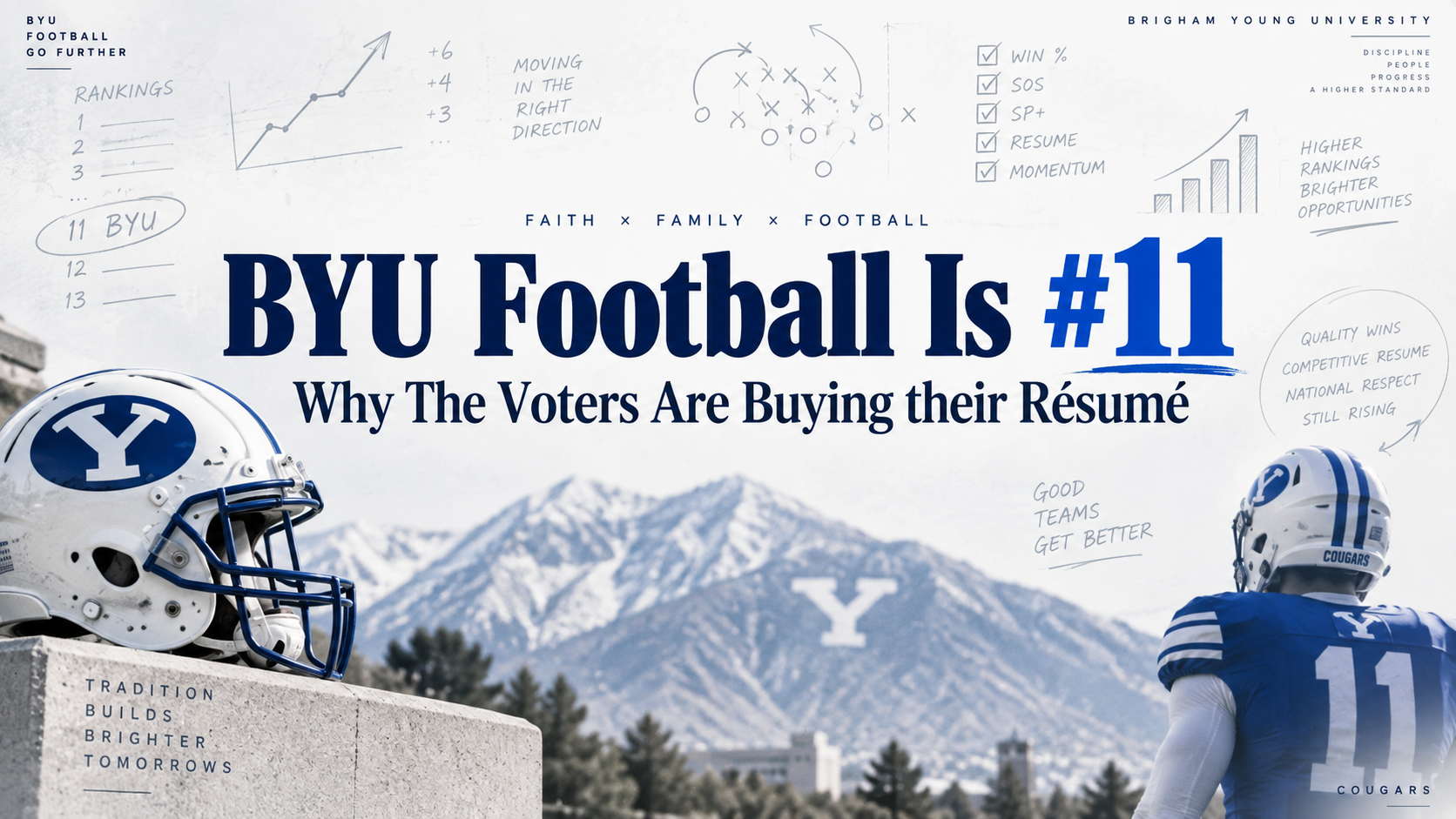
BYU’s four-place jump to No. 11 in the Associated Press poll looks dramatic. The more interesting story, however, is not that the Cougars moved four positions. It is how they got those four positions. Two were essentially available.
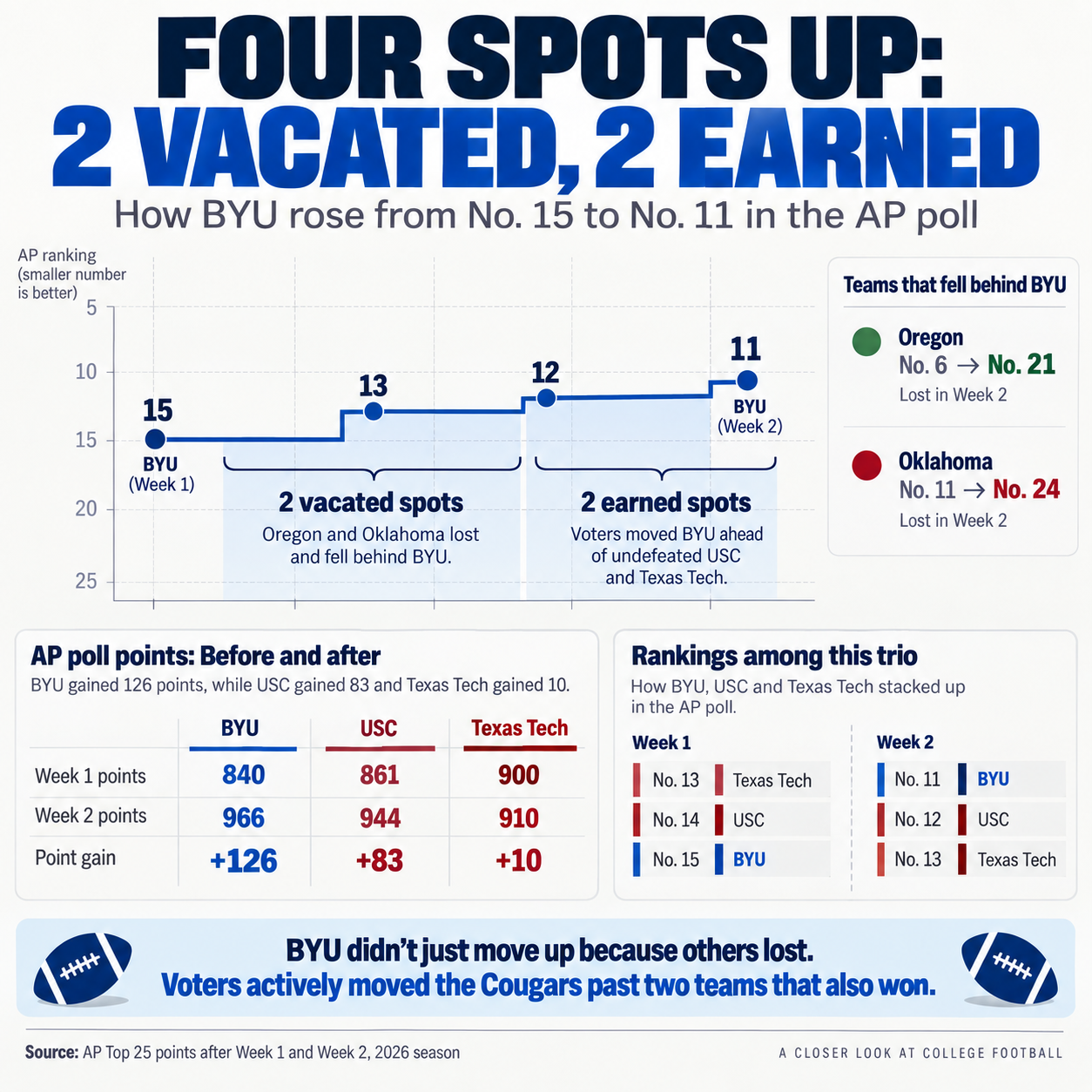
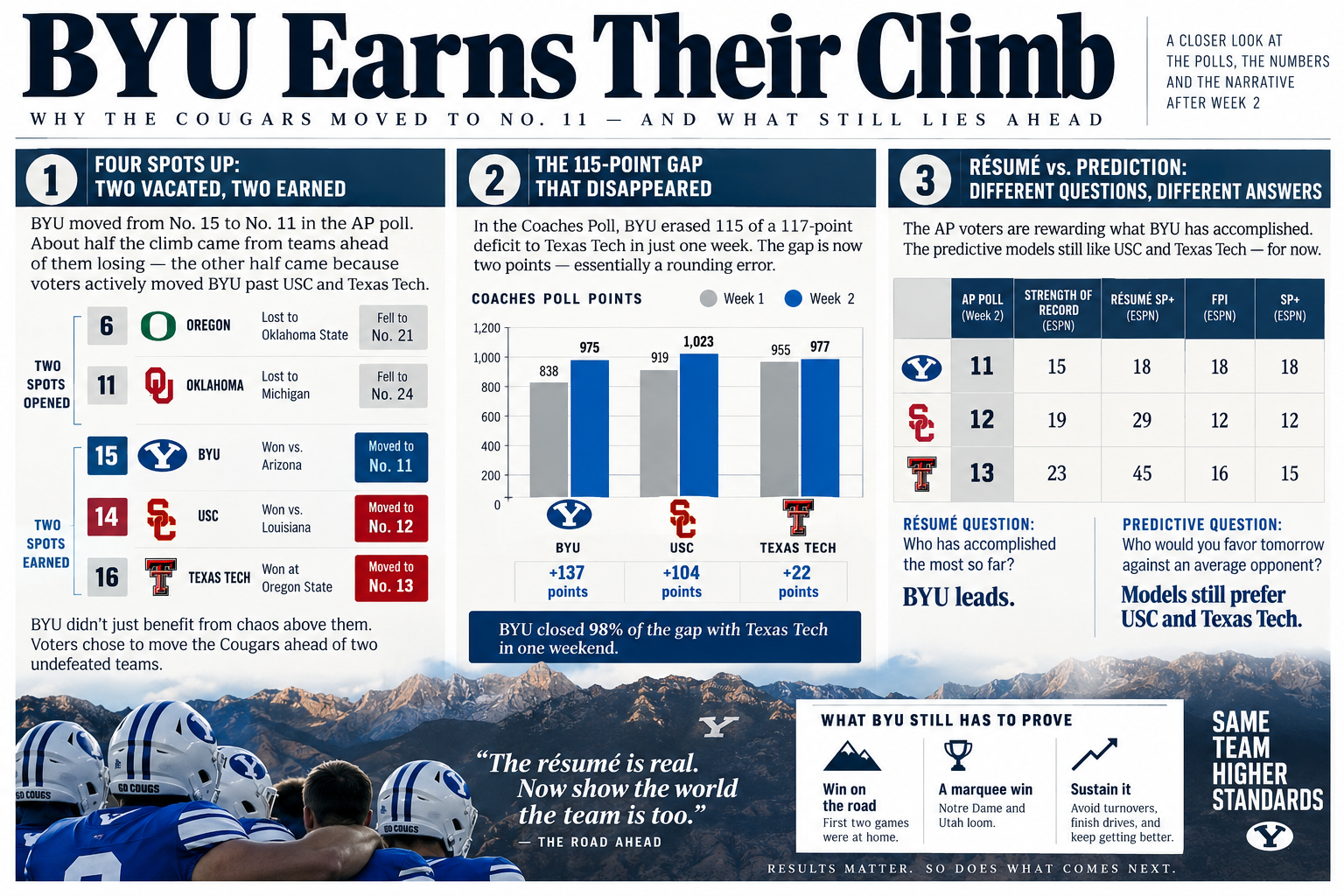
No. 6 Oregon lost to Oklahoma State and collapsed to No. 21. No. 11 Oklahoma lost to Michigan and fell to No. 24. If every undefeated team around BYU had simply remained in the same relative order, the Cougars would have moved from No. 15 to approximately No. 13 just by surviving the weekend. But BYU landed at No. 11.
That means voters did something more important: they actively moved BYU ahead of two undefeated teams that also won — USC and Texas Tech. After beating Arizona 28-17, BYU moved to No. 11 with 966 AP points. USC beat Louisiana 49-30 and sits No. 12 with 944. Texas Tech won at Oregon State 35-24 and is No. 13 with 910. The previous week, the order was reversed: Texas Tech had 900 points, USC 861 and BYU 840. So BYU didn't merely rise because other teams failed. BYU changed voters' minds.
The hidden number behind BYU's jump
Poll positions can be misleading because they depend on what happens around a team. Poll points tell us more about what voters themselves actually did. There were 69 AP voters in the previous poll and 68 this week, so simply comparing raw point totals slightly understates the need to normalize the numbers. Divide each team's points by the number of voters and BYU went from 12.17 points per ballot to 14.21.
Because an AP voter awards 25 points for No. 1, 24 for No. 2 and so forth, that increase is roughly equivalent to voters collectively moving BYU two full places higher on an average ballot. USC improved by about 1.40 ballot positions. Texas Tech improved by only about 0.34.
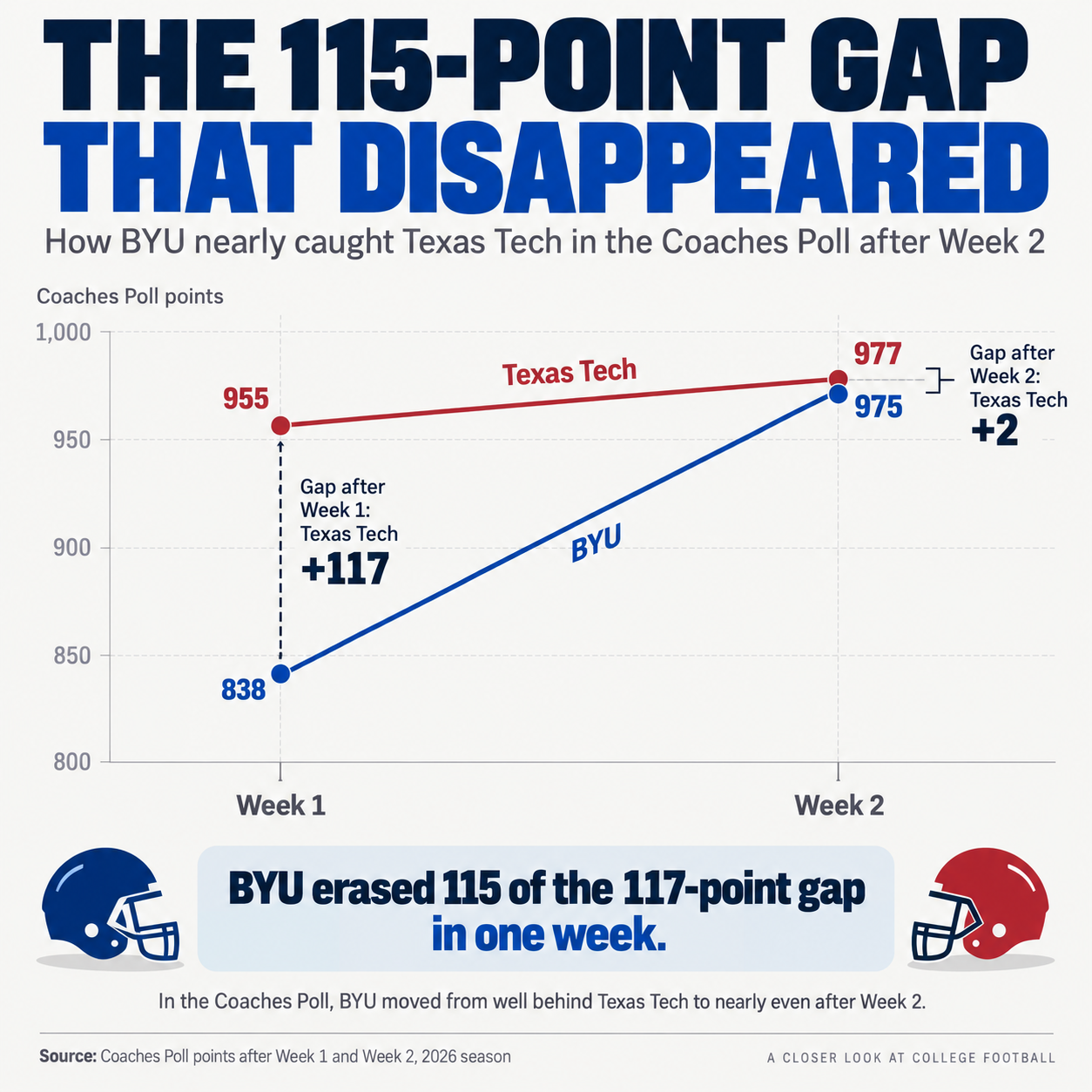
The Coaches Poll tells almost exactly the same story, even though its headline ranking looks less favorable to BYU. Last week BYU had 838 points, compared with 919 for USC and 955 for Texas Tech. This week BYU has 975, USC 1,023 and Texas Tech 977. BYU therefore erased 115 of its 117-point deficit to Texas Tech in one weekend. The coaches now separate Texas Tech and BYU by two points out of nearly 1,000. That is essentially a rounding error masquerading as a ranking position.
Normalize the Coaches Poll by its 74 voters and BYU gained the equivalent of about 1.85 ballot positions. USC gained 1.41. Texas Tech gained 0.30. That is perhaps the strongest statistical finding of the entire exercise:
Both groups of voters upgraded BYU more than they upgraded USC or Texas Tech. The AP movement happened to push BYU across both teams. The coaches stopped about two points short of pushing BYU across Texas Tech.
Why Arizona changed the equation
BYU beat Utah Tech 63-7 in the opener and actually slipped from a preseason tie for No. 14 to No. 15 in the AP poll. That looked like disrespect if viewed only through rankings, but statistically it was mostly noise. USC and BYU had been tied at No. 14; one week later USC simply accumulated 21 more points. More importantly, destroying an FCS opponent tells voters relatively little about how good a team is. A top-15 team is supposed to destroy an FCS opponent.
Arizona represented a much stronger information signal. The Wildcats went 9-4 in 2025, finished 6-3 in the Big 12 and returned first-team All-Big 12 quarterback Noah Fifita. Arizona also entered the BYU game with 33 AP points, making it one of the teams sitting just outside the Top 25.
BYU didn't dominate Arizona from kickoff. In some ways, that actually made the second half more informative. Arizona led 17-14 at halftime after gaining 240 yards. BYU then shut the Wildcats out over the final 30 minutes and held them to 87 total yards and minus-2 rushing yards after halftime. Bear Bachmeier finished with 217 passing yards, three passing touchdowns, 37 rushing yards and another score. BYU won 28-17 without Bachmeier throwing an interception. That is a very different type of evidence from beating Utah Tech by 56. BYU faced resistance from a credible conference opponent, adjusted, and controlled the second half.
Why BYU passed USC and Texas Tech
This is where résumé rankings and power ratings begin telling different stories. USC is probably still considered the stronger team by many predictive systems. Texas Tech is too.
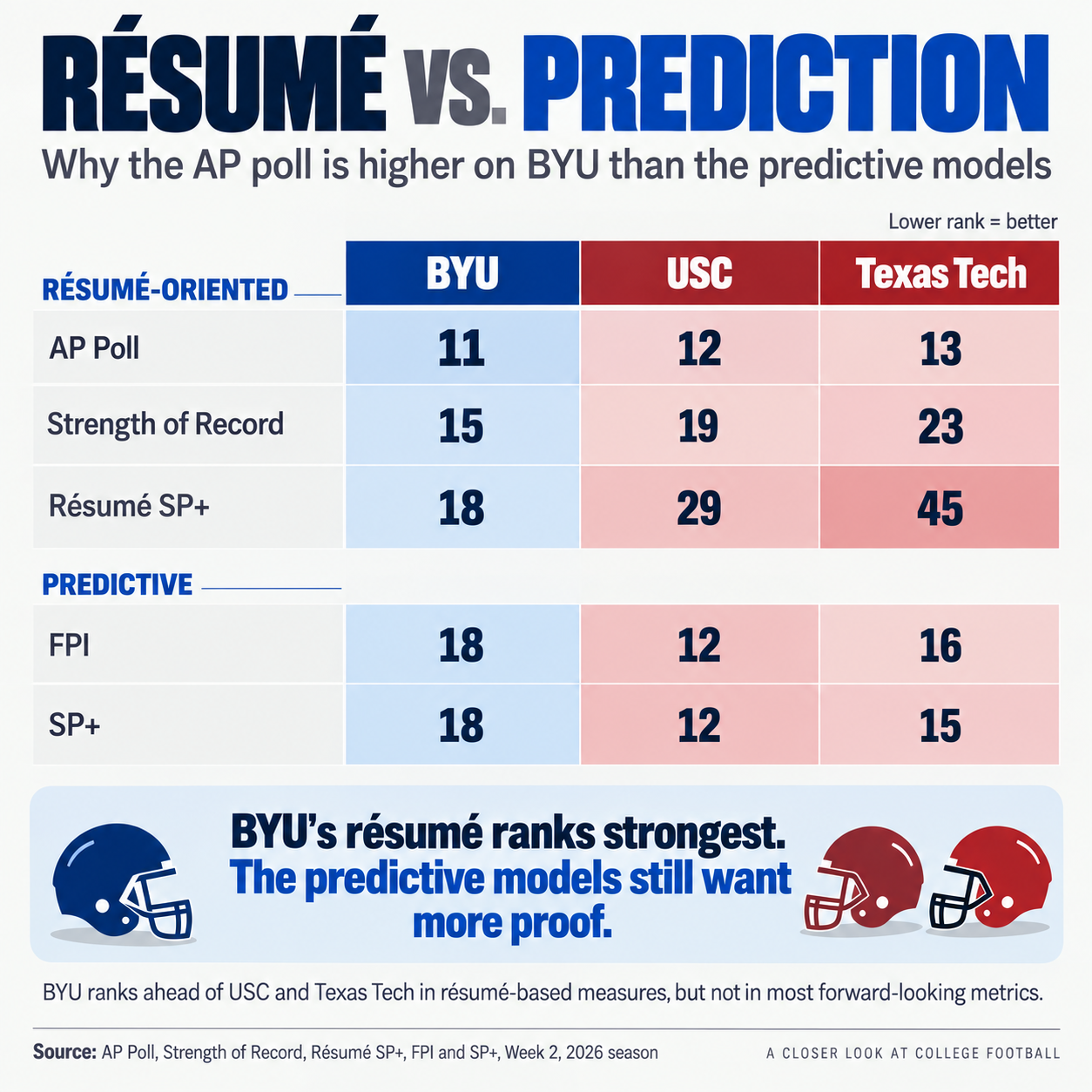
ESPN's current FPI ranks USC No. 12, Texas Tech No. 16 and BYU No. 18. FPI projects BYU at roughly 9.1 wins and gives the Cougars a 33.6% chance of reaching the College Football Playoff. Texas Tech is slightly higher at 35.2%.
SP+ reaches essentially the same conclusion. Its forward-looking rankings put USC No. 12, Texas Tech No. 15 and BYU No. 18. BYU's overall SP+ rating is 16.8, compared with 19.5 for USC and 19.1 for Texas Tech. If the question is:
"Who would I favor tomorrow against an average opponent?" the computers still prefer USC and Texas Tech. But change the question to: "Who has accomplished the most so far?" and BYU jumps in front.
ESPN's Strength of Record currently places BYU 15th nationally, USC 19th and Texas Tech 23rd. Résumé SP+ is even more dramatic: BYU ranks 18th, USC 29th and Texas Tech 45th. Résumé SP+ compares what a team actually did with what an elite team would have been expected to do against the same schedule. That is the statistical explanation for No. 11 BYU.
The AP voters appear to be asking a more résumé-oriented question than the predictive models. Texas Tech's 35-24 win at Oregon State looks respectable until the underlying performance is examined. Oregon State outgained Tech 472-352 and averaged 6.6 yards per play to Tech's 4.8 before the Red Raiders pulled away late.
USC scored 49 points against Louisiana, and its offense remains legitimately dangerous, but the Trojans also allowed 30 points and 358 yards. BYU's opponent was better, BYU's defensive performance was better, and the Cougars produced the weekend's strongest résumé result of the three. The voters noticed.
So is No. 11 too high?
Possibly — if you believe rankings should predict the future. Probably not — if rankings should reward results already achieved. That distinction matters.
SP+ explicitly describes itself as predictive rather than résumé based, and early-season predictive systems still contain substantial information from preseason expectations because two games simply aren't enough data to completely redefine a football team.
That is why BYU can simultaneously be the AP's No. 11 team and SP+'s No. 18 team without either ranking necessarily being wrong. The poll says: BYU has earned more. The model says: We still aren't certain BYU is better. And after two games, both statements can be true.
What about the BYU bias?
This is where the numbers require some nuance. The belief that college football polls contain bias is not conspiracy theory. Academic studies have found measurable human-voter effects.
A study of individual AP ballots found evidence of favoritism toward teams located in a voter's state, teams from conferences represented in that state, certain major conferences and teams receiving prominent television exposure. Researchers also found voters could overreact to simple signals such as losses. Separate research into college football polls has identified conference-related effects in both AP and Coaches voting. So poll bias is real as a general phenomenon.
But that does not establish a specific anti-BYU bias in 2026. Much of the strongest research comes from the BCS era, when BYU was outside an automatic-qualifying power conference. BYU is now a Big 12 member, appears regularly on major television networks and is coming off a 12-2 season that ended with a No. 11 AP ranking. The structural circumstances have changed considerably.
There is also recent fuel behind BYU fans' skepticism. During the undefeated portion of the 2025 season, ESPN itself argued that BYU had legitimate reason to object when the Cougars were placed behind multiple one-loss teams. BYU eventually finished 11-2 before its bowl, was the second team left out of the playoff, won the Pop-Tarts Bowl and finished 12-2 and No. 11 nationally. That history helps explain the perception.
But this week's evidence points in the opposite direction. An anti-BYU AP bias should not produce voters leapfrogging BYU over two undefeated teams with stronger traditional brands or preseason expectations. An anti-BYU Coaches bias should not allow the Cougars to erase 115 of 117 points between themselves and Texas Tech in seven days.
A better description is inertia rather than persecution. USC entered the season with strong roster expectations. Texas Tech began ahead of BYU in both polls and remains above BYU in FPI and SP+. Voters have legitimate statistical reasons not to discard those priors after two games. Human beings also naturally anchor to preseason expectations, which makes early-season rankings slow to fully adjust.
BYU isn't being ignored. BYU is being asked to accumulate evidence. And this weekend, voters responded when it did.
What BYU still has to prove
The largest remaining problem is the gap between résumé BYU and predictive BYU. The AP sees No. 11. FPI sees No. 18. SP+ sees No. 18.
For BYU to become a convincing Top-10 team rather than merely a Top-10 résumé, those numbers eventually need to converge. The first test is winning away from LaVell Edwards Stadium. BYU's first two games were at home. The Cougars travel to Colorado State on September 19, then after a bye face TCU in Fort Worth on October 3. Later come road trips to UCF, Utah and Kansas.
The second test is acquiring a true marquee win. Arizona is a good victory. It is not yet a Top-15 victory. Notre Dame comes to Provo on October 17 after finishing last season No. 10, and Utah — No. 17 in the current AP poll — awaits in Salt Lake City on November 7. Those are games capable of moving both voters and computers.
The third test is sustainability. BYU has played clean offensive football, Bachmeier has accounted for eight touchdowns through two games, and the defense has produced game-changing stretches. But turnovers, red-zone performance and fourth-down stops fluctuate. Elite teams eventually have to win games even when those high-leverage events stop breaking perfectly. That is where BYU's season now becomes interesting.
Two weeks ago voters were essentially saying, prove last season wasn't a one-year peak. After Saturday, that question has changed. Now the AP is saying something closer to: We believe the résumé. Show us the team is really this good. That is progress.
And statistically, it may be the biggest change of all. The verdict after Week 2: BYU's No. 11 ranking is not a product of teams simply falling out of the way. Approximately half of the four-position climb came from chaos above them. The other half came because voters actively reevaluated BYU and moved the Cougars past undefeated USC and Texas Tech. The predictive models remain skeptical enough to keep BYU around No. 18, which gives the Cougars something substantial still to prove.
As for bias? Historically, the evidence says college football polling bias is real. The evidence does not say this week's poll is biased against BYU. For once, the numbers say the opposite: BYU gave voters evidence, and voters rewarded it.
More BYU football originals
 BYU Is No. 9: Too High, Too Low or Just Right?Read the original →
 How BYU moved up in today’s national polls: The votes and stats behind the jumpRead the original →
 The CFP May Get Bigger. BYU’s Standard Against Notre Dame Shouldn’tRead the original →
Questions about a source, update or correction? Contact the editor. Story updates are reflected in the published timestamp above.