
FEED THE COUGAR ORIGINAL · Football
Why 3rd-and-Long Is Fueling BYU’s Defensive Success
Nearly half of BYU’s opponent third downs have required seven or more yards, and the results are dramatic. Opponents are converting 53.8% of third downs under seven yards but only 25% when BYU forces 3rd-and-7 or longer. The numbers show how BYU’s defense is creating its biggest advantage on first and second down
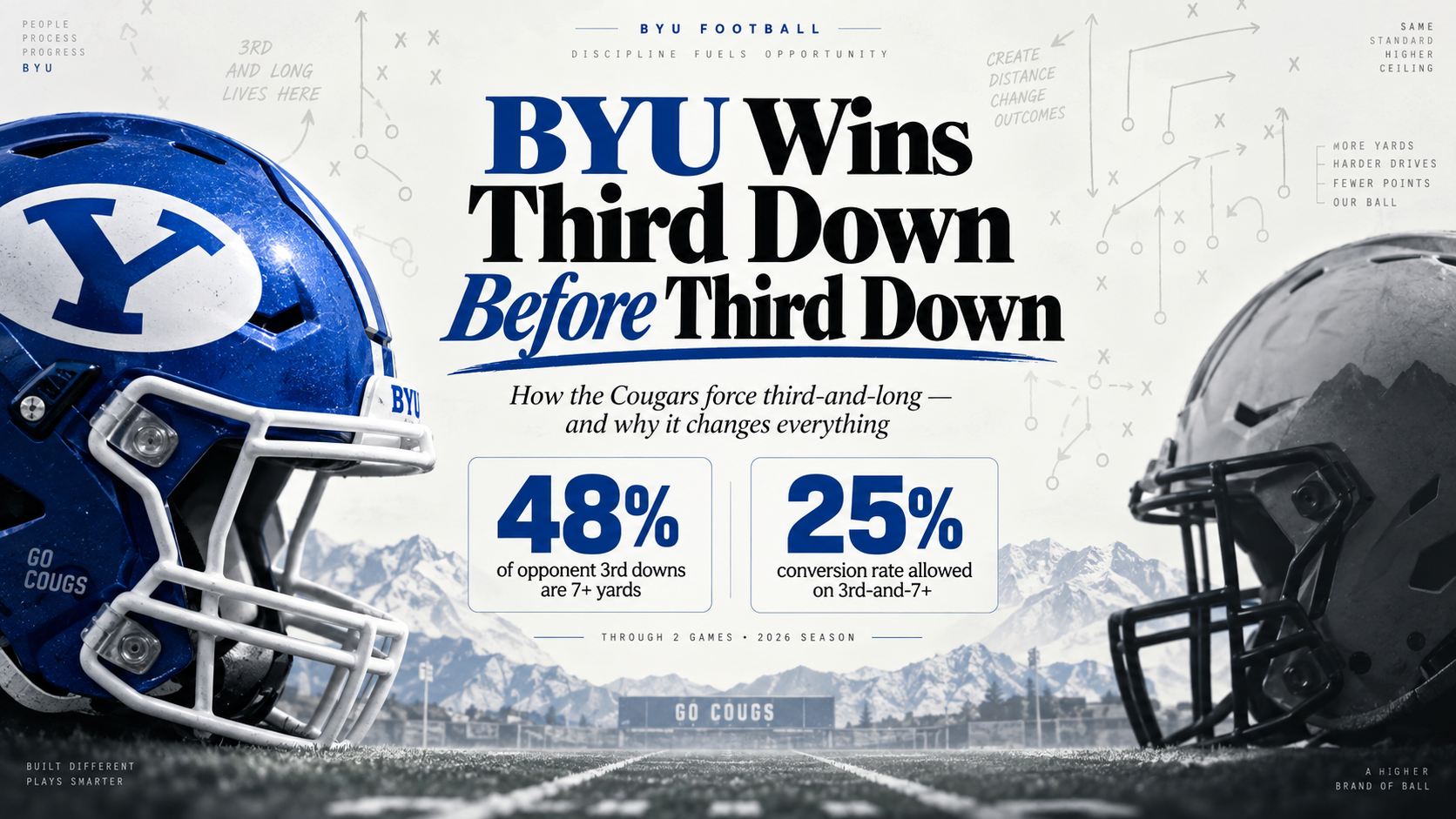
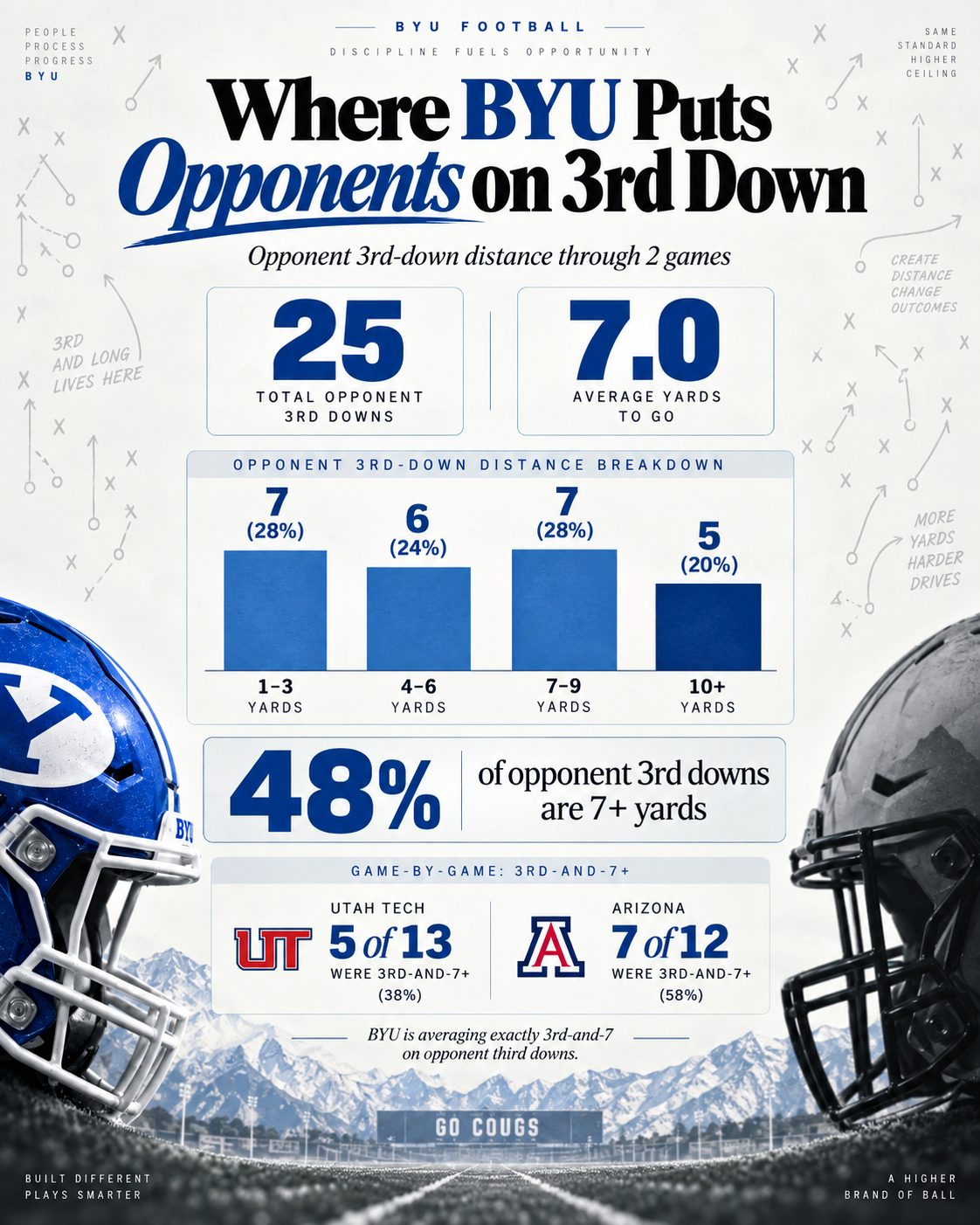
Through two games, BYU's defense has faced 25 third downs, and nearly half of them have started with the offense needing at least seven yards. Opponents have faced 3rd-and-7 or longer on 12 of 25 third downs — 48% of the time. The average distance on every opponent third down is exactly 7.0 yards.
That may be the most revealing statistic about BYU's defense so far because the real story isn't simply how often the Cougars get off the field on third down. It's how often they create a third-down situation that already favors the defense.
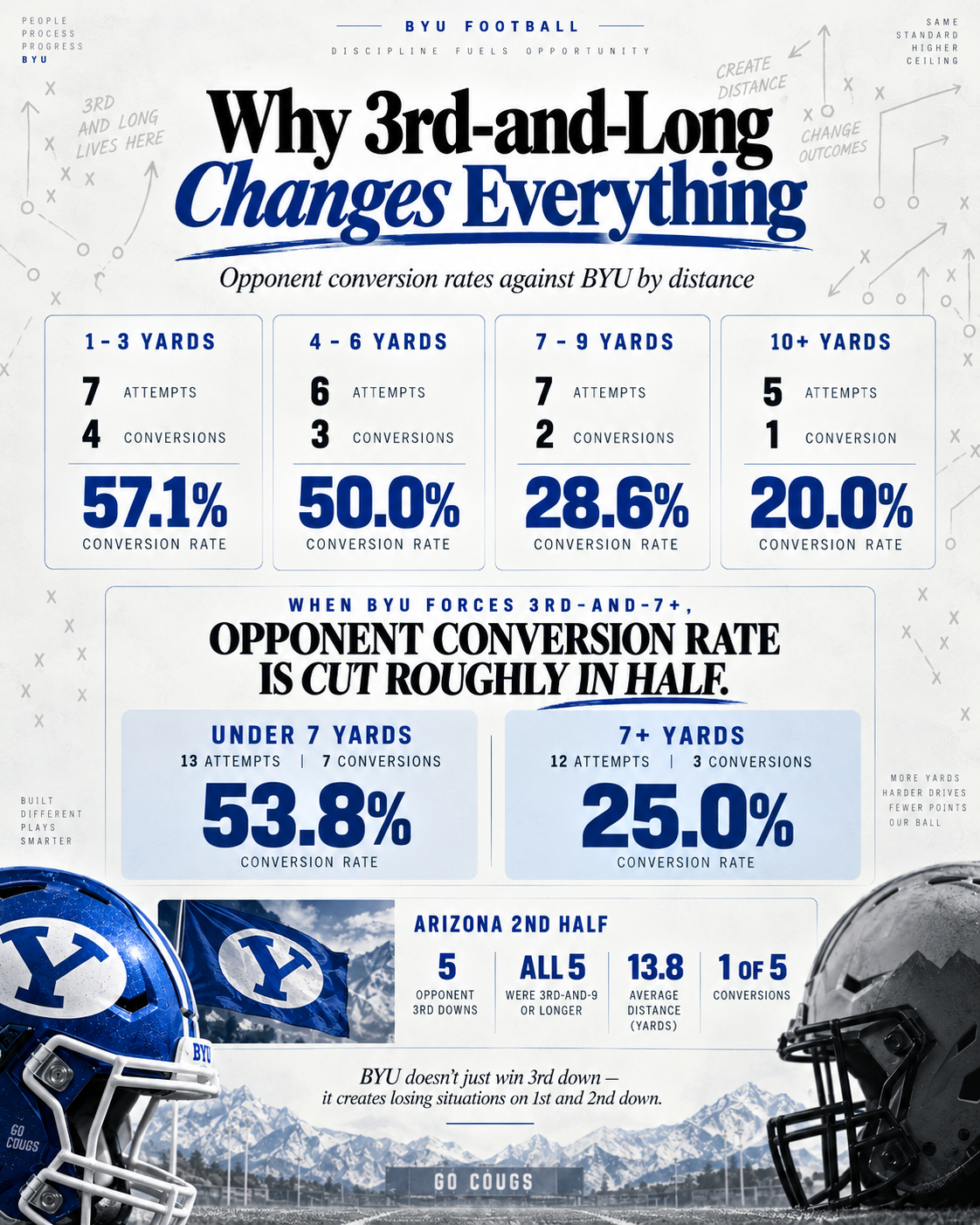
When opponents face BYU on 3rd-and-6 or shorter, they have converted 7 of 13 attempts — 53.8%. Once the distance reaches seven yards, that rate drops sharply. Opponents are just 3 of 12 — 25% — on 3rd-and-7 or longer. In other words, BYU is effectively cutting the opponent's third-down conversion rate in half by creating long-yardage situations.
Distance changes everything
Breaking BYU's third-down defense into four distance categories shows the pattern clearly: | Distance | Attempts | Conversions | Conversion Rate | | --------- | -------: | ----------: | --------------: | | 1–3 yards | 7 | 4 | 57.1% | | 4–6 yards | 6 | 3 | 50.0% | | 7–9 yards | 7 | 2 | 28.6% | | 10+ yards | 5 | 1 | 20.0% |
The dividing line is obvious. When the offense needs three yards or fewer, BYU has allowed a 57.1% conversion rate. From four to six yards, opponents are still converting half the time. But once the distance reaches seven yards, the numbers change dramatically. BYU has allowed only two conversions on seven attempts from 7–9 yards and only one on five attempts when the offense needs 10 yards or more.
That makes BYU's performance on first and second down just as important as anything happening on third down. A third-down stop may get the statistical credit, but many of those stops are being created one or two plays earlier.
Arizona showed what this can become
The Arizona game provided the clearest example of what BYU's defense looks like when it consistently wins early downs. Arizona faced 12 third downs against BYU, and seven required at least seven yards — 58.3%. The Wildcats finished 5-of-12 overall on third down, but that full-game number hides how dramatically the matchup changed after halftime.
In the first half, Arizona's seven third downs required 6, 8, 1, 6, 7, 2 and 1 yards, an average of only 4.4 yards to go. Those are manageable situations because the offense still has access to much of its playbook. Third-and-1 keeps the run fully available. Third-and-2 allows quarterback keepers, quick throws and play-action. Even third-and-5 or 6 doesn't completely dictate what the offense has to do.
The second half was completely different. Arizona's five third downs required 9, 15, 12, 9 and 24 yards, an average of 13.8 yards to go. Every third down Arizona faced after halftime was 3rd-and-9 or longer, and the Wildcats converted only one of those five chances.
That change in down-and-distance coincided with a complete change in offensive production. Arizona scored 17 points in the first half and zero in the second. The Wildcats gained 240 yards before halftime but only 87 afterward. The connection is straightforward: Arizona spent the first half operating in manageable situations, then spent the second half consistently trying to escape long-yardage downs.
Winning third down on first and second down
The best illustration came on Arizona's final full possession. Tausili Akana sacked Noah Fifita for seven yards on first down, turning the series into 2nd-and-17. On the next play, Akana and Keanu Tanuvasa combined for another seven-yard sack. Suddenly Arizona was staring at 3rd-and-24.
At that point, BYU held nearly every schematic advantage. Arizona had to throw. The quarterback needed time for deeper routes to develop. BYU's pass rush could attack without seriously respecting the run, while the secondary could defend the first-down marker instead of protecting against every possible play concept.
Fifita's third-down pass fell incomplete and Arizona punted. Statistically, that goes down as a third-down stop. In reality, BYU had already won the down with what happened on first and second down. That is the larger point behind the numbers. BYU's defense becomes significantly more effective when it keeps offenses behind schedule.
Short yardage is a different game
BYU has not been nearly as dominant when opponents stay ahead of the chains. On 3rd-and-1 through 3, offenses are converting 57.1% of the time. On 3rd-and-4 through 6, they are converting 50%.
Those situations allow the offense to maintain uncertainty. The defense still has to respect the run, quick throws, quarterback movement and play-action. The offense doesn't have to reveal much about what it intends to do.
Third-and-long changes that equation. From 7–9 yards, opponents are converting only 28.6% against BYU. At 10 yards or more, the rate falls to 20%.
Utah Tech versus Arizona
The progression between BYU's first two games is also worth tracking. Against Utah Tech, 5 of 13 third downs — 38.5% — required seven or more yards. Utah Tech finished 5-of-13 overall, but all five conversions came after halftime, when BYU already had a massive lead. Utah Tech had gone 0-for-6 on third down in the first half.
Against Arizona, the long-yardage percentage climbed to 7 of 12 — 58.3%. Then in the second half, BYU pushed it even further: five Arizona third downs and five situations of 3rd-and-9 or longer. That is the version of the defense BYU wants to reproduce.
The number to watch
Two games is still a small sample, so it is too early to declare this a season-long defensive identity. But the early trend gives us a useful number to track going forward: 48% of opponent third downs have required seven or more yards, and opponents are converting only 25% of those opportunities.
So when watching BYU's defense, the most important moment may not actually be third down. Watch what happens on first down. Watch whether second down becomes 2nd-and-8 instead of 2nd-and-4. Watch whether BYU creates negative plays, stuffs the run or forces an incompletion that puts the offense behind schedule. Because once BYU gets an opponent to 3rd-and-7 or longer, the math changes dramatically. BYU isn't simply trying to win third down. It is trying to win third down before third down ever arrives.
More BYU football originals
 BYU’s Bye-Week To-Do List: The 3 Numbers That Need FixingRead the original →
 The Fourth-Quarter Cougar Killers: The Stats Behind BYU’s Late-Game SuccessRead the original →
 The CFP May Get Bigger. BYU’s Standard Against Notre Dame Shouldn’tRead the original →
Questions about a source, update or correction? Contact the editor. Story updates are reflected in the published timestamp above.