
FEED THE COUGAR ORIGINAL · Football
BYU Sports Nation Prediction Scorecard: Week 5 — The Biggest Picks Are Looking Better Than Ever
BYU is 4-0, ranked No. 8 nationally and allowing just 14.3 points per game. After the Week 4 bye and a gritty win at TCU, we revisit Spencer Linton and Jarom Jordan’s preseason predictions to see which picks are on track, which are getting closer and which are starting to fade.

BYU is 4-0, ranked No. 8 nationally and allowing just 14.3 points per game. Texas Tech remains unbeaten, Matthias Dunn has pushed his season-long field goal to 49 yards, and five weeks into the season some of Spencer Linton and Jarom Jordan’s boldest preseason predictions are beginning to look surprisingly reasonable.**
Week 4 brought almost no movement to the BYU Sports Nation prediction tracker because the Cougars were on their bye. Week 5 was different. BYU went into Fort Worth, survived a rainy and offensively difficult game against TCU and came home with a 17-10 victory that moved the Cougars to 4-0 overall and 2-0 in Big 12 play.
The win was hardly an offensive showcase. BYU finished with 216 total yards and only 62 passing yards, but the Cougars protected the football, controlled enough of the game with Bear Bachmeier’s legs and leaned on a defense that held TCU to 10 points. A day later, BYU climbed to No. 8 in both the AP and Coaches polls.
That combination matters for this series. The biggest preseason predictions were never about individual box-score numbers; they were about whether BYU could remain nationally relevant, contend for the Big 12 Championship and position itself near the College Football Playoff. Through four games, those forecasts are holding up considerably better than some of the smaller statistical predictions.
As always, the original probabilities remain frozen. The point is not to rewrite the predictions after seeing the results, but to track how much evidence is accumulating for or against them.
The Week 5 scorecard
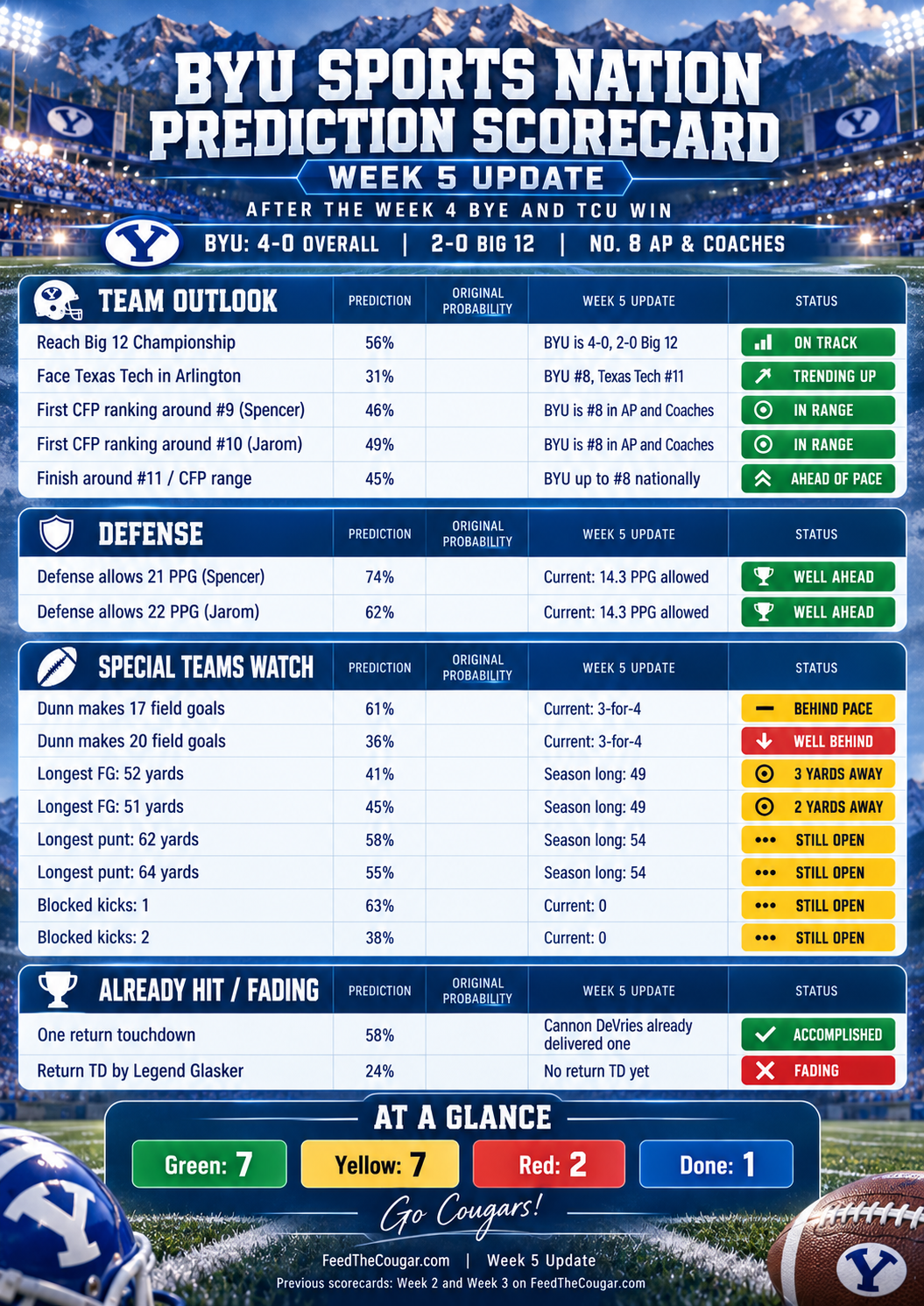
The new scorecard tells the story quickly. Seven predictions are currently trending positively, seven remain open or within reach, two have moved into the red, and one prediction has already been completed.
The strongest group is concentrated at the top of the board: BYU’s Big 12 Championship outlook, the possibility of a BYU-Texas Tech matchup in Arlington, both top-10 CFP ranking forecasts and the two defensive scoring predictions. Most of the uncertainty now sits in special teams, where exact totals and long kicks remain much harder to forecast.
That split is becoming one of the most interesting parts of the exercise. Spencer and Jarom appear to have been much better at identifying the overall quality of BYU’s team than predicting exactly how individual special-teams statistics would develop.
The top-10 predictions are no longer ambitious
Spencer predicted BYU would appear around No. 9 when the first College Football Playoff rankings are released. Jarom went with roughly No. 10.
Those predictions looked aggressive before the season. They do not anymore.
BYU reached No. 9 in both major polls after its 3-0 start, slipped slightly during the bye and then climbed to No. 8 after beating TCU. The actual CFP committee rankings will not arrive until November, so neither prediction can be marked complete, but BYU has already spent multiple weeks occupying essentially the exact national neighborhood Spencer and Jarom envisioned.
The challenge has changed. BYU no longer needs to climb into the top 10 before the committee begins ranking teams; it needs to avoid falling out of it.
That is a dramatically better position than these forecasts required five weeks ago.
The BYU-Texas Tech prediction keeps getting more interesting
The prediction that BYU would reach the Big 12 Championship Game was bold enough. Predicting the opponent would specifically be Texas Tech made it considerably harder, which is why we gave the exact matchup only a 31 percent preseason probability.
Through Week 5, both halves are cooperating.
BYU is 4-0 and 2-0 in conference play. Texas Tech remains undefeated as well, and both programs are sitting near the top of the national rankings. Instead of one team having to rescue the prediction while the other struggles, both have strengthened it at the same time.
That does not mean Arlington is close to settled. Conference races can change quickly once the schedule gets deeper, and head-to-head tiebreakers, road games and November injuries can completely reshape the standings.
But this prediction no longer looks like a fun preseason dart throw. BYU and Texas Tech have become two of the Big 12 teams everyone else is trying to catch.
The defense has built itself a huge cushion
The defensive predictions may be in the best shape of anything on the board.
Spencer predicted BYU would allow 21 points per game. Jarom predicted 22. After holding TCU to 10 points, the Cougars have allowed only 57 points through four games, an average of 14.25 per game.
The significance is not that BYU needs to maintain a 14-point defensive average for the rest of the season. It does not.
To finish exactly at Spencer’s 21-point projection, BYU could allow 195 points over its remaining eight regular-season games. That works out to roughly 24.4 points per game the rest of the way. Jarom’s 22-point prediction provides even more room, allowing BYU to surrender approximately 25.9 per game over the final eight and still hit his number.
That cushion matters because the schedule will become more difficult. BYU is unlikely to hold every opponent to 10 or 17 points, but it no longer has to. The first four games have given both defensive forecasts room to absorb some rougher Saturdays without falling off pace.
Dunn’s 49-yarder created the most interesting Week 5 movement
Matthias Dunn produced the single most important play for this prediction tracker against TCU.
His 49-yard field goal in the third quarter gave BYU a 10-7 lead and pushed his season long five yards beyond the 44-yarder he made against Colorado State. Suddenly, both preseason longest-field-goal predictions are within one kick of being completed.
Jarom predicted Dunn’s longest field goal would be 51 yards. Spencer predicted 52.
Dunn is now two yards away from Jarom and three from Spencer.
Those predictions can change instantly. BYU does not need a season-long trend or a certain number of opportunities; it simply needs one drive to stall around the opponent’s 34-yard line and Young to send Dunn onto the field.
The field-goal totals, however, are moving in the opposite direction.
Dunn is 3-for-4 through four games. Spencer predicted 17 made field goals, meaning Dunn would need 14 more over the final eight regular-season games, an average of 1.75 makes per game. Jarom’s prediction of 20 has become much more difficult, requiring 17 additional field goals, or a little more than two per game.
That makes Dunn one of the strangest entries on the board: his distance predictions are suddenly close to hitting while his volume predictions are drifting farther away.
The punting and blocked-kick predictions are stuck in neutral
Fuller Shurtz continues to punt effectively, but the one number this scorecard cares about has not moved much.
His season long remains 54 yards, leaving Spencer’s predicted 62-yarder and Jarom’s 64-yarder well short of completion. Unlike the field-goal totals, though, those predictions are not really “behind pace.” One punt with favorable field position, good contact and a strong roll could settle either one immediately.
The blocked-kick predictions are similar. BYU still has zero, while Spencer predicted one and Jarom predicted two. There is no trend to analyze yet because a block is an event rather than a pace statistic.
Both categories therefore remain open rather than failed.
The Glasker return prediction is becoming a role problem
Legend Glasker has not been a disappointing player. Far from it.
He has already emerged as one of BYU’s most explosive offensive weapons, contributing as both a receiver and runner. The problem is that Spencer and Jarom did not merely predict that Glasker would score an explosive touchdown; they specifically predicted that he would score on a return.
That distinction is becoming important.
Cannon DeVries already delivered the general return-touchdown prediction with his 100-yard kickoff return. Glasker, meanwhile, has not developed into BYU’s primary kick or punt returner. The issue is becoming less about whether Glasker is capable of taking one back and more about whether he will receive enough opportunities to do it.
For that reason, this is the prediction I would move from yellow to red. It is still mathematically alive, but the role required to make it happen has not materialized.
Five weeks in, the big-picture predictions are winning
Only one prediction has officially been checked off, which makes the scorecard look less impressive than the underlying results.
BYU has already reached No. 8 nationally. The Cougars are 4-0 and 2-0 in the Big 12. Texas Tech remains unbeaten. BYU’s defense is allowing 14.3 points per game, and Dunn’s longest field goal has climbed to 49 yards.
The predictions in the most trouble are mostly specific statistical guesses: 20 made field goals, exact punting distances, blocked kicks and a return touchdown by one particular player.
The predictions describing what BYU’s season would look like are considerably healthier.
Spencer and Jarom envisioned a team capable of contending for Arlington, living around the top 10 and playing defense well enough to remain in the College Football Playoff conversation. Four games into BYU’s season, that description does not sound especially bold anymore.
It sounds a lot like the team BYU has become.
---
Previous Prediction Scorecards
Week 3: BYU Sports Nation Prediction Scorecard — The Top-10 Picks Are Already Here
More BYU football originals
 The CFP May Get Bigger. BYU’s Standard Against Notre Dame Shouldn’tRead the original →
 Sione Moa Is Cleared. BYU Still Has to Decide How Much He Can Give Notre DameRead the original →
 Notre Dame Has 68 Blue-Chips to BYU’s 12. The Records Are Nearly IdenticalRead the original →
Questions about a source, update or correction? Contact the editor. Story updates are reflected in the published timestamp above.